Key takeaways
- Pick the puzzle a child can finish with a little struggle — too easy gets ignored, too hard gets dumped on the floor.
- The real developmental leap isn't piece count; it's moving from a form board (each piece in its own cutout) to a true interlocking jigsaw, usually around age 3.
- A 2012 University of Chicago study linked frequent home puzzle play to better spatial skills (a large effect), but it's correlational — and the benefit tracked with how parents played, not with the puzzle itself.
- The free half of the value is narrating spatial words ('turn it,' 'find the flat edge') while you sit and do it together.
On this page
The right puzzle is the one your kid can finish — barely
If you want one rule for buying a jigsaw puzzle for a child, here it is: pick the one they can complete with a little struggle, not the one that looks impressive on the shelf. A puzzle that is too easy gets ignored after one go. A puzzle that is too hard gets dumped on the floor in tears.
The sweet spot — finishable, but only with effort — is where the real developmental work happens, and it shifts every year as a young child's hands and planning catch up.
What actually changes with age: not the piece count but the method. A three-year-old shoves pieces around by trial and error; a four-year-old starts using the picture to decide where a piece goes. Match the puzzle to that, and the box count falls into place on its own.
What the milestones actually say
Two reliable, non-commercial sources anchor the age guidance here: the CDC's developmental milestones (what most kids can do at a given age) and a University of Chicago study on early puzzle play.
Three milestones that set the floor
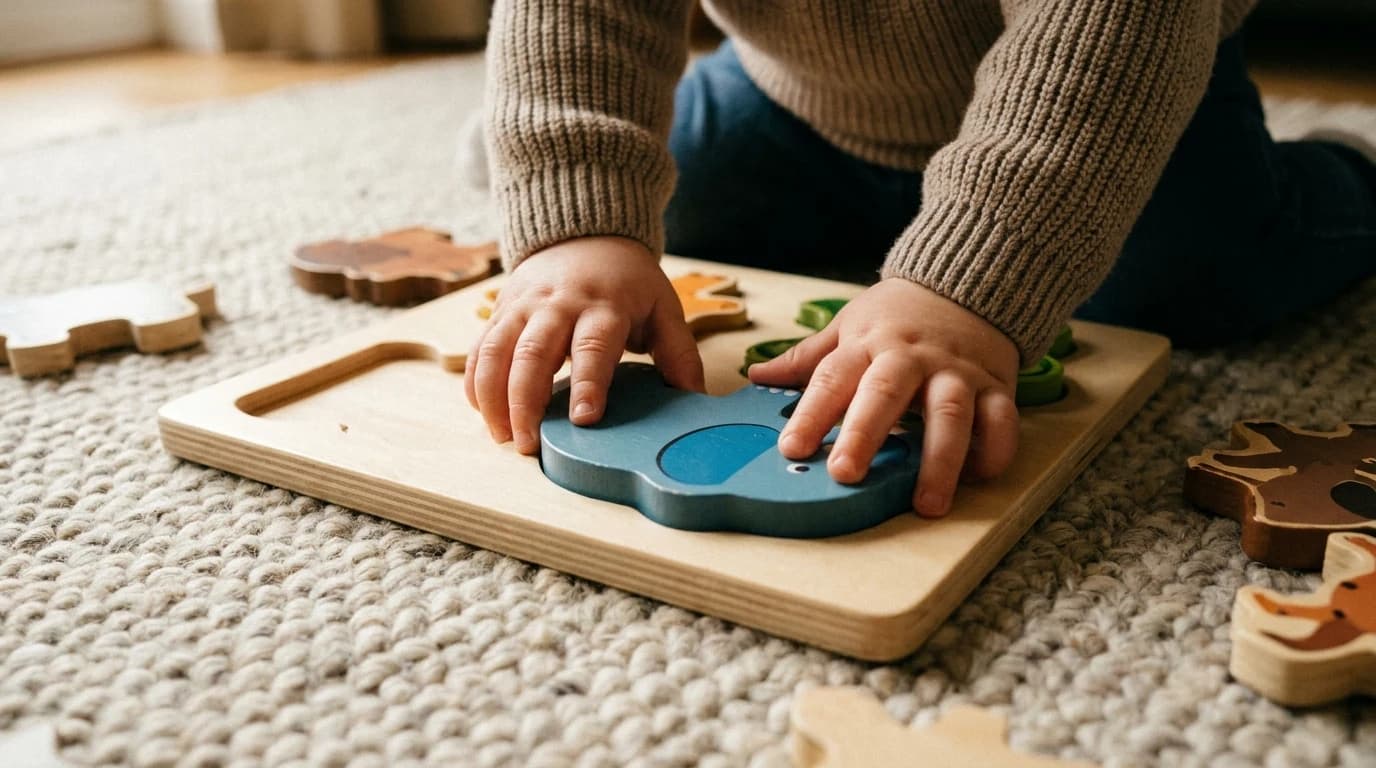
- Around 2.5 years — the CDC's 30-month guidance tells parents to "help your child do simple puzzles with shapes, colors, or animals" and to "name each piece when your child puts it in place." That naming part matters more than it sounds, and we will come back to it.
- By 3 years — CDC fine-motor milestones include stringing beads and drawing a circle on demand, the hand control that interlocking pieces require.
- By 5 years — the social milestone shifts to "follows rules or takes turns when playing games," which is why cooperativeco-opGame where all players win or lose together against the game's system. Pandemic, Spirit Island, and Gloomhaven are the canonical co-ops. Tends to outperform competitive games for couples and mixed-skill groups. puzzle-building works for a group of kindergartners but not a room of toddlers.
A piece-count guide by age
Use this as a starting point and adjust to the actual kid in front of you. A puzzle-obsessed three-year-old may blow past these; a kid who would rather be running around may want fewer pieces for longer.
| Age | Puzzle type | Rough piece count | What's developing |
|---|---|---|---|
| 1–2 yrs | Knobbed form board (one piece per cutout) | 2–6 chunky pieces | Pincer grasp, hand-eye coordination |
| 2–3 yrs | Form board / chunky tray puzzles | 6–12 pieces | Matching shape to outline, wrist rotation |
| 3 yrs | First interlocking jigsaws | ~12–24 pieces | Trial-and-error fitting, persistence |
| 4 yrs | Interlocking, picture-driven | ~24–48 pieces | Using the picture to plan, edge-finding |
| 5–6 yrs | Larger interlocking | ~48–100 pieces | Sorting, strategy, sustained attention |
| 7–8 yrs | Detailed jigsaws | ~100–250 pieces | Section-building, abstract reasoning |
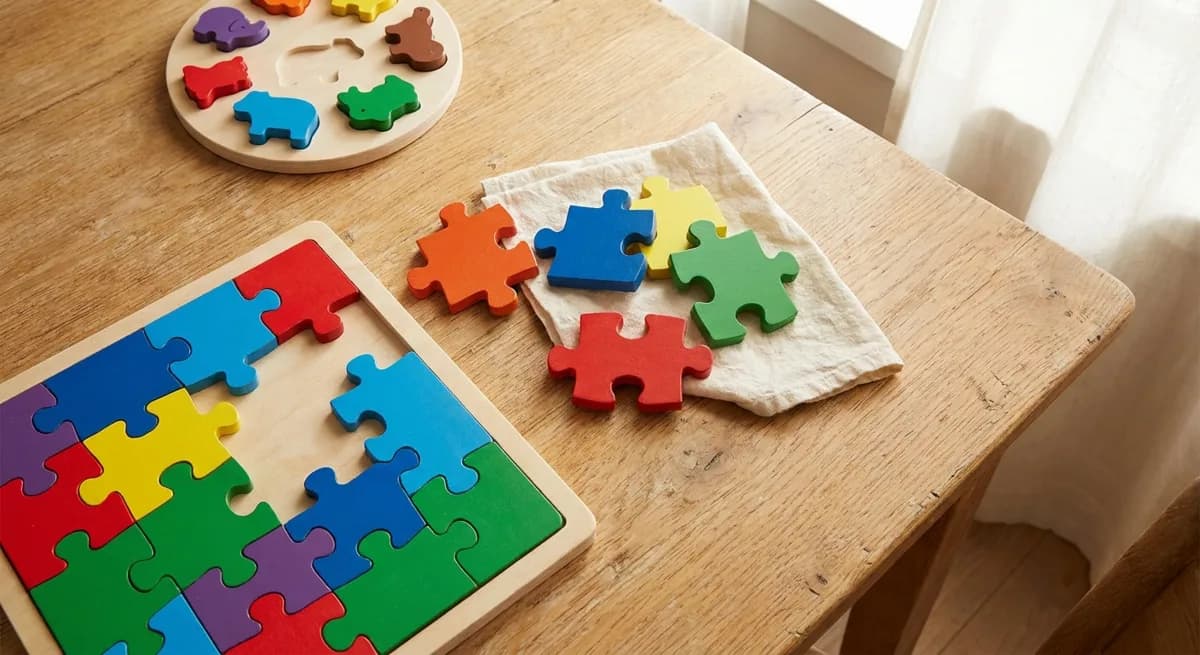
The one real leap: moving from a form board (each piece drops into its own labeled cutout) to a true interlocking jigsaw (pieces only connect to each other). It usually clicks around age three, and the child can no longer rely on a one-to-one slot — they have to read shape and image together.
What the research does — and does not — show
Here is the honest version, because the "puzzles make your kid smarter" headlines oversell it.
A 2012 University of Chicago study (Levine, Verdine, and colleagues) followed 53 children from 26 to 46 months. Children who played with puzzles at home scored meaningfully higher on a spatial-transformation task at 54 months than children who didn't — a large effect (d = .89) that held even after controlling for parents' income, education, and overall talkativeness. Among the kids who did puzzle, more frequent play predicted better spatial skill. Spatial skill, in turn, is one of the earlier predictors of later math ability.
The caveats matter as much as the finding
- It's correlational, not causal. The study observed families; it did not randomly assign puzzles. Puzzle-loving kids may differ from non-puzzlers in ways the study couldn't fully control for.
- Frequency and engagement mattered more than the puzzle itself. The benefit tracked with how often and how richly parents and kids played — not with owning a fancier puzzle.
- The spatial-language piece may be doing real work. Parents used more spatial words ("turn it," "the corner," "flip it over") on harder puzzles, and that talk is a plausible part of the mechanism.
The takeaway is not "buy more puzzles." It's that a puzzle is a prop for the thing that actually helps — a few minutes of you sitting down and narrating the spatial moves. A cheap 24-piece puzzle you do together beats an expensive one your kid does alone in the corner.
How to use a puzzle well (the part that's free)
Picking the right box is half of it. The other half costs nothing:
Five habits that do more than the box does
- Narrate the spatial words. "Turn that one. Try the flat edge along the bottom. That corner piece goes up here." This is the move the research points to, and it's the easiest thing in the world to skip.
- Start with the frame. Teaching a kid to find the straight-edged pieces first gives them a strategy, not just trial and error — that's the leap from age 3 to 4 in action.
- Let them struggle for a beat. Resist grabbing the piece. The productive zone is mild frustration, not rescue.
- Reuse, then retire. Once a puzzle is finished fast and confidently three or four times, it's done its job — rotate it out and size up.
- Watch the floor, not the box. Missing pieces are the real reason a puzzle fails. A 48-piece puzzle missing two pieces is more frustrating than a 100-piece complete one.
When to size up (and when to wait)
Read the reaction, not the calendar
Size up when you see:
- The current puzzle finished quickly and without help
- A request to do it again immediately — that's boredom signalling readiness
- Confident edge-finding and sorting before the pieces are all out
Hold steady, or drop down, when you see:
- Pieces flung across the room
- The picture ignored entirely
- A kid who quits in the first minute
Pushing through the second column teaches avoidance, not persistence. Piece count is a dial you turn based on the kid's reaction, not a fixed schedule you march through.
And don't rush the interlocking jump. A three-year-old who's still happily mastering form boards is doing exactly the right developmental work. There's no prize for a toddler who finishes a 100-piece puzzle — and no evidence it buys anything an age-appropriate one wouldn't. Once a kid has worked past the 250-piece tier, the adult-grade brands start to matter more than the count, and our jigsaw brand comparison ranks the ones worth paying for.
Your next step
Got the piece count? Here is which brands are worth paying for.
Common questions
How many pieces should a puzzle have for a 3-year-old?
What's the difference between a form board and an interlocking jigsaw?
Do jigsaw puzzles actually make kids smarter?
When should I move my child up to a bigger puzzle?
What's the single best thing I can do during puzzle time?
Research Sources
- Levine, Ratliff, Huttenlocher & Cannon (2012), Developmental Psychology / PMC — "Early Puzzle Play: A Predictor of Preschoolers' Spatial Transformation Skill" (53 children 26–46 mo; puzzle players outperformed non-players on spatial transformation, d = .89; frequency predicted skill among players)
- CDC, Learn the Signs. Act Early. — Milestones by 30 Months ("Help your child do simple puzzles with shapes, colors, or animals. Name each piece when your child puts it in place.")
- CDC, Learn the Signs. Act Early. — Milestones by 3 Years (fine-motor milestones: strings items together, draws a circle when shown how)
- CDC, Learn the Signs. Act Early. — Milestones by 5 Years ("Follows rules or takes turns when playing games with other children")