Key takeaways
- USA Pickleball fixes the court at 20 by 44 feet, the net at 36 inches on the sidelines and 34 at the centre, and the paddle at 24 inches of combined length and width, and none of it changes for juniors.
- Rule 3.D.3 says there is no restriction on paddle weight, so weight is the only fit variable the sport leaves to you, and no governing body publishes a children's chart.
- Published grip guidance bottoms out at a 4-inch circumference, so handles never get thinner for a child; weight and handle length do the fitting instead.
- The rulebook says all approved balls are acceptable indoor or outdoor, which contradicts the compatibility warning printed on most listings.
- Approved paddles are capped for power and spin by test, so a flagship paddle buys feel and durability rather than a higher legal ceiling.
On this page
A family pickleball set is one of the few sports purchases where the buyer and the users have very different bodies. You are picking one box for a nine-year-old, a teenager mid growth spurt, and two adults, and the listing answers none of that. It tells you the core is 13mm and the face is fiberglass.
The useful part is that the sport's governing body already made most of the decisions for you, in writing. USA Pickleball's rulebook and its Equipment Standards Manual pin down the court, the net, the ball and the paddle's outline. What they conspicuously leave alone is the one number that decides whether a kid can swing the thing.
What the rulebook already decided for you
| Element | The published spec | Where it comes from |
|---|---|---|
| Court | 20 ft x 44 ft, identical for singles and doubles | Rulebook 3.A.1 |
| Net height | 36 in at the sidelines, 34 in at the centre | Rulebook 3.B.6-3.B.7 |
| Net span | posts 22 ft apart; net at least 21 ft 9 in long | Rulebook 3.B.2-3.B.3 |
| Ball | 2.87-2.97 in across, 0.78-0.935 oz, 26 to 40 round holes | Equipment Standards 2.D.3, 2.D.4, 2.D.8 |
| Paddle outline | length plus width no more than 24 in; length no more than 17 in; no thickness limit | Rulebook 3.D.2 |
Now read the list again for what is absent: a junior version of any of it. USA Pickleball runs junior events in 12-and-under, 13-14 and 15-16 brackets, and those brackets play the full court over the full-height net with the same ball an adult uses. The organisation's own Youth Pickleball Guide for physical-education teachers diagrams that same 44-by-20 court with the same 34-inch centre net.
The one spec left deliberately blank: Rule 3.D.3 reads, in full, "There is no restriction on paddle weight." Every other dimension on the court is pinned to a quarter of an inch. Weight, the variable that decides whether a nine-year-old is still holding the paddle up at the net in game three, is the one thing nobody standardised.
Which makes every kid-fit chart reasoning, not a standard
No governing body publishes a paddle chart for children. Anything you find online is somebody's inference, this one included, so here it is with its sources marked.
Grip circumference is the only column with a published manufacturer method behind it. Selkirk's grip size guide says to measure from the bottom lateral crease of the palm to the ring-finger tip, puts pickleball grips at 4 to 5 inches around, offers a height shortcut, and warns that the tennis index-finger test that many buying guides still recommend is not the pickleball method.
| Player | Height band | Grip circumference | What to solve for instead |
|---|---|---|---|
| Child, roughly 8-11 | under 5 ft 3 | 4 in | the lightest paddle in the box, and the shortest handle |
| Young teen | under 5 ft 3 | 4 in | weight again; hands outgrow paddles slower than arms do |
| Teen or smaller adult | 5 ft 3 to 5 ft 8 | 4.25 in | balance, once the weight is manageable |
| Adult | above 5 ft 8 | 4.5 in | whatever they actually like |
The grip column follows Selkirk's published height guidance. The right-hand column is our reasoning from the rulebook specs above, not a recommendation from any governing body.
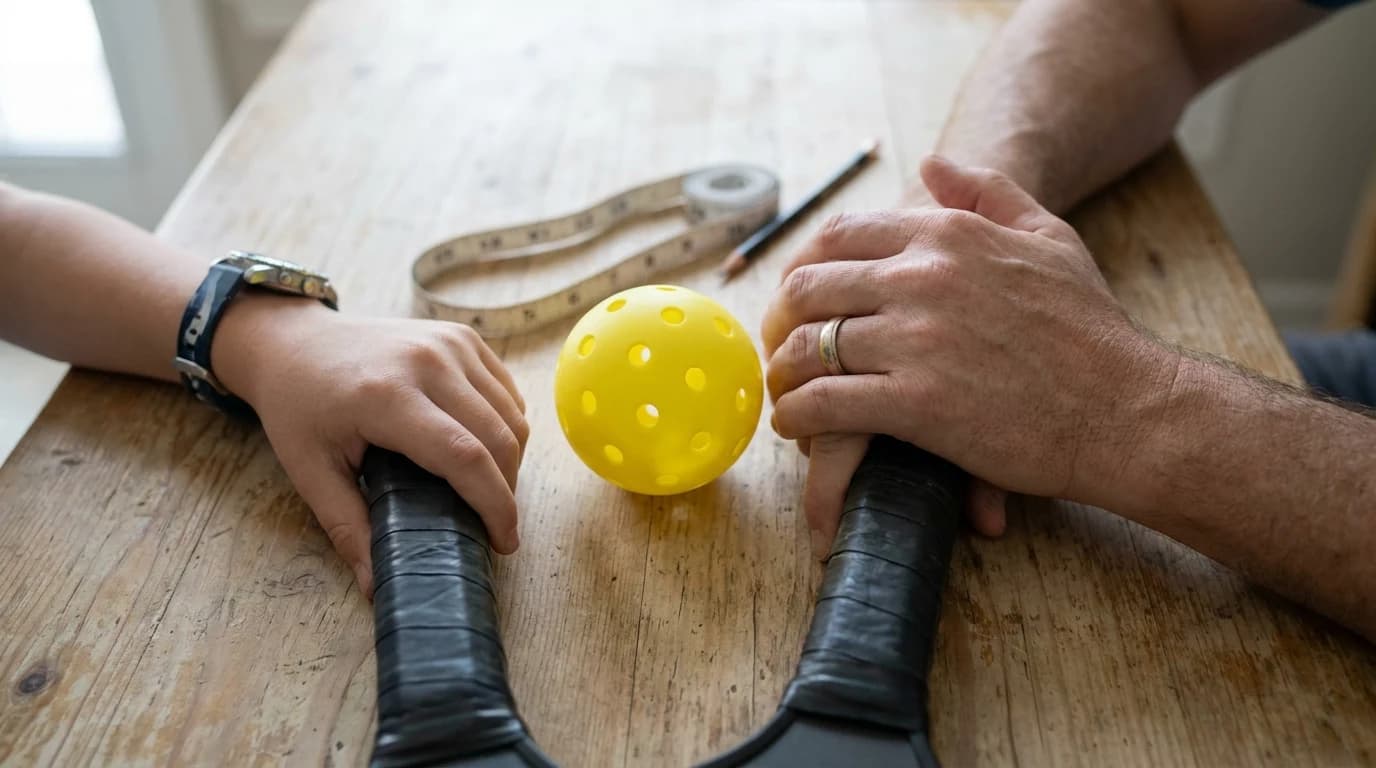
Notice what the published guidance does at the bottom of the range: it stops. A seven-year-old and a five-foot-two adult get the same 4-inch answer, because 4 inches is the smallest grip anyone makes. Handles do not get thinner for children, so on a kid's paddle, fit is solved by weight and handle length.
Is your youngest old enough for a real set?
The Youth Pickleball Guide tells PE teachers to start with third grade and above, because that is "typically the age that kids can begin to rally successfully with each other (with help!)". Its activity plans run ages 8 to 18.
That floor is about rallying, not swinging. A five-year-old can hit a ball off a bounce all afternoon; what they cannot yet do is keep a rally alive with another beginner, and that is what makes a set worth owning rather than a novelty in the garage.
Wood or composite depends on who is holding it
A wood set earns its place when:
- Nobody has played, and the honest odds are it does not stick
- The surface is a driveway or school lot, where paddles get dropped and scraped
- The smallest player is a teenager or an adult
A wood set is the wrong call when:
- The point is getting a younger child playing: wood is the heaviest common construction, and a tiring paddle ends the session early
- Somebody already plays and will notice the dead feel
- You are buying once and want two seasons out of it
Our two entry picks split along that line: the niupipo wood starter set is the indestructible sampler, and the JOOLA Essentials set puts honeycomb-core composite paddles in the same box for a family that already knows it wants to keep playing. Each product page carries its stated weight, and that gap between constructions is the biggest fit variable in the box.
The ball rule almost every listing gets wrong
Product pages will tell you that indoor and outdoor balls are not interchangeable. The rulebook disagrees, in one sentence. Rule 3.C.1: "All approved balls are acceptable for indoor or outdoor play."
What is true is the custom, not the rule. The rulebook's figure says only that the larger-holed ball is customarily used indoors and the smaller-holed one outdoors, and the Equipment Standards Manual sets one range of 26 to 40 holes covering both. Outdoor balls are harder and hold their line in wind; indoor balls are softer and quieter. Buy for the surface you use most and treat the outdoor multi-pack as a consumable, not a compatibility decision.
Rule of thumb: buy the cheapest set that fits the smallest hands in the house, then upgrade the one person still playing in six months. Nothing in the specs rewards buying ahead.
What a premium paddle cannot buy
Approved paddles are power- and spin-capped by test, not by price. The Equipment Standards Manual publishes the ceilings.
| Tested property | Published limit | What it caps |
|---|---|---|
| PBCoR, paddle/ball restitution | 0.44, cut to 0.43 from 1 Nov 2025 | how much power the face returns |
| Surface roughness, Rz average | 30 micrometres, no reading above 33 | how much bite the face has |
| Kinetic coefficient of friction | 0.1875 maximum | how much spin it can impart |
Every approved paddle, starter kit or flagship, is measured against those same ceilings. The premium price buys consistency, balance, durability and a face that keeps its texture longer. It does not buy a higher legal maximum, and on a driveway where nobody has a reliable topspin yet, nothing is approaching that ceiling anyway.
The box check before you buy
- Paddle count matches how you will play. Two paddles is a rally; doubles needs four, which usually means two sets.
- The paddles are not all identical. A four-paddle box of one weight fits one body type in your family.
- Balls suit the surface, not the label. Any approved ball is legal either way; hole size is a wind and noise decision.
- The net is a separate problem. No driveway comes with one, and the spec to match is 22 ft of posts at 36 and 34 inches, which is what a regulation portable net delivers.
- Ignore the core-thickness marketing. There is no thickness rule, which is exactly why every brand advertises millimetres.
The full ranking lives on the pickleball sets page. But the decision is smaller than the listings suggest: court, net and ball are fixed by rule, the grip bottoms out at 4 inches, and the only real choice is how much paddle the smallest person in your family can hold up for an hour.
Your next step
Ready to buy a set? Here are the ranked picks.
Common questions
What size pickleball paddle should a kid use?
Is the net lower for kids' pickleball?
Can we use indoor pickleballs outside?
How old does a child need to be to start playing?
Research Sources
- USA Pickleball 2026 Official Rulebook - court dimensions (3.A.1), net heights of 36 in sideline and 34 in centre (3.B.6-3.B.7), all approved balls acceptable indoor or outdoor (3.C.1), paddle size limits (3.D.2), and the statement that there is no restriction on paddle weight (3.D.3)
- USA Pickleball Equipment Standards Manual, Revision 3 - ball diameter, weight and hole-count ranges (2.D.3, 2.D.4, 2.D.8), paddle surface roughness and coefficient of friction limits (2.E.2), and the PBCoR power cap of 0.44 falling to 0.43 on 1 November 2025
- USA Pickleball Youth Pickleball Guide - the recommendation to introduce the sport from third grade and above because that is typically when kids can rally with each other, activity plans for ages 8-18, and the full-size court and net diagram used for youth programs
- USA Pickleball Junior and Youth Pickleball - the 12 & Under, 13-14 and 15-16 junior tournament age groups, with no separate junior equipment standard
- Selkirk Sport - how to measure pickleball grip size from the bottom lateral crease of the palm to the ring-finger tip, the 4 to 5 inch circumference range, the height-based shortcut, and the warning that the tennis index-finger test is not the pickleball method