Quick Answer
For a first paddle, the specs that matter most are the ones the rulebook does not regulate. Rule 3.D.2 caps combined length and width at 24 inches, which makes shape a zero-sum trade: reach costs face width, and a beginner whose problem is missing the middle of the paddle should buy the width. Thickness and weight are explicitly unregulated, so no price tier buys a legal advantage in either. And treat USA Pickleball Approved as a floor rather than a shortlist: the approved list holds 5,352 entries, and the rule requiring you to use one sits in the tournament-only part of the rulebook.
Key takeaways
- Rule 3.D.2 caps combined paddle length and width at 24 inches, so the two are one budget: a 16.5-inch elongated paddle can be at most 7.5 inches wide, a 15.5-inch widebody at most 8.5 inches.
- The rulebook says in plain words that there is no restriction on paddle thickness and no restriction on paddle weight, which are the exact two specs every listing advertises.
- The USA Pickleball Approved Paddle List currently holds 5,352 entries, so the stamp is a floor almost the whole market clears rather than a curated shortlist.
- The requirement to use a paddle from that list, and the match forfeit for being caught without one, sit in Part III of the rulebook, which applies to tournament play only.
- Approval is revocable and listings go stale: USA Pickleball has sunset seven named models from certification, and JOOLA's own page states the Graf Edge 16mm has not been eligible for USAP competitions since 1 May 2026.
On this page
Every beginner paddle guide opens with carbon versus fiberglass. Almost none opens the rulebook — a shame, because USA Pickleball has already settled more of this decision than any brand has.
Every paddle is spending the same 24 inches
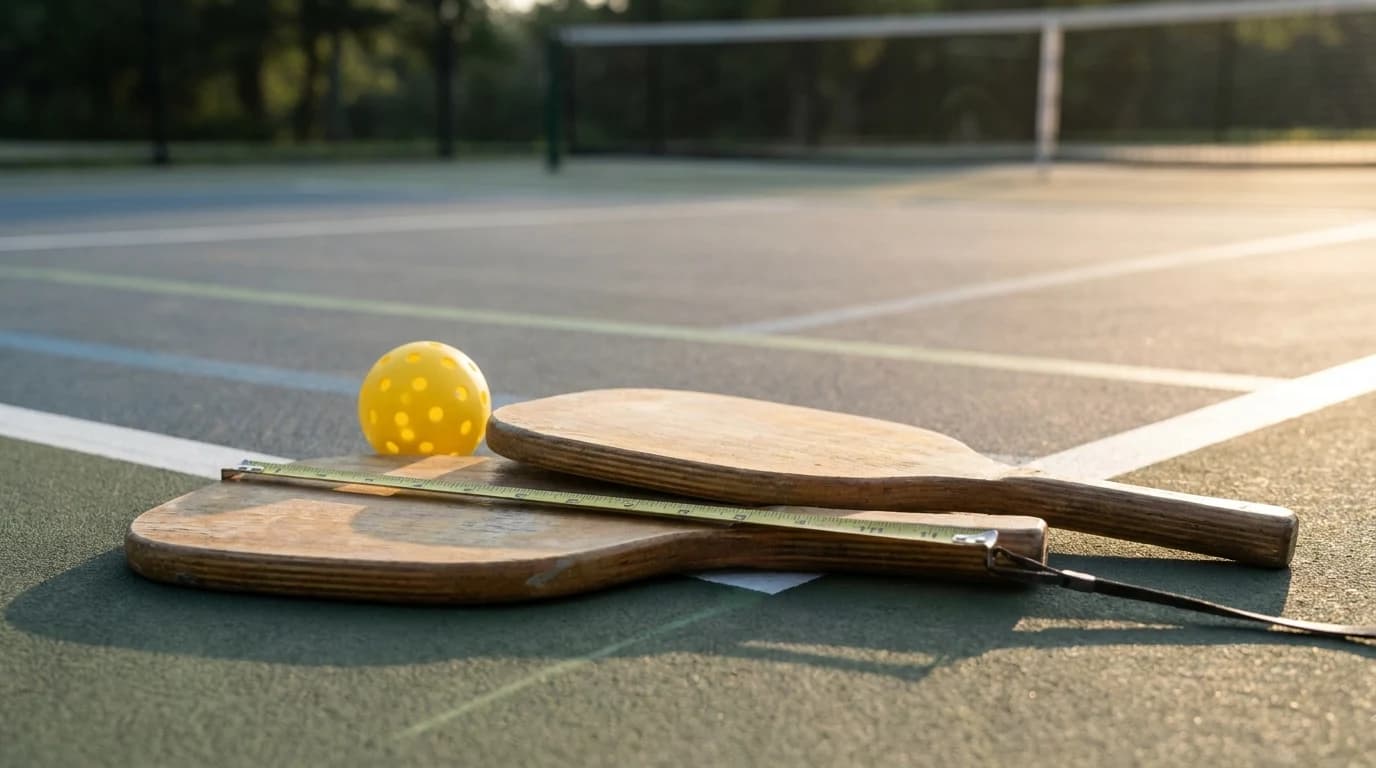
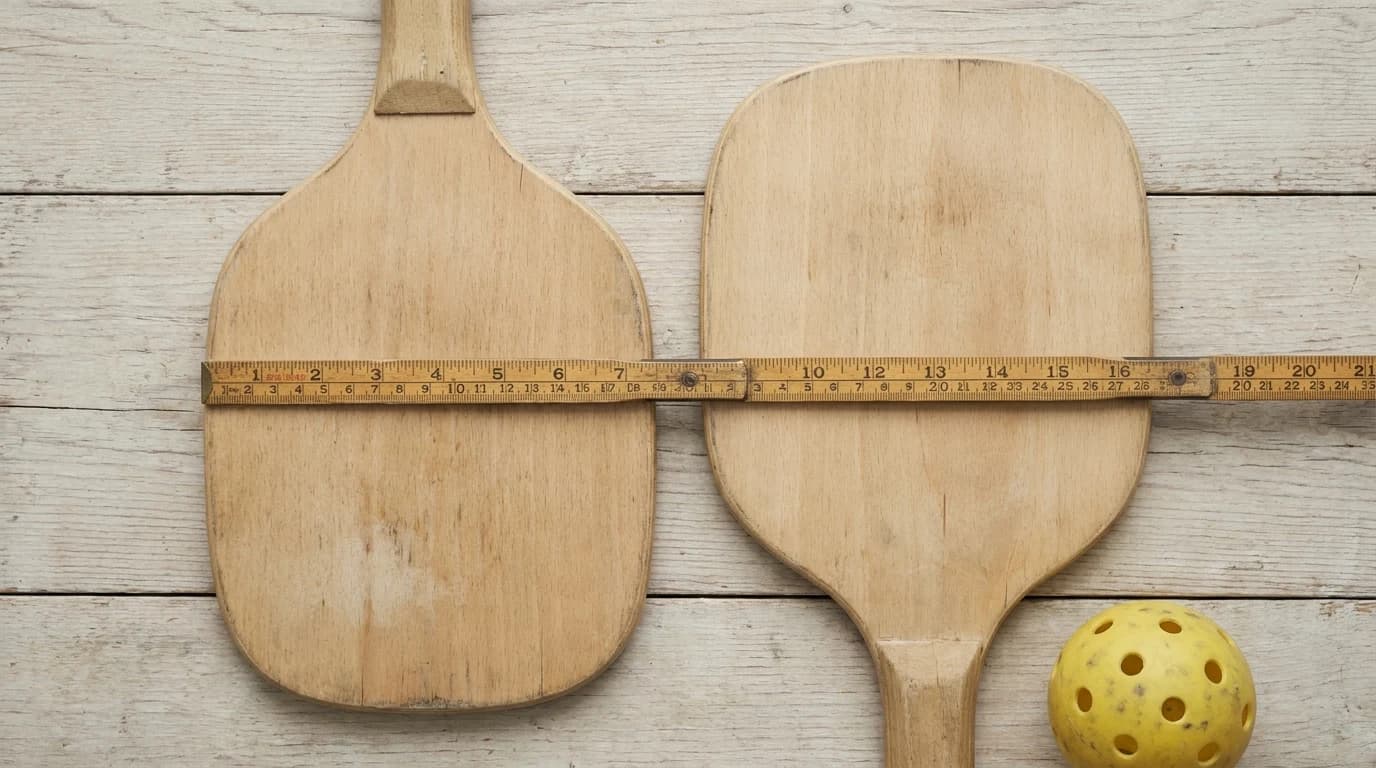
Rule 3.D.2 of the 2026 Official Rulebook settles the entire shape debate in one sentence: combined length and width, edge guard and butt cap included, must not exceed 24 inches, and length alone must not exceed 17.
So they are not independent specs. They are one budget, and every inch a brand spends on reach it takes off the face.
| If the paddle is this long | Widest its face can legally be | What you are buying |
|---|---|---|
| 17.0 in (legal ceiling) | 7.0 in | most reach, narrowest face |
| 16.5 in | 7.5 in | the usual "elongated" build |
| 16.0 in | 8.0 in | the middle of the market |
| 15.5 in | 8.5 in | the usual "widebody" build |
| 15.0 in | 9.0 in | shortest swing, biggest face |
Those are ceilings, not measurements, but brands push right up against them. JOOLA publishes 16.5 by 7.5 inches for the Graf Edge 16mm — exactly 24.0, the whole allowance poured into length. HEAD makes the opposite trade on the widebody Radical Elite, whose spec sheet notes that a wider body also makes the paddle shorter and more manoeuvrable.
Read the shape, not the adjective: "elongated" and "widebody" are not features a paddle has. They are the two ends of a single 24-inch trade — and a beginner whose problem is missing the middle of the face wants the width, not the reach.
The two numbers the rulebook refuses to set
Read Rule 3.D twice: once for what it pins down, once for what it pointedly does not.
Fixed by rule, identical on every legal paddle:
- Combined length plus width: 24 inches maximum (3.D.2)
- Length on its own: 17 inches maximum (3.D.2)
- Surface: no holes, rough texturing, sandpaper characteristics, rubber, moving parts or anti-skid paint (3.D.5)
Left completely open, in the rulebook's own words:
- Thickness — "There is no restriction on paddle thickness" (3.D.2)
- Weight — "There is no restriction on paddle weight" (3.D.3)
Which is the joke buried in every spec sheet: core thickness and weight are the two numbers listings shout, and the exact two the governing body declined to regulate. Nobody buys a legal advantage in either.
What "USA Pickleball Approved" actually buys you
Two facts should temper how much that stamp sways a first purchase.
First, the scale. USA Pickleball's Approved Paddle List currently holds 5,352 entries — a floor almost the whole market clears, not a shortlist somebody curated for you.
Second, the scope. Part I of the rulebook applies to all play; Part III is introduced, in the document's own words, as rules "that apply to tournament play only." The dimensions sit in Part I. The obligation on you to be holding a listed paddle sits in Part III.
| Rule | What it covers | Where it applies |
|---|---|---|
| 3.D.1 | maker must print brand, model and the approval seal | Part I — all play |
| 3.D.2, 3.D.3 | dimensions, thickness, weight | Part I — all play |
| 3.D.5 | prohibited surface features | Part I — all play |
| 18.A | player must use a paddle on the Approved Paddle List | Part III — tournament play only |
| 18.A.2 | match forfeit if discovered mid-match | Part III — tournament play only |
Read the first row against the last: printing the seal is the manufacturer's job; checking it against the live list is something only a tournament asks of you. And approval is revocable — under PBCoR power testing, USA Pickleball sunset seven named models, scoping that consequence explicitly to sanctioned tournament play.
What the stamp is worth: on a public court it is a floor that one of 5,352 models clears. It starts mattering the day you enter a sanctioned event, and it can be withdrawn from a paddle you already own.
Two listings, read properly
The two paddles below are live listings at the same price today, one carbon-faced and one fiberglass. Both are reasonable first buys. Both carry something the headline does not tell you.
The approval line can be out of date
JOOLA's own page for the Graf Edge 16mm carries one line under the description: as of 1 May 2026, it says, this paddle is not eligible for use in USAP competitions. The same spec block lists it as UPA-A certified — the competing sanctioning body — while retail headlines still advertise USAP approval. On a public court that changes nothing. If your club runs sanctioned events, it changes everything.
The model can be gone from the maker's own range
HEAD publishes a full spec block for the Radical Elite: fiberglass composite face, 15 mm standard core, widebody shape, 5.1-inch handle, midweight 230 g / 8.1 oz. Well documented — and not among the 26 paddles HEAD currently lists in its US range, though the model page still resolves on HEAD's UK store. A paddle the maker has moved on from, still moving through retail stock.
Which quietly answers the question that opens every other guide: at this end of the market the two faces cost the same, so carbon versus fiberglass is a preference, not a budget tier.
The 30-second check before you buy:
- Search the brand and model on the Approved Paddle List; a listing that names neither clearly is its own answer
- Read the manufacturer's spec block, not the retail headline
- Check the model still appears in that maker's current range for your country
- Confirm length, width and thickness are published at all — a paddle hiding its dimensions is hiding where it spent the 24 inches
Spec to symptom
With the rulebook out of the way, only a handful of numbers move anything. The JOOLA Graf Edge 16mm sits at one end of this table, the Radical Elite at the other.
| Spec | Rulebook status | Turning it up gives you | Where most beginners want it |
|---|---|---|---|
| Face width | capped by the 24-inch budget | margin on off-centre contact | wider |
| Length | capped at 17 in | reach at the net and on the stretch | shorter, until contact is reliable |
| Core thickness | unregulated | a softer, more absorbent hit | thicker |
| Static weight | unregulated | stability, at the cost of arm fatigue | mid, never the heaviest |
| Handle length | unregulated | room for a two-handed backhand | shorter, which returns face area |
| Grip circumference | unregulated, and alterable after purchase | a fuller hand position | whatever fits — see below |
The third column is the direction manufacturers claim in their own spec copy — HEAD calls its widebody a larger sweet spot and its fiberglass face a softer feel with easy power — not a measured result. Grip is the row to relax about: the rulebook sets no circumference, and Rule 3.D.6 lists grip-size inserts and replacement grip wrap among the alterations that keep a paddle legal. It is the one spec you can still move after the box is open.
If you have not actually played yet, do not buy a paddle
Our read of this category: the commonest beginner mistake is buying a good paddle before knowing whether the sport sticks. A set answers month one's only real question — and a set's listing still prints the face, core and weight, the specs the table above says to read.
- Cheapest way in: the niupipo fiberglass starter set — fiberglass face over a polymer honeycomb core, a listed face of 10.87 by 7.80 inches, 7.62 to 8 oz a paddle. A sampler, priced like one
- If you know it will stick: the Selkirk SLK Neo set — raw-carbon face, 16 mm polymer core, widebody shape, two paddles in the box
- Balls are the consumable: an outdoor multi-pack is the line item you will actually keep re-buying
- No court nearby: a regulation portable net — 22 feet wide, 36 inches at the posts, 34 at the centre
Rule of thumb: buy the specs you can measure and ignore the ones you cannot. Width, length, thickness and weight are printed. "Power", "control" and "sweet spot" are adjectives.
The full ranking sits on the pickleball sets page. Buying for a household? Our family-set guide covers grip sizing and the kid-fit problem the rulebook leaves alone.
Common questions
Is a heavier pickleball paddle better for beginners?
What does USA Pickleball Approved actually mean?
Does core thickness make a paddle more forgiving?
Should I buy a single paddle or a starter set first?
Research Sources
- USA Pickleball 2026 Official Rulebook - Rule 3.D.2 (combined length and width no more than 24 in, length no more than 17 in, no restriction on paddle thickness), 3.D.3 (no restriction on paddle weight), 3.D.5 (prohibited surface features), 18.A and 18.A.2 (approved-list requirement and match forfeit), and the Part III scope line stating those rules apply to tournament play only
- USA Pickleball Approved Paddle List - searchable by brand and model; 5,352 entries listed on 4 September 2026
- USA Pickleball, Paddle Certification Updates - the PBCoR standard and the seven named paddle models sunset from certification for sanctioned tournament play only
- JOOLA - Graf Edge 16mm product page: 16.5 in length, 7.5 in width, 7.8 oz average weight, 16 mm core, carbon friction surface, UPA-A certified, and the note that as of 1 May 2026 the paddle is not eligible for use in USAP competitions
- HEAD - Radical Elite product page: fiberglass composite hitting surface, 15 mm standard core, widebody shape (a wider body makes the paddle shorter and more manoeuvrable), 130 mm / 5.1 in standard handle, midweight 230 g / 8.1 oz
- HEAD - US pickleball paddle range, 26 models listed on 4 September 2026, none of them the Radical Elite