Key takeaways
- The swap matters more than the ban — a screen-free rule only sticks when something better is already within arm's reach.
- Match the activity to the time you have, not to what's "educational": 15 idle minutes needs a different fix than a free afternoon.
- Let some boredom sit — the AAP says "some boredom allows for creativity," so the goal is fewer screens, not zero idle moments.
- A finished thing (a built circuit, a won game, a drawing) satisfies a kid in a way infinite scroll never does.
On this page
Start here: a screen ban alone usually backfires
The instinct when a kid whines "I'm bored" is to either hand over a tablet or announce a flat "no screens." Both miss. Pull the screen without offering a real swap and you mostly buy a louder kid and a faster relapse — boredom hates a vacuum and a phone is the path of least resistance.
The American Academy of Pediatrics is blunt about the fix: don't just cut, swap. Its Family Media Plan tells parents to "add fun swaps to your plan, like reading, outdoor play, family games and hobbies so screens don't crowd out other important experiences," and it names summer breaks as a great time to reset those rules.
The whole job: the screen-free part is easy. Having something genuinely better already on the table is the hard part. This isn't a guilt list — it's a stocked shelf.
Key takeaways
- The swap matters more than the ban. A screen-free rule only sticks when something better is already within arm's reach.
- Match the activity to the time you have, not to what's "educational." A bored kid with 15 minutes needs a different thing than one with a free afternoon.
- Let some boredom sit. The AAP literally says "some boredom allows for creativity" — the goal is fewer screens, not zero idle moments.
- A finished thing beats a passed level. Activities that produce something real (a built circuit, a won game, a drawing) leave a kid satisfied in a way infinite scroll never does.
Sort your fixes by runway, not by "screen time replacement"
The single most useful move is to stop thinking "what replaces the iPad" and start thinking "how much time and energy is on the clock right now." Here's the shelf I keep stocked.
| Runway | Energy | The fix | Why it works |
|---|---|---|---|
| 10–20 min | Restless | A quick card game or fidget puzzle | Fast loop, clear end, beatable in one sitting |
| 30–45 min | Social | A gateway board game with a parent or sibling | Real-time interaction the AAP rates above any app |
| An afternoon | Focused | A build kit or long-form project | Produces a finished, show-it-to-someone result |
| Genuinely idle | Low | Nothing — let it ride | "Some boredom allows for creativity" (AAP) |
The last row is not a cop-out
The point of a screen-free summer isn't to schedule every minute; it's to make the default something other than a screen. A kid staring at the ceiling for ten minutes and then inventing a game is the system working.
The 15-minute fix: a fast card or puzzle loop
When the clock is short and the kid is wired, you want a tight loop with a visible finish line. A round of cards or a hands-on brain-teaser delivers the dopamine of "I did a thing" without opening a 90-minute commitment.
One box that scales from ten minutes to actually deep
If there's a sibling or a parent free, a quick card game is the move — and a starter that scales from "kill ten minutes" to "actually pretty deep" is worth keeping in the drawer. A Magic: The Gathering Final Fantasy Commander Deck is a ready-to-play, no-deckbuilding-required box: shuffle and go for a fast duel, or grow into the strategy later. It's a single-purchase fix that doesn't get boring by week two the way a one-trick toy does.
The honest caveat: card games need a second person. If your kid is solo and restless, a tactile puzzle or fidget on the shelf is the better grab — same fast loop, no opponent required. Over a longer runway a jigsaw puzzle does the same job across a whole afternoon and needs nobody else at the table.
The afternoon project: a build kit that ends in a finished thing
This is the heavy hitter of a screen-free summer. A long-form build kit turns "I'm bored" into three hours of quiet focus and ends with something the kid actually made — the opposite of a passed level you can't show anyone.
Two on-ramps, same payoff
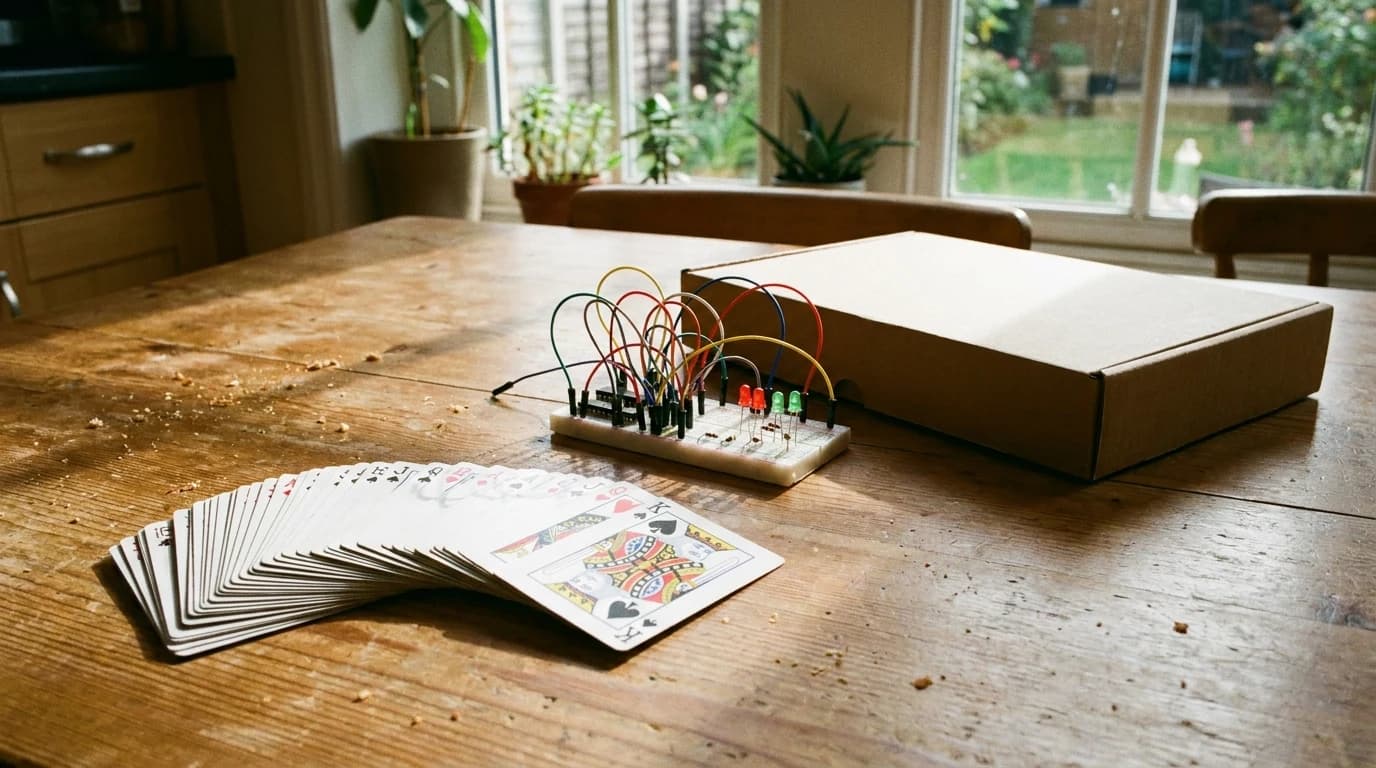
- Official Arduino Starter Kit — walks a beginner through a sequence of real, working projects (a light that responds to a knob, a tiny instrument, a motor) with a printed project book, so there's no "now what?"
- ELEGOO Mega R3 Starter Kit — a bigger pile of components and a downloadable tutorial set at roughly half the price: more parts to tinker with, a slightly rougher on-ramp.
For an older kid who would rather tell a story than solder one, a boxed role-playing set fills the same long afternoon and runs for several of them — the tabletop RPG starter sets we rank highest all ship a pre-written adventure so nobody has to invent a world first. The skills are real and they compound: a kid who finishes the kit can keep inventing well past summer. The value here isn't "STEM" as a buzzword; it's that a build kit reliably eats a whole afternoon and leaves a kid proud instead of glazed.
The family slot: a game everyone will actually play
Some of the best screen-free hours are the ones nobody planned — a game pulled out after dinner that runs two rounds longer than intended. The AAP is clear that this kind of real-time play beats digital media for learning, and it ties play to "a key to executive function skills" and the broader "21st century skills" kids actually need.
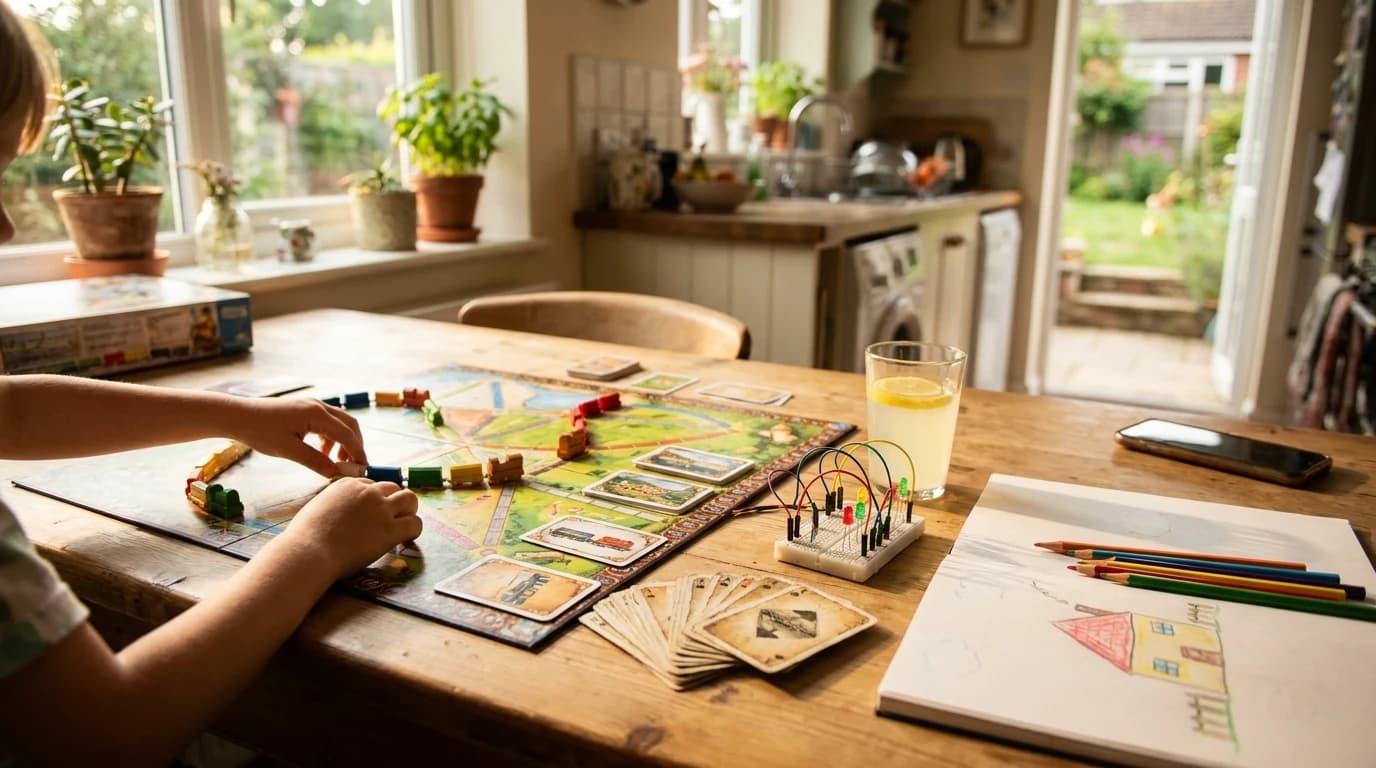
The trick is picking a game the whole table will sit for, which means teachable in minutes, not "deep." Ticket to Ride is the canonical answer: claim train routes across a map, learn it in five minutes, and it holds non-gamers and competitive kids at the same table. It's the rare box that survives mixed ages without dumbing down — which is exactly why it's a summer default and not a one-time novelty.
Worth knowing: a real swap doesn't have to cost anything. The AAP's own play tips lean on "simple and inexpensive objects" — blocks, containers, dress-up, a sketchbook. The board game is the no-friction option when you want guaranteed buy-in; the cardboard box and the backyard are the free ones.
What most people get wrong
Two myths that quietly recreate the problem
What actually holds a screen-free summer together:
- A small, deliberate shelf: a fast loop, a family game, one real project
- Protected unstructured time, even when it looks like nothing
- Letting boredom in the gaps do its job
What parents substitute instead, and shouldn't:
- A packed schedule of lessons, which trades one form of crowding for another
- The assumption that screen-free time has to be productive to count
- Forty toys in a bin, on the theory that more options means less boredom
The AAP explicitly protects unstructured, even boring, time as the soil creativity grows in. And the options myth runs backwards: a kid drowning in 40 toys plays with none of them; a kid handed one good game, one build kit, and a free afternoon plays for hours.
Sources & research
- American Academy of Pediatrics, HealthyChildren.org — How to Make a Family Media Use Plan ("add fun swaps to your plan, like reading, outdoor play, family games and hobbies"; summer/holiday breaks are a good time to review; set screen-free zones): https://www.healthychildren.org/English/family-life/Media/Pages/How-to-Make-a-Family-Media-Use-Plan.aspx
- American Academy of Pediatrics, HealthyChildren.org — The Power of Play: How Fun and Games Help Children Thrive ("some boredom allows for creativity"; "simple and inexpensive objects" support creativity through unstructured play): https://www.healthychildren.org/English/family-life/power-of-play/Pages/the-power-of-play-how-fun-and-games-help-children-thrive.aspx
- American Academy of Pediatrics, HealthyChildren.org — Want Creative, Curious, Healthier Children... Let Them Play (play is "a key to executive function skills" and builds "21st century skills, including social, emotional, language and cognitive skills"): https://www.healthychildren.org/English/news/Pages/healthier-children-play-according-to-the-AAP.aspx
Your next step
Need something for this afternoon? Start here.
Common questions
What's the fastest screen-free fix when my kid is bored right now?
Why doesn't just banning screens work?
Should every screen-free activity be educational?
What's one game that works for the whole family at once?
Research Sources
- American Academy of Pediatrics, HealthyChildren.org — How to Make a Family Media Use Plan ("add fun swaps to your plan, like reading, outdoor play, family games and hobbies"; summer/holiday breaks are a good time to review; set screen-free zones)
- American Academy of Pediatrics, HealthyChildren.org — The Power of Play: How Fun and Games Help Children Thrive ("some boredom allows for creativity"; "simple and inexpensive objects" support creativity through unstructured play)
- American Academy of Pediatrics, HealthyChildren.org — Want Creative, Curious, Healthier Children... Let Them Play (play is "a key to executive function skills" and builds "21st century skills, including social, emotional, language and cognitive skills")