Key takeaways
- The shelf is the enemy: browsing 20 games at 6:45 p.m. is a decision-fatigue trap. A fixed three-game rotation (opener, anchor, wildcard) gets a game on the table in under two minutes.
- Pick by the slot, not the mood — match the game to the time you actually have and the youngest player present, then swap one rotation slot per month for novelty.
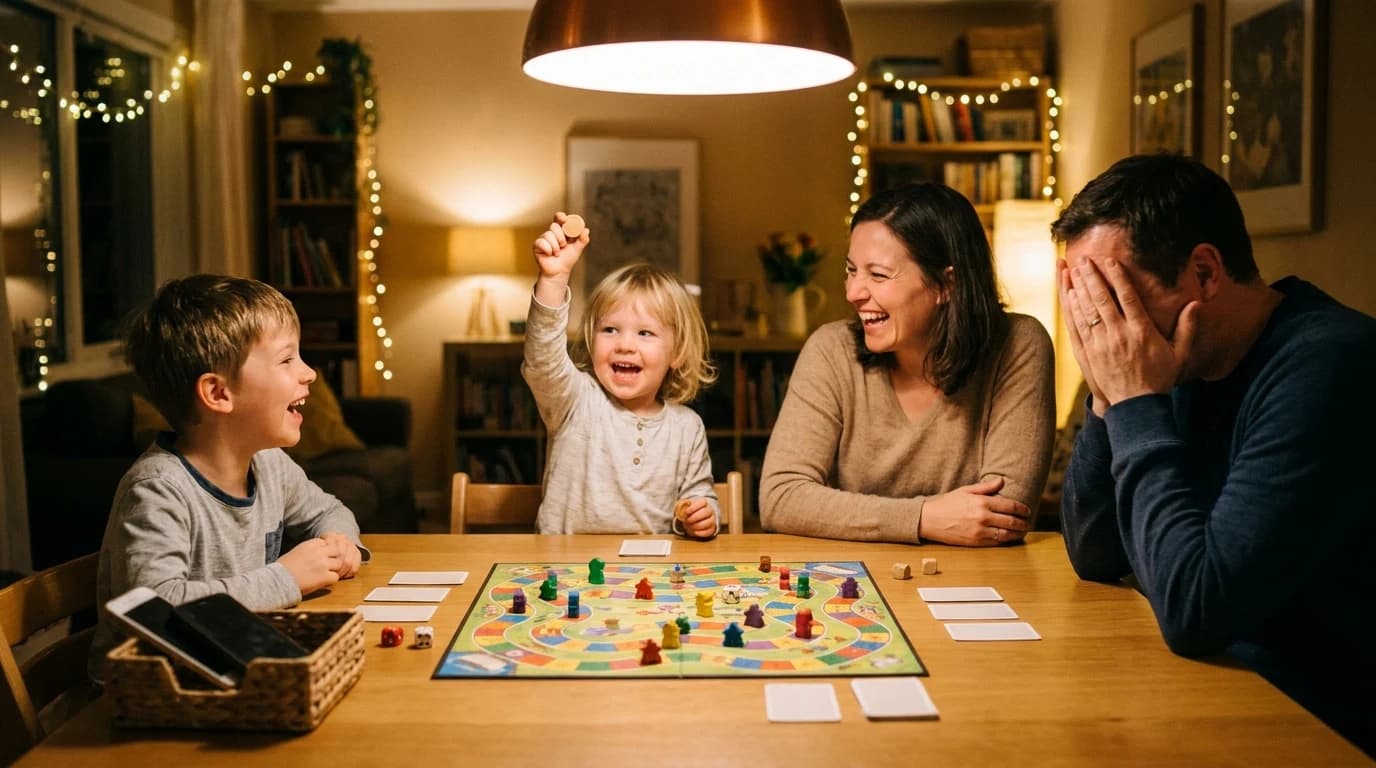
- The youngest player needs a job, not a handicap. Banker, dealer, or timer boss keeps a five-year-old engaged longer than any rule change.
- Consistency beats content: 50 years of family-routines research ties predictable rituals to better child adjustment. Same night, same time, and end one game early.
On this page
The honest answer up top
Family game night doesn't fail because you own the wrong games. It fails at 6:45 p.m., when everyone is standing in front of the shelf negotiating.
The fix isn't a shopping trip; it's a system: a fixed weekly slot, a three-game rotation you choose from instead of the whole shelf, a picker matrix that matches the game to the time you actually have and the youngest player at the table, and a real job for every kid.
The goal: game night stops being an event you organize and becomes a ritual that runs itself — the form that, per 50 years of family-routines research, actually lasts.
Key takeaways
- The shelf is the enemy. Browsing 20 games at 6:45 p.m. is a decision-fatigue trap. A fixed three-game rotation gets a game on the table in under two minutes.
- Pick by the slot, not the mood. Match the game to the time you actually have and the youngest player present. The matrix below does it for you.
- The youngest player needs a job, not a handicap. Banker, card dealer, timer boss. A role keeps a five-year-old at the table longer than any rule change.
- End while it's still fun. One game short of "one more game" is what makes everyone show up next week. The ritual is the product; tonight's winner is a detail.
More choice, worse night (the part nobody believes)
The instinct: a bigger shelf makes a better night. The research says the opposite.
Big selection draws attention; small selection produces decisions
In the famous field experiment by Sheena Iyengar and Mark Lepper (2000), a grocery-store tasting booth displaying 24 jams attracted more shoppers than one displaying 6 (60% stopped versus 40%), but only about 3% of the big-display shoppers actually bought a jar, against nearly 30% from the small display.
Your game shelf works the same way. Twenty boxes look like abundance, but at decision time they generate stalling, vetoes, and an eventual default to a screen. The families whose game night survives past week three aren't the ones with the best collections — they're the ones who removed the choosing. So don't browse. Rotate.
The three-game rotation
Put exactly three games in the rotation each month and pick only among those:
| Slot | What it is | Length | Example profile |
|---|---|---|---|
| Opener | Fast, loud, zero setup. Gets bodies to the table | 10–15 min | A card or party game everyone already knows |
| Anchor | The main event, one step above easy | 30–45 min | A gateway-weight strategy game |
| Wildcard | Rotates monthly — the one new-ish thing | varies | A co-op, a premium jigsaw, whatever's earning its slot |
Swap one slot a month, and let that dictate what you buy
At the start of each month, swap one slot (usually the wildcard) and leave the other two alone. That single swap gives you novelty without reopening the shelf, and it tells you what to buy next: a new game enters the house only when a rotation slot opens for it. (This is the same principle that makes toy rotation work.)
Pick by the slot, not the shelf
The two variables that decide what to play: the time before the youngest melts down, and who's at the table. Everything else is preference noise.
| Time you really have | Youngest is 4–6 | Youngest is 7–10 | Adults + teens only |
|---|---|---|---|
| Under 20 min | Opener only — dexterity or matching | Opener, or one anchor round with a timer | Two quick openers, tournament style |
| 20–45 min | Opener, then anchor as a team | The anchor, played straight | Anchor, or a two-player game in pairs |
| A full evening | Anchor early, jigsaw wind-down | Anchor + wildcard | Wildcard night — the meatier stuff |
Two notes. First, "youngest is 4–6" doesn't mean playing a preschool game: it means running the anchor with support; the balancing levers are in how to play board games with mixed ages. Second, the rotation travels: a couple of compact travel games keep the ritual alive in a rental cabin, and game night is one of the cheapest anchors to build a budget family vacation around.
Keep the youngest in the game
Give a job, not a handicap
What keeps a young player at the table:
- Banker, dealer, dice roller, timer boss — a real responsibility with real consequences
- Something to do between their own turns
- Explaining the first rule, dealing the first hand, and starting to play
What families try first, and shouldn't:
- Bending the rules in the young player's favor, which bores older kids and insults younger ones
- Reading the rulebook aloud before anyone has touched a piece
- Parking the youngest as a spectator until their turn comes round
A kid with a job stays at the table longer than a kid waiting for their turn, because between turns they still matter. The full teaching method is in how to teach a board game without ruining game night — the short version is that nobody has ever enjoyed a rulebook read aloud.
Logistics that decide whether it repeats
Four rules that carry a ritual
- Same night, same time. Barbara Fiese's review of 50 years of family-routines research (APA, 2002) found that predictable routines and meaningful rituals track with better child adjustment and parenting competence. The repetition carries the value, not any single great session. A floating game night is a canceled game night.
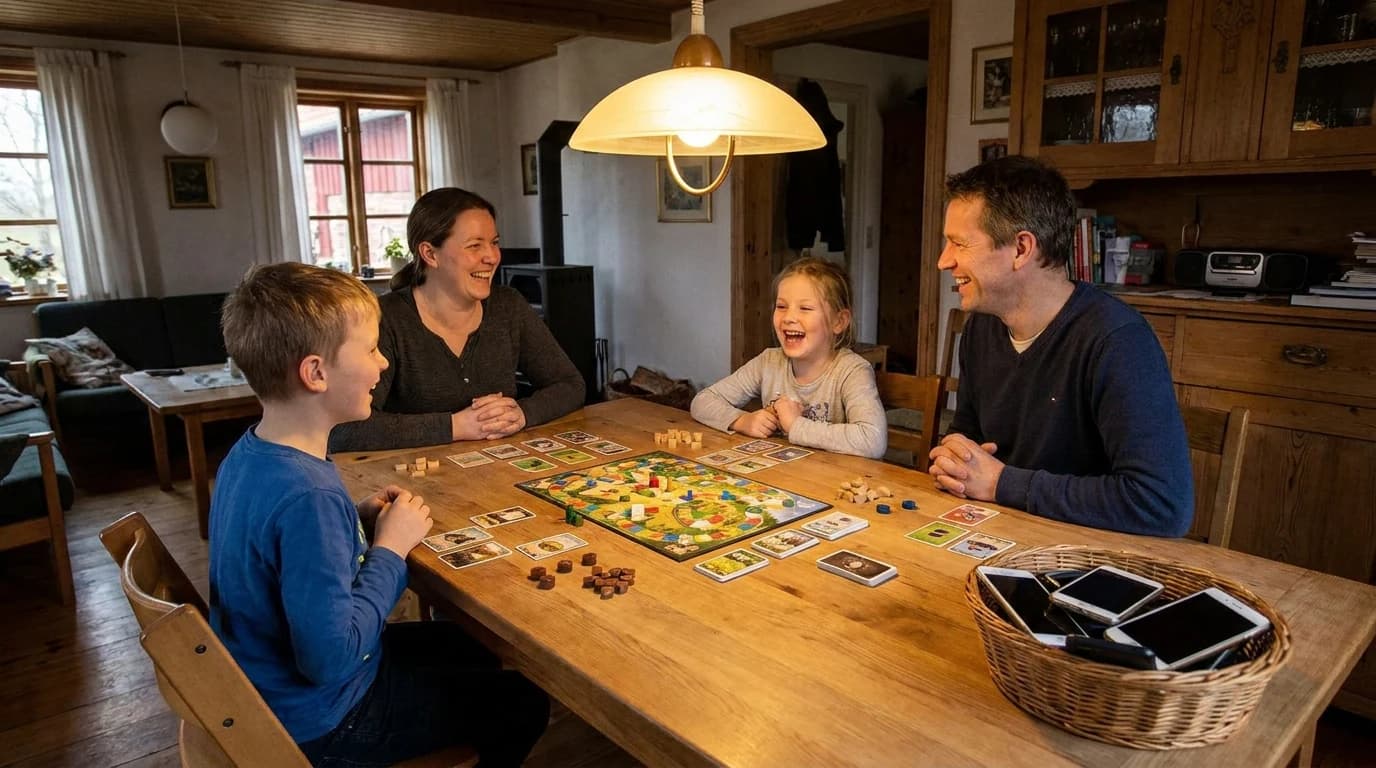
- Phones in a basket, snacks before. The screen ban applies to adults first; kids clock a parent checking a phone instantly. There's a real attention payoff too: the case for analog play as a screen-free attention reset is the best argument for going device-free, not just TV-free. And greasy fingers ruin cardboard: snack plates before setup, water only at the table.
- The 9-minute cap. If a game takes longer than about nine minutes to set up and explain, it doesn't belong in a weeknight rotation. Save it for the full-evening column.
- Quit one game early. End on the wave, not after it breaks. "Same time next week" said while everyone still wants more is the whole retention strategy.
What most people get wrong
The standard failure is treating game night as a content problem — buy more games, find the perfect game — when it's a friction problem. More games raise the cost of starting (the jam study working against you), and the "perfect game" doesn't survive a tired Tuesday.
The falsifiable claim: a family with three fixed games and a fixed night will still be playing in six months; a family with twenty games and a floating night won't. The system is the product. The games are just the pieces.
Sources
- Iyengar, S. & Lepper, M. — When Choice is Demotivating: Can One Desire Too Much of a Good Thing? (Journal of Personality and Social Psychology, 2000; the jam-display field experiment: 24 flavors drew 60% of passersby vs 40% for 6 flavors, but ~3% vs ~30% purchased).
- Fiese, B. et al. — A Review of 50 Years of Research on Naturally Occurring Family Routines and Rituals (Journal of Family Psychology, 2002; routines and rituals related to parenting competence, child adjustment, and marital satisfaction).
Your next step
Building the three-game rotation? Start with these.
Common questions
How often should we do family game night?
How many board games do we actually need for game night?
How do I keep a young kid engaged during family game night?
What kills family game night for most families?
Research Sources
- Iyengar & Lepper — "When Choice is Demotivating: Can One Desire Too Much of a Good Thing?" (JPSP 2000; jam field experiment: 24-flavor display drew 60% of shoppers vs 40% for 6 flavors, but ~3% vs ~30% purchased)
- Fiese et al. — "A Review of 50 Years of Research on Naturally Occurring Family Routines and Rituals: Cause for Celebration?" (Journal of Family Psychology, 2002; routines/rituals related to parenting competence, child adjustment, and marital satisfaction)