Key takeaways
- A University of Toledo study found toddlers played twice as long, and in more creative ways, with 4 toys available than with 16.
- Toy rotation means keeping a small set out and storing the rest, then swapping every week or two so stored toys come back feeling brand new.
- Open-ended toys (blocks, loose parts, pretend props) rotate well; single-function electronic toys do not, because their novelty wears off and never returns.
- The cheapest fix for a bored child is usually better storage, not a new purchase, the AAP notes high quality does not mean expensive.
On this page
Quick Answer
If a child seems bored with their toys, the instinct is to buy something new. But the research points the other way: the problem usually isn't too few toys, it's too many out at once. A University of Toledo study found that when toddlers played in a room with 4 toys instead of 16, they played twice as long with each toy and in more creative ways.
The fix isn't more stuff: keep a small set available, box up the rest, and swap them every week or two. Toys a child "outgrew" come back feeling brand new, and you stop spending money to solve a problem that better storage already solves.
What toy rotation actually is
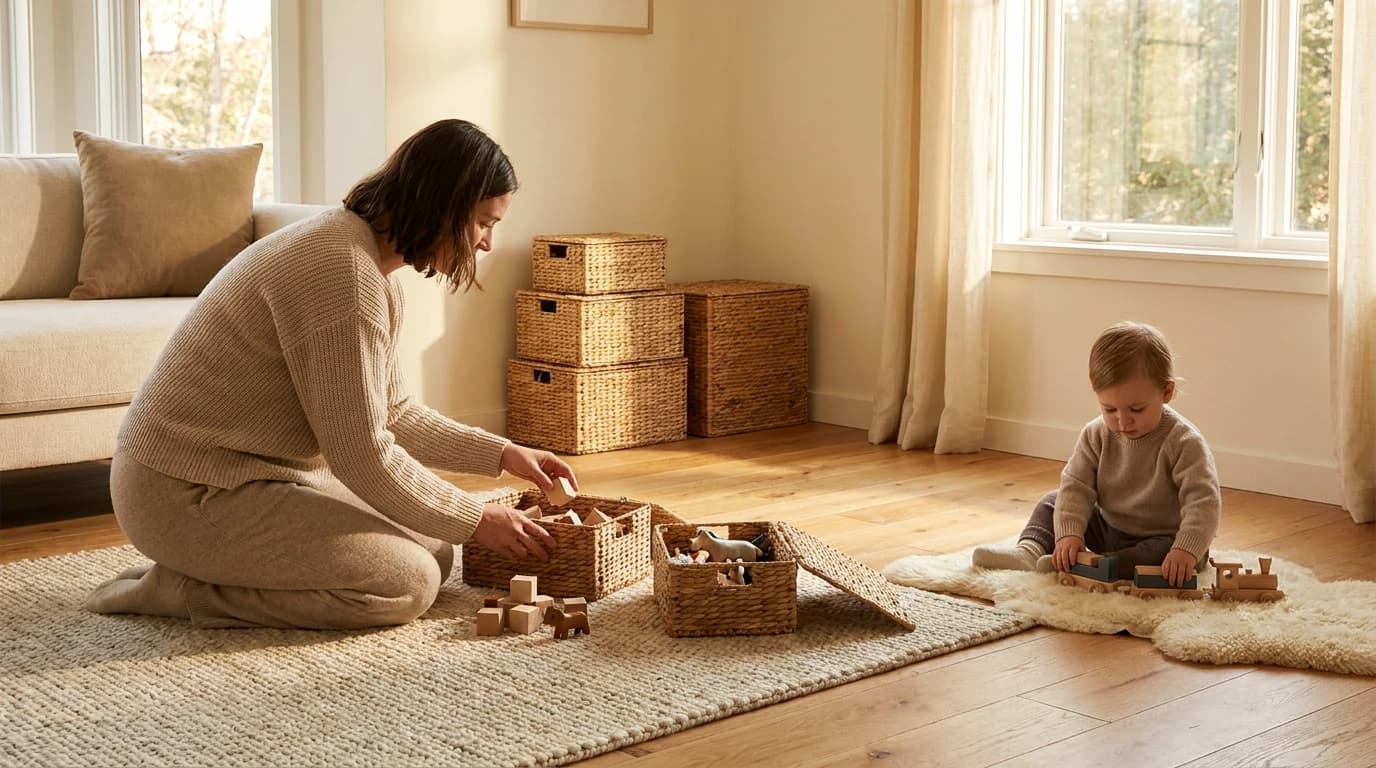
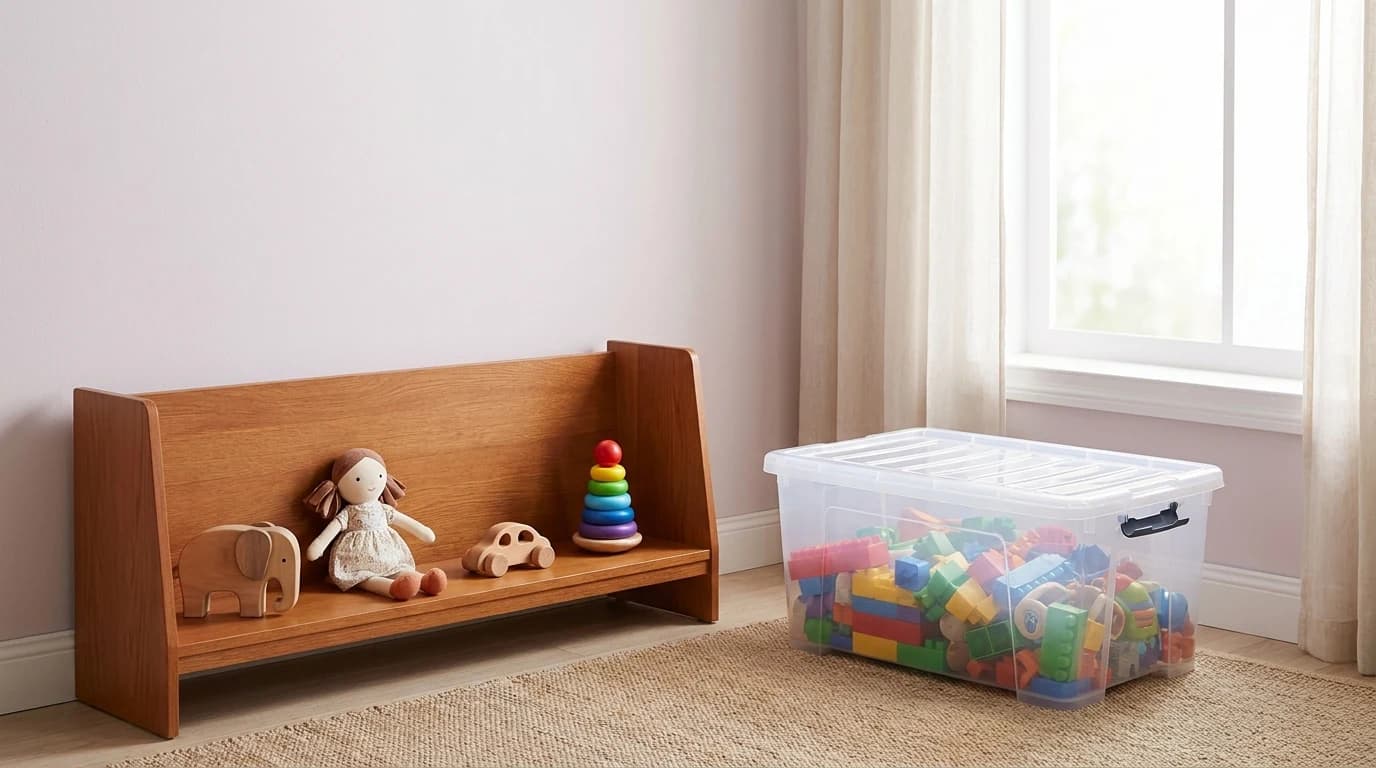
Toy rotation means deliberately limiting how many toys are accessible at one time and storing the rest out of sight, then cycling them in and out on a schedule. That's it. No special bins or apps required, though clear lidded boxes help.
The idea isn't new. It's the same minimalist logic Montessori classrooms have used for decades: a few carefully chosen materials on an open shelf, swapped as interest fades or a child masters them. What's changed is that we now have child-development evidence for why it works at home, not just a teaching tradition that says it does.
What the Toledo study actually did
The team studied 36 toddlers aged 18 to 30 months. Each child visited a playroom twice: once with 4 toys available, once with 16.
- With 4 toys, children stuck with each one longer and played in more sophisticated ways — instead of just stacking or tipping a toy, they began to hammer with it, feed it, or hide it.
- With 16 toys, many kids touched 10 or more in the first 15 minutes, flitting from one to the next without exploring any.
- The researchers' own takeaway was blunt: "If your child receives an abundance of toys, you don't need to introduce them all at once. Save some for later and swap them out."
Why putting toys away makes kids play more
Three things happen when you cut the visible toy count
- Less decision fatigue. A floor covered in options is a tiny, constant "what should I do?" problem. Fewer choices means a child commits to one thing and goes deep instead of sampling everything.
- Attention has room to build. The Toledo finding was about quality of play, not just duration. Deeper, longer engagement with a single object is where the motor and cognitive skill-building happens, the experimenting, problem-solving, and pretending.
- Stored toys reset to "new." A toy that's been in a closet for three weeks lands like a fresh gift. The novelty that makes a brand-new toy exciting is, in large part, just unfamiliarity, and rotation manufactures that for free.
The money-saver: Zero To Three describes the universal experience of buying "a toy a child plays with for two days and never touches again." Rotation is the antidote — instead of the toy dying after 48 hours, it goes away and comes back interesting.
The toys worth keeping in rotation
Not every toy rotates well. The ones that reward repeated play are open-ended, meaning they can be used many different ways rather than doing one thing.
| Toy type | Rotates well? | Why |
|---|---|---|
| Blocks, stacking cups, magnetic tiles | Excellent | Used a hundred ways; "open-ended," per Zero To Three |
| Loose parts (cups, scarves, wooden rings, boxes) | Excellent | NAEYC: invite creative thinking, problem-solving, repurposing |
| Pretend props (animals, play food, dolls) | Very good | Grow with the child, support imaginative play |
| Single-function light-up/electronic toys | Poorly | One outcome; novelty wears off fast and doesn't return |
Why the open-ended column wins
Zero To Three's guidance is to "choose toys that can be used in a variety of ways" and "look for toys that will grow with them," precisely the toys that earn a spot in the rotation. NAEYC's early-childhood educators make the same point about "loose parts," ordinary open-ended materials children can move, combine, and control, noting they "promote children's creative thinking, imagination, and problem-solving skills" and can be rotated between play areas to renew interest.
The American Academy of Pediatrics adds the budget-friendly version: "high quality does not mean expensive," and things as simple as cardboard boxes or pads of paper keep little ones happily occupied.
What most people get wrong
Two assumptions the study contradicts
What's usually happening:
- A child who "ignores" a toy in a crowded space hasn't outgrown it — they've stopped seeing it
- The toy is visual noise in a pile, not a toy that failed
- Pulled out three weeks later in an otherwise sparse room, it gets an hour of attention
What parents conclude instead, and shouldn't:
- That a bored kid needs more toys
- That an ignored toy has been outgrown and should be replaced
- That rotation is a big organizational project
The Toledo study is the falsifiable version of the first claim: if more toys produced richer play, the 16-toy room should have won. It lost, and not by a little.
As for the organizational myth — the bare-minimum version is one box in a closet. Put half the toys in it, and the next time interest dips, swap the box's contents with what's on the floor. No labels, no schedule, no system to maintain.
A 15-minute rotation setup
You can start today with what you own:
- Gather and cull. Pull every toy into one pile. Set aside anything broken, outgrown, or with missing pieces to donate or toss. (Per the AAP, also retire anything with a loose button battery or unsecured magnets.)
- Pick a small "on" set. Keep roughly 4 to 8 toys available, weighted toward open-ended ones (blocks, pretend props, art supplies). Box up the rest.
- Store the "off" toys out of sight. Closet, garage, under-bed bins. Out of sight is the active ingredient, not out of reach.
- Swap on dip, not on a calendar. When engagement fades, usually every one to two weeks, trade the active set for a stored box. Watch your child rediscover "old" toys.
- Keep favorites permanent. A beloved lovey, blanket, or one go-to toy stays out always. Rotation is about the background set, not security objects.
None of this is anti-toy. It's pro-play. The goal isn't a minimalist nursery for its own sake; it's getting the toys you already own to do what new toys do, hold attention, invite imagination, and earn their floor space, without a single new purchase.
Your next step
Rotating something new in? These are the picks worth the slot.
Common questions
Does toy rotation actually work, or is it just a minimalist fad?
How many toys should be out at a time?
How often should I rotate?
Which toys are worth keeping in the rotation?
Research Sources
- University of Toledo - Fewer toys lead to richer play experiences (36 toddlers, 4 vs 16 toys; twice as long and more sophisticated play with fewer toys; 'save some for later and swap them out')
- Zero To Three - Tips for Choosing Toys for Toddlers ('open-ended' toys used a variety of ways; toys that grow with the child; the toy played with for two days then never touched again)
- NAEYC, Young Children - Using Materials Creatively to Enhance Toddler Learning (loose parts and open-ended materials promote creative thinking and problem-solving; can be rotated between learning areas; cites Dauch et al. 2017)
- American Academy of Pediatrics, HealthyChildren.org - Toy Buying Tips for Babies & Young Children ('high quality does not mean expensive'; cardboard boxes and paper; imagination and real interaction over single-function digital toys)