Key takeaways
- The American Academy of Pediatrics' 2018 clinical report The Power of Play traces object play from simple exploration to symbolic use (a child using a banana as a telephone) and states that explicit instructions and single-script designs limit a child's creativity.
- HealthyChildren.org (AAP) explains the mechanism: when a child pretends a spoon is a hairbrush they are thinking symbolically, the same mental move that underlies language, so open-ended props quietly build vocabulary and communication.
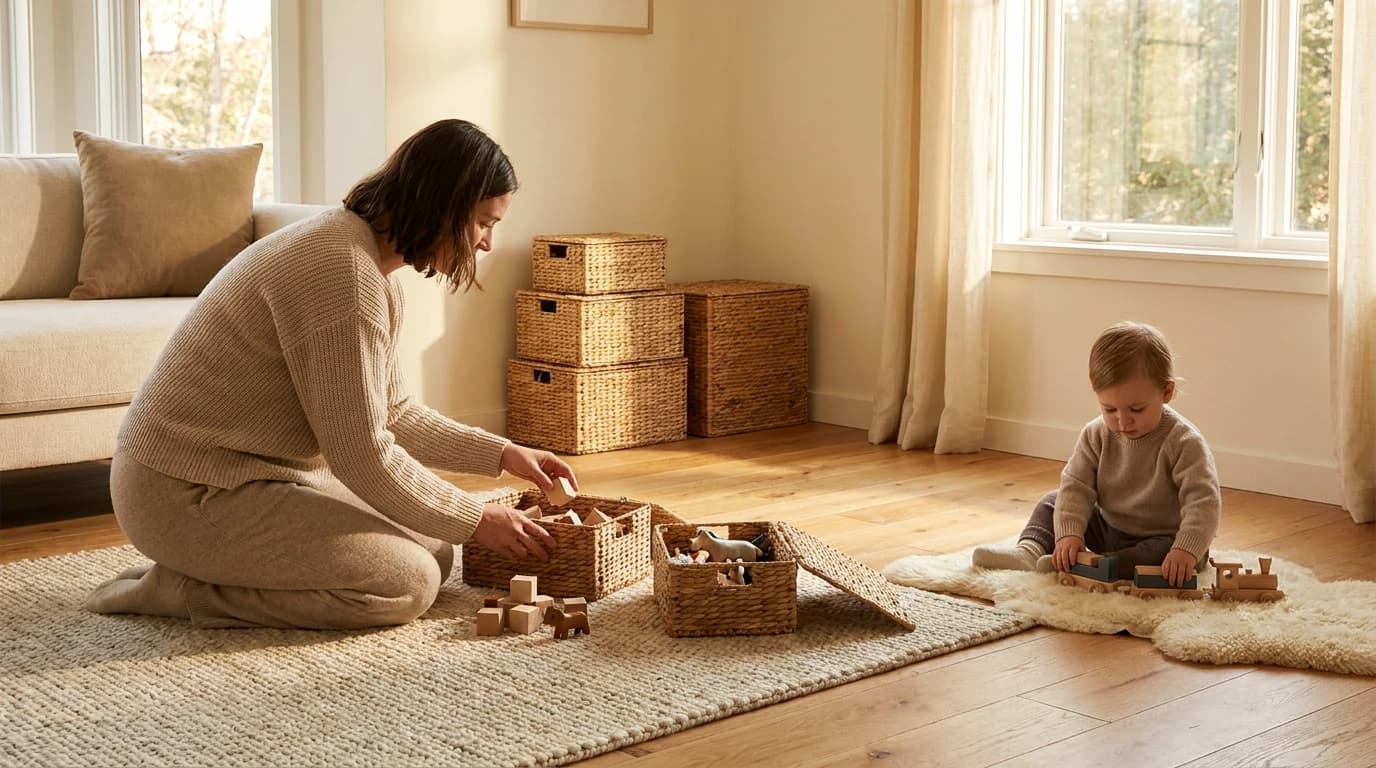
- Eastern Connecticut State University's TIMPANI study, summarized by NAEYC, finds the highest-scoring toys are the plainest open-ended ones (blocks, simple vehicles, classic construction sets) because children can use them in multiple ways.
- Honest caveat: a controlled study of 211 preschoolers found quality social pretend play improved social behavior and peer relationships but did not raise standardized social-cognitive or emotional test scores. Buy it for the play, not for a test result.
On this page
Quick Answer
If you want a gift that grows a young child's imagination, the deciding factor is not how "educational" the toy claims to be — it is how many different things the child can pretend the toy is. The American Academy of Pediatrics' 2018 clinical report The Power of Play describes object play maturing from simple exploration into symbolic use, "when a child uses a banana as a telephone," and notes plainly that explicit instructions and single-script designs limit a child's creativity.
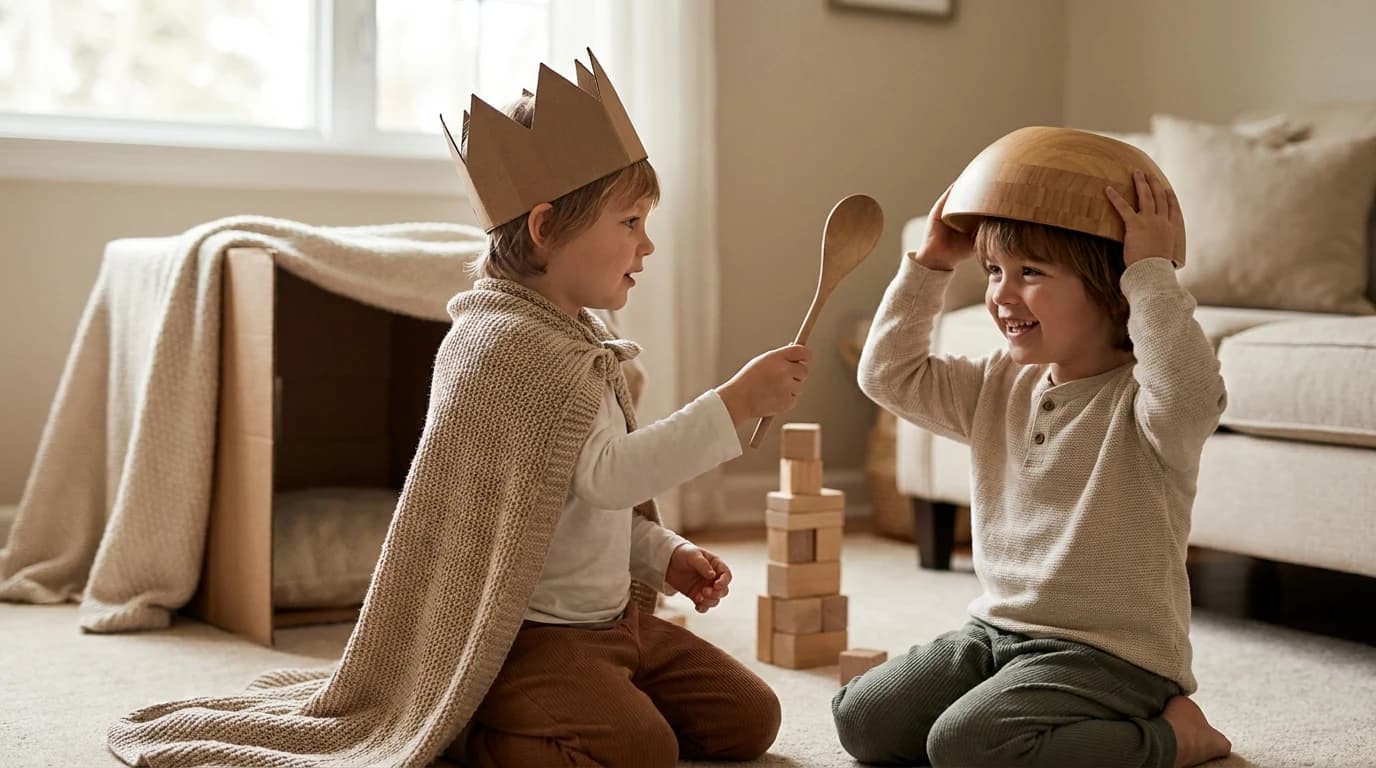
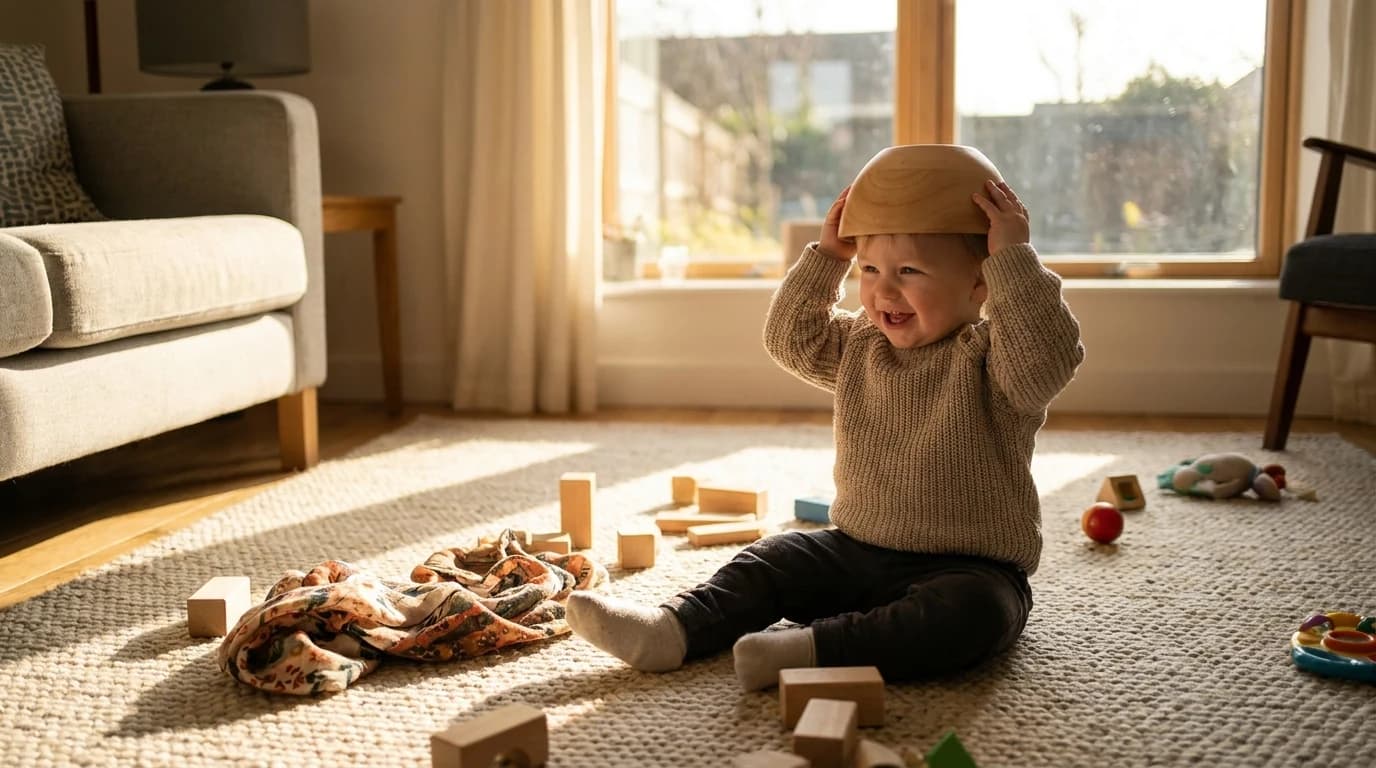
So the most reliable pretend-play gift is usually the most open-ended one: blocks, simple figures, a play scarf, a cardboard-and-blanket fort, a plain wooden bowl that becomes a hat, a drum, a boat, a steering wheel. The flashy toy that does exactly one scripted thing tends to do that one thing — and then sit in the bin.
Why pretend play is worth aiming for
Pretend play (also called imaginative, make-believe, or symbolic play) is not filler between "real" learning. The AAP report ties it to two things at once:
- Executive function — the social-emotional, cognitive, language, and self-regulation skills behind the capacity to pursue a goal and ignore distractions.
- A buffer against stress — the shared, joyful back-and-forth between a child and a caregiver helps regulate the body's stress response.
Substitution is the same move as language
The mechanism, per HealthyChildren.org: "When children use one object to stand for another, such as pretending a spoon is a hairbrush, or a tablecloth is a cape, they are thinking symbolically. This type of thinking is key to learning and using language as words also stand for thoughts and ideas."
That single sentence is the whole case. Symbolic substitution — this stands for that — is the same mental move that underlies language itself. A toy that invites substitution is quietly running language reps. A toy that can only ever be the one thing printed on the box does not.
The skills pretend play actually builds
| Pretend-play moment | Skill it exercises |
|---|---|
| A spoon becomes a hairbrush; a box becomes a rocket | Symbolic thinking, the foundation of language |
| "You be the teacher, I'll be the student" | Negotiation, turn-taking, cooperation |
| Acting out a doctor's visit before the real one | Emotional rehearsal, confidence, problem-solving |
| Inventing the rules of an imaginary world | Self-direction, planning, executive function |
Props do the work costumes get credit for
These map directly to what the research describes. HealthyChildren.org notes that costumes and props help children "step into a new role," and that distinct props in group play make turn-taking easier — when you wear the apron you're the chef, when you hold the menu you're the diner. The AAP report adds that dress-up, make-believe, and imaginary play "encourage the use of more sophisticated language" as children negotiate shared, rule-bound scenarios with playmates.
What most people get wrong
More realism is not more immersion
The intuitive move at the toy aisle is to buy up in realism and features: the kitchen that beeps and announces "dinner is ready," the doll that talks back, the play set with one obvious correct way to use it.
The research points the other way. The clearest counterweight comes from the TIMPANI toy study at Eastern Connecticut State University, where researchers have spent years scoring how children actually play with specific toys across thinking, social interaction, and creativity. Professor Jeffrey Trawick-Smith's summary, published by the National Association for the Education of Young Children, is blunt:
The finding: "Basic is better. The highest-scoring toys so far have been quite simple: hardwood blocks, a set of wooden vehicles and road signs, and classic wooden construction toys... they are relatively open-ended, so children can use them in multiple ways."
A highly realistic, single-function toy answers its own question — there is nothing left to pretend. An open-ended one is a prompt, not a script.
The honest caveat: open-endedness is not magic
What the evidence supports:
- A controlled study of 211 preschoolers found quality social pretend play improved children's social behavior and peer relationships
- Symbolic substitution running alongside language development
- Props making turn-taking easier in group play
What it does not support:
- Movement on standardized social-cognitive or emotional test scores in that same study
- Treating pretend play as a worksheet that lifts every measurable metric
- Buying a toy for a test result rather than for the play
How to choose a pretend-play gift (a short framework)
You usually don't need to know the specific child. Aim for materials that pass the substitution test — could this be three different things?
- Props over scripts. A play scarf, a set of plain blocks, a wooden boat, a doctor's bag with generic pieces, a basket of play food. Avoid anything whose only mode is one pre-recorded routine.
- Open characters over branded ones. Simple figures and animals let a child write the story. Heavily branded characters often arrive with the story already written, which can narrow play to re-enacting the show.
- One good set beats a bundle. A single rich, open-ended thing invites deeper invention than a pile of one-trick gadgets — and it's the same logic behind ranking toys on replay depth rather than feature count.
- Free works too. A cardboard box, a blanket fort, and a few household objects are, by the AAP's own examples, premium pretend-play equipment. The banana-telephone needs no batteries.
The headline isn't anti-toy. It's anti-script. The best pretend-play gift hands a child an open question — what could this be? — and then gets out of the way.
Your next step
Looking for open-ended props? These are the kits kids keep re-imagining.
Common questions
What actually counts as a good pretend-play toy?
Are realistic, feature-rich toys bad for imagination?
Does pretend play really help with language?
Will buying pretend-play toys make my child smarter or more advanced?
Research Sources
- American Academy of Pediatrics - The Power of Play: A Pediatric Role in Enhancing Development in Young Children (Pediatrics, 2018; Yogman et al.)
- American Academy of Pediatrics (HealthyChildren.org) - Pretend Play: Ways Children Can Exercise Their Imagination
- NAEYC - What the Research Says: Impact of Specific Toys on Play (Trawick-Smith, TIMPANI study, Eastern Connecticut State University)
- The impact of social pretend play on preschoolers' social development: Results of an experimental study (Early Childhood Research Quarterly, 211 children, randomized)