Key takeaways
- Father's Day 2026 is Sunday, June 21 - the strongest kid-made gift is one that carries the child's own handprint, handwriting, or voice, not one that looks store-bought.
- Match the craft to the child's stage: pediatric OT guidance has kids snipping paper around 2-2.5, cutting a straight line by 3-3.5, a circle by about 4, and complex shapes around 5-6. The wrong-age craft is a frustration machine.
- NAEYC's process-focused art (no sample to copy, no right answer, entirely the child's own) builds creativity; product-focused art where an adult 'fixes mistakes' produces frustration and identical results.
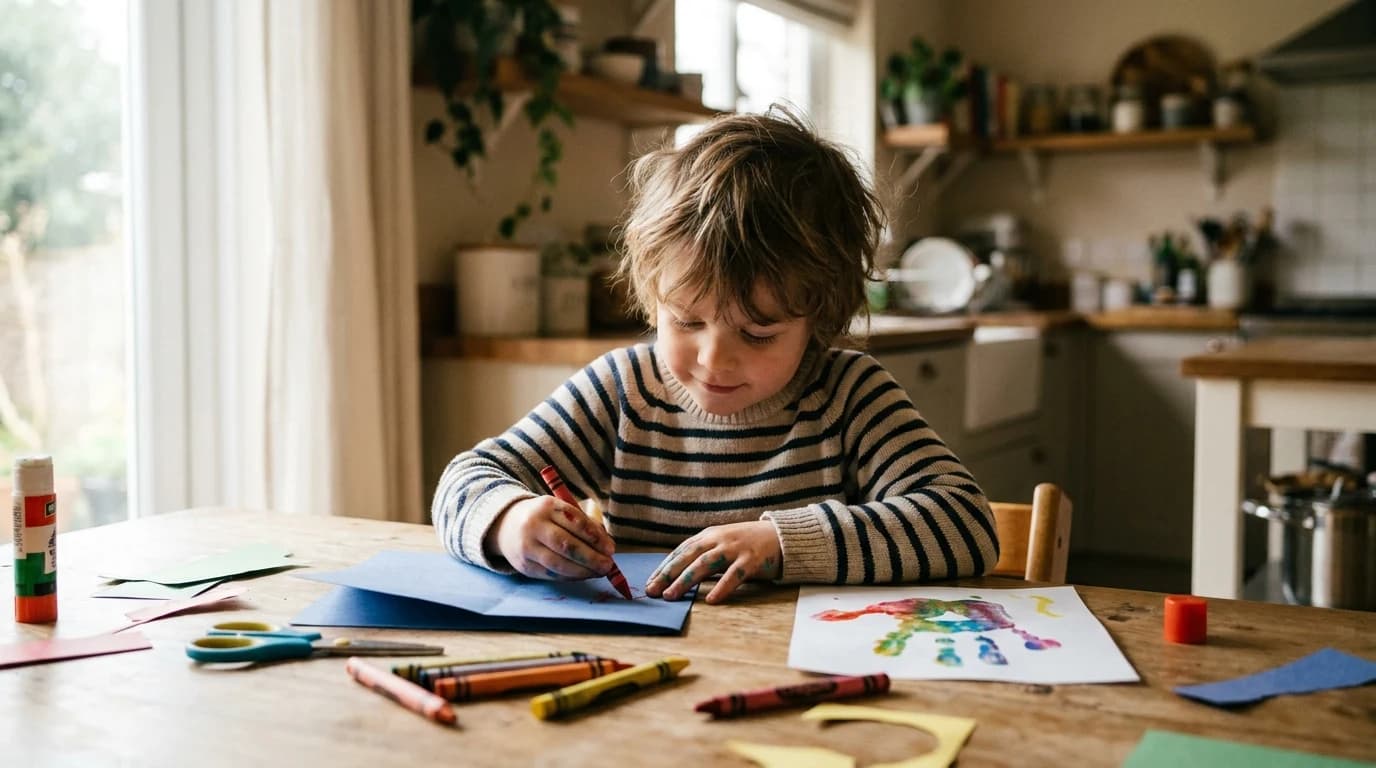
- A wobbly card a four-year-old made beats a perfect one a parent quietly finished - the American Academy of Pediatrics ties the doing (cutting, coloring, planning) to fine-motor, cognitive, and creative development.
On this page
Quick Answer
Father's Day 2026 lands on Sunday, June 21. If a kid is making the gift, the best one almost always carries their own handwriting, their own messy handprint, or their own voice — not the polished store-bought look.
The research backs this: the National Association for the Education of Young Children (NAEYC) distinguishes process-focused art (no sample to copy, no right answer, "the art is entirely the children's own") from product-focused art (follow instructions, a finished product in mind, "the children's finished art all looks the same") — and it's the process kind that builds creativity and confidence.
So pick a craft that fits the kid's hands, hand them the materials, and let it come out wobbly. Below: doable, low-cost, mostly screen-free ideas sorted by age, plus the handful of supplies worth keeping on hand.
What you'll need (most you already own)
You can do almost all of this with paper, crayons, and a jar. These are the only things worth buying if you're short:
| Supply | Used for | Pick |
|---|---|---|
| Washable kids paint + brush | Handprint cards, painted frames | Crayola Kids Washable Paint Set, 42ct |
| Blunt-tip kid scissors | Preschool snip-and-glue collages | Fiskars SoftGrip Blunt-Tip Kids Scissors |
| Construction paper | Cards, collages, coupon books | Crayola Construction Paper Bulk Pack, 480 sheets |
| Blank wooden frame to decorate | Photo gift a kid customizes | DIY Mosaic Picture Frame Craft Kit |
| Handprint keepsake kit | The dated baby/toddler handprint | Hand & Footprint Clay Keepsake Kit |
Buy almost nothing. A jar from the recycling, an old photo, and a shoebox cover the "Reasons I Love You" jar, the frame, and the coupon book. Spend on a kid-sized pair of blunt scissors and washable paint — that's it.
Match the craft to the hands, not the calendar
A toddler can't cut a straight line yet — that's the timeline, not a flaw. Pediatric occupational-therapy guidance on scissor development is specific:
- 2–2.5 yrs: snip paper edges
- 3–3.5 yrs: cut a 6-inch straight line
- ~4 yrs: cut a circle
- 5–6 yrs: cut more complex shapes
Hand a 3-year-old a cut-out-hearts craft and you've built a frustration machine. Match the task to the stage and the kid stays in the "look what I made!" zone.
Ideas by age
| Age band | What they can make | Why it works |
|---|---|---|
| Toddler (1–3) | Painted handprint card; scribble "portrait" of Dad; decorated rock paperweight | Whole-hand grasp + sensory paint; no cutting; the print is the keepsake |
| Preschool (3–5) | Snipped-paper collage card; "Reasons I Love You" jar (adult writes, kid decorates + dictates); a painted photo frame | Snipping + gluing matches emerging scissor skills; dictation captures their real voice |
| Early elementary (5–8) | "All About My Dad" interview sheet; homemade coupon book; a comic strip about Dad | Writing + simple cutting; the interview answers are the gold (save these forever) |
| Tween (8–12) | Breakfast-in-bed plan; hand-bound mini photo book; recorded "thank you" video or written letter | Real autonomy: they plan, sequence, and execute it mostly themselves |
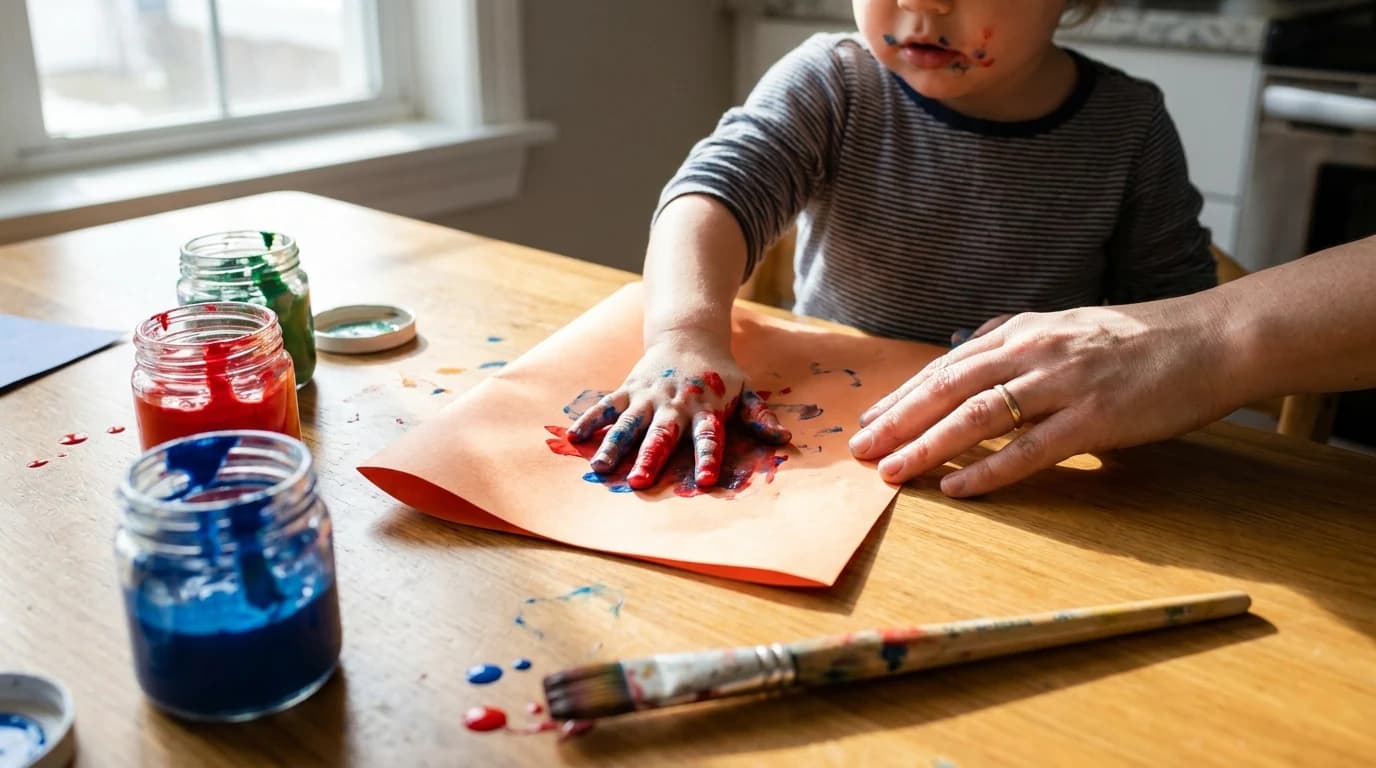
Toddler: Press a paint-covered palm onto folded construction paper with washable paint. For a forever version, the air-dry handprint clay kit casts the print in a frame.
Preschool: Set out blunt-tip scissors and colored paper for a glue-and-snip collage, or have them decorate a DIY Mosaic Picture Frame Craft Kit around a photo of them with Dad. For the "Reasons I Love You" jar, the kid decorates a jar and dictates the reasons while you write.
Early elementary: A fill-in All About My Dad book does the prompting for you — or just write the interview by hand. Either way, the unedited answers are the keepsake. For a no-buy keepsake, a tray of fuse beads makes a "#1 DAD" coaster.
Three keepsakes worth saving
- The handprint, dated. A painted handprint with the year written small in the corner is the single best toddler gift — a physical record of how small the hand was. Dads keep these for decades.
- The "All About My Dad" interview. Ask a 5–8-year-old: What's Dad really good at? His favorite food? How old is Dad? What do you two do together? Write the answers verbatim — funny wrong ones included ("Dad is 100"). The unedited voice is the gift.
- The coupon book. Five hand-drawn coupons: "one hug," "I'll set the table," "movie pick is yours," "breakfast in bed," "no arguing at bedtime." Cheap, screen-free, and it keeps giving for weeks.
A breakfast-in-bed plan a kid can run
Tweens love a project with steps. Make it a real plan:
- Night before: set out a tray, cup, folded napkin; pick a burner-free menu (toast + fruit + juice is foolproof).
- Morning: kid assembles the cold items solo; an adult handles anything hot.
- The flourish: add the handmade card and one flower (real or folded paper).
The point isn't a flawless plate — it's a kid sequencing a kind act start to finish.
What most people get wrong
The instinct is to help the craft look good — straighten the card, redo the crooked letters, "finish" the painting. The research says that quietly defeats the purpose.
Signs the child still owns the craft:
- No sample to copy and no right answer
- The finished pieces all look different
- The art is entirely the children's own
NAEYC's tells that an adult has taken over:
- The grown-up "might fix mistakes"
- There's "a right and a wrong way to proceed"
- The children "experience frustration"
The American Academy of Pediatrics ties the doing — coloring, cutting, planning, gluing — to fine-motor, cognitive, and creative development.
The bottom line: a wobbly card a four-year-old made beats a perfect one a parent quietly finished. A dad isn't grading the lettering — he's keeping proof that a small person thought about him and tried. Fix the craft and you've swapped the kid's gift for your own.
Sources
- National Association for the Education of Young Children (NAEYC) — How Process-Focused Art Experiences Support Preschoolers (process- vs product-focused characteristics; "the art is entirely the children's own").
- American Academy of Pediatrics, HealthyChildren.org — Nature Art: Outdoor Inspiration to Boost Your Child's Development (hands-on creative activities develop fine-motor, cognitive, and creative skills).
- GrowingHandsOnKids — Scissor Skill Development Checklist for Ages 2–6 (snipping ~2–2.5, straight line ~3–3.5, circle ~4, complex shapes ~5–6).
Common questions
What is a good Father's Day craft for a toddler who can't cut or write?
When can a child use scissors well enough for a cut-and-glue craft?
Should I fix my kid's craft so it looks nicer for Dad?
Research Sources
- National Association for the Education of Young Children - How Process-Focused Art Experiences Support Preschoolers (process- vs product-focused art; 'the art is entirely the children's own,' adults who 'fix mistakes' produce frustration)
- American Academy of Pediatrics, HealthyChildren.org - Nature Art: Outdoor Inspiration to Boost Your Child's Development (hands-on creative activities build fine-motor, cognitive, and creative skills)
- Growing Hands-On Kids - Scissor Skill Development Checklist for Ages 2-6 (developmental progression: snip ~2-2.5, straight line ~3-3.5, circle ~4, complex shapes ~5-6)