Key takeaways
- Match the challenge to the gap, not the youngest player. A game one step above what a kid can do alone — with a parent or older sibling scaffolding it — is where real learning happens; dropping to the easiest common denominator disengages everyone.
- Pick one balancing lever before you start: help the younger player (hints, a co-pilot), constrain the older player (a handicap), or erase the contest (go cooperative or team up). Say it out loud.
- Cooperative and team formats sidestep the age gap entirely — when everyone's on the same side, a preschooler and an adult can play the same game with no rule-bending.
- Older kids learn by teaching: handing the ten-year-old the job of coaching the five-year-old cements what the older one already knows.
On this page
The honest answer up top
The problem with playing a board game across a big age gap isn't the game — it's the gap in what each player can do without help. A five-year-old and a ten-year-old aren't bad at the same game; they're at two different points on the same skill curve.
The fix isn't picking the youngest kid's game and boring everyone else, or the oldest kid's game and crushing the little one. It's keeping one shared game and quietly balancing the inputs — giving the younger player support, the older player a constraint, or recasting the whole thing as a team.
The reframe: done right, the age gap stops being a handicap and becomes the best part. The older kid mentors, the younger kid stretches, and both learn more than they would playing down to their own level.
Key takeaways
- Match the challenge to the gap, not the youngest player. A game that's one step above what a kid can do alone — with a parent or older sibling scaffolding it — is where real learning happens. Drop to the easiest common denominator and everyone disengages.
- Pick your lever before the game starts. You have three: help the younger (open cards, hints, a co-pilot), constrain the older (handicap, harder goal, no hints), or erase the contest (go cooperativeco-opGame where all players win or lose together against the game's system. Pandemic, Spirit Island, and Gloomhaven are the canonical co-ops. Tends to outperform competitive games for couples and mixed-skill groups. or team up). Choose one and say it out loud.
- Cooperative and team formats sidestep the gap entirely. When everyone's on the same side, a four-year-old and an adult can genuinely play the same game with no rule-bending, because winning isn't a head-to-head measure of skill.
- Older kids learn by teaching. Handing the ten-year-old the job of coaching the five-year-old isn't babysitting — it's the single most effective way to cement what the older one already knows.
Why "just play the kids' game" backfires
The instinct with a big spread — say a 4-year-old, an 8-year-old, and two adults — is to default to the simplest game everyone can technically play. It keeps the peace for one round. Then the older kids check out, the adults phone it in, and game night quietly dies because nobody above age six actually wanted to be there.
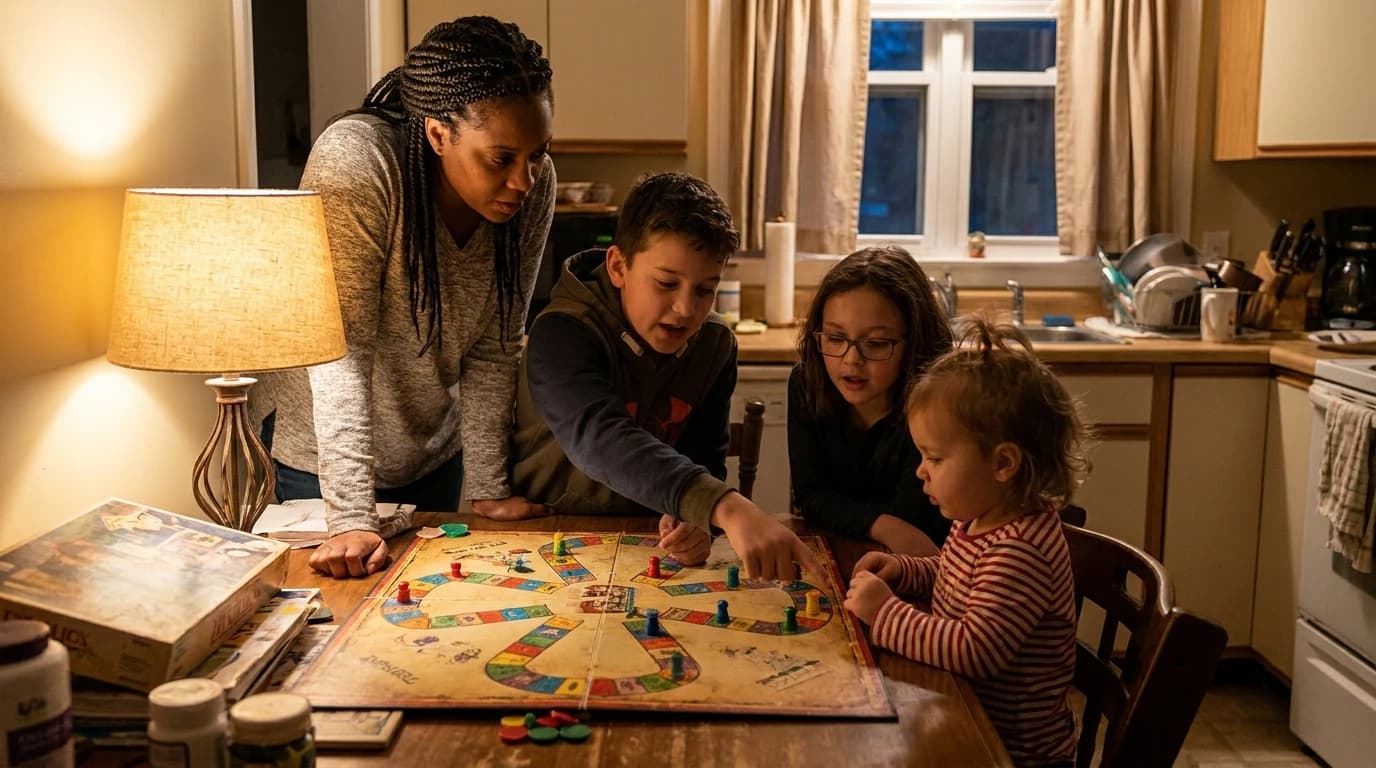
The band just beyond independent skill is where learning lives
The developmental research points the other way. Kids learn most when an activity sits in their zone of proximal development — the band just beyond what they can do alone, reachable with help.
The University of Florida's Anita Zucker Center describes it plainly: you "identify a skill or milestone that is one or two steps ahead of what the child can do independently," then scaffold it — model it, support it, and pull the support away as the child gets fluent. A game pinned at the youngest player's solo level has no ZPD in it for anyone older. A slightly-too-hard game with scaffolding has it for everyone.
So the goal flips: don't shrink the game to the youngest kid. Keep a game with real meat in it and add support where it's needed.
The three balancing levers
Before you sit down, decide which of these you're using. Mixing them mid-game is where arguments start.
| Lever | What you do | Best when | Watch out for |
|---|---|---|---|
| Help the younger player | Open hand, hints allowed, a parent or older sibling plays as co-pilot, simplified scoring for them only | The game is genuinely competitive and you want it to stay a contest | The younger one feeling "carried" — let them make the final call on their own turn |
| Constrain the older player | Older/stronger player takes a handicap: fewer resources, a harder win condition, no hints, plays an extra opponent | Two kids close-ish in age, one clearly ahead | Making it feel like a punishment — frame it as "your challenge mode" |
| Erase the contest | Switch to a cooperative game, or split into mixed-age teams (one strong + one learning per team) | The biggest gaps (preschooler + adult), or kids who melt down at losing | Picking a co-op that's still too text-heavy for the youngest reader |
Erasing the contest is the widest-gap default
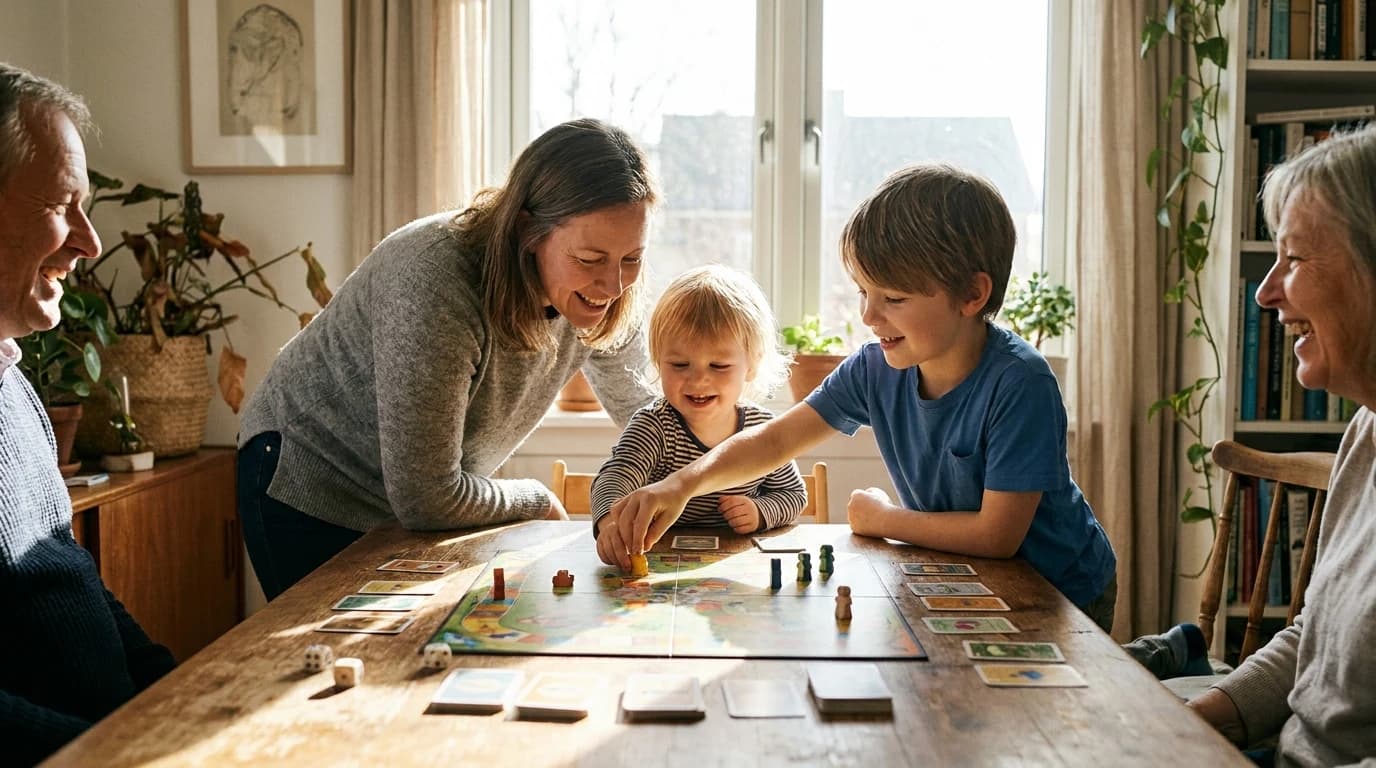
When everyone is working toward the same outcome, the question "is this fair given how different our ages are?" disappears — there's no head-to-head skill comparison to be unfair about. A preschooler and a grandparent can play the literal same cooperative game, with the adult narrating choices and the child making moves, and it works. For an older mixed-age table, a boxed escape room game erases the contest just as cleanly, since the puzzles get solved by whoever spots them.
Team-ups are the secret weapon
Even in a competitive game, you can pair players instead of balancing them individually: each team is one stronger player plus one learner. This is where the age gap pays off.
In a mixed-age pairing the older child naturally scaffolds the younger one — and that's not just nice for the little kid. Montessori educators describe the arc in three steps:
- Watch it — the child observes the skill in use
- Do it — the child practices it themselves
- Teach it — the child truly owns it by explaining it to someone else
The older sibling explaining why you'd save that card or block that route is consolidating their own understanding while widening the younger one's reach.
Worth knowing: the American Academy of Pediatrics, in its Power of Play guidance, calls shared cooperative play "great opportunities to encourage sharing and cooperative play" — turn-taking and social-emotional skills come with the format, not the title.
Team board games turn an evening into low-stakes practice at negotiating, waiting, and reading another person's plan.
How to pick a game that flexes
Some games balance across ages far better than others. Look for these traits when you want one game to serve a 5-year-old and a 12-year-old at once:
- A short, real decision each turn rather than long planning chains. Younger kids stay in it; older kids still have something to chew on.
- Hidden-but-simple goals (collect a set, reach a spot) that an adult can keep secret for a learner without rewriting rules.
- A natural co-op or team mode, or one that's trivial to invent (everyone vs. a timer, everyone vs. the board).
- Components a non-reader can handle — icons over text, chunky pieces, color-matching.
- A short game length. A 20-minute game you play three times beats a 90-minute slog where the youngest taps out at minute 15.
The best mixed-age game is usually one you already own
Avoid the trap of buying a brand-new "family" game for every gathering. The best mixed-age game is usually one you already own that you've learned to flex with the levers above.
What most people get wrong
Fairness is not equal odds
What actually keeps everyone engaged:
- Each player sitting in their own zone of proximal development
- Support where a player falls short, removed as they grow
- A real role in a real game, with a coach beside them
What parents engineer instead, and shouldn't:
- Secretly tilting the game so everyone has the same chance of winning
- Rigging a five-year-old a shot at beating a teenager
- Treating the older kid's evening as time "wasted" playing down
The research doesn't support equal odds as the goal. What drives engagement and learning is a little stretch, supported. The satisfaction a young player is after is doing more this month than they could last month — not a manufactured win.
The other myth: that the older kid is "wasting" their evening. They aren't, if you give them the teaching job. Coaching a younger sibling through a game is one of the most efficient ways to deepen a skill you already have. The age gap isn't the problem to engineer around. It's the resource.
Sources
- University of Florida, Anita Zucker Center for Excellence in Early Childhood Studies — Z is for Zone of Proximal Development (identifying the band just beyond a child's independent skill; scaffolding "one or two steps ahead," then removing support).
- Treehouse Learning — Ways of Learning: Mixed-Age Classrooms (Montessori mixed-age grouping; "watch it, do it, teach it"; older children widen a younger child's ZPD through scaffolded help).
- American Academy of Pediatrics, HealthyChildren.org — The Power of Play: How Fun and Games Help Children Thrive (cooperative and shared play builds turn-taking, sharing, and social-emotional skills).
Your next step
Need a game the whole table can play? These scale across ages.
Common questions
What's the best single board game for a really wide age range?
Is it cheating to give a younger kid hints or an open hand?
How do I keep the older kid from being bored playing 'down'?
My kids melt down when they lose — does that change the approach?
Research Sources
- University of Florida, Anita Zucker Center for Excellence in Early Childhood Studies — Z is for Zone of Proximal Development (identify a skill one or two steps ahead of independent ability; scaffold it, then remove support as the child becomes fluent)
- Treehouse Learning — Ways of Learning: Mixed-Age Classrooms (Montessori mixed-age grouping; 'watch it, do it, teach it'; the more skilled child widens the novice's zone of proximal development through scaffolded help)
- American Academy of Pediatrics, HealthyChildren.org — The Power of Play: How Fun and Games Help Children Thrive (shared, cooperative play builds turn-taking, sharing, and social-emotional skills)