Key takeaways
- The thrill is built, not random — mystery packs run on a variable-ratio reinforcement schedule, the same unpredictable-reward system casinos use, so "I'll stop after one" is the hardest promise to keep.
- Budget beats banning: give your kid a fixed amount that's genuinely theirs to spend so each pack trades off against something else they want.
- Name the trick out loud — telling a kid these products are designed to make them want another one measurably weakens the pull.
- Watch the spend pattern, not the hobby. Collecting is fine; open-ended, escalating, "I need the rare one" spending is the part to manage.
On this page
The honest answer up top
Blind boxes, mystery plush, and foil card packs aren't a discipline problem — they're a design problem. The fun isn't an accident; it's engineered with the same reward mechanic slot machines use.
So the fix isn't "say no to all of it." It's to put the spending inside a fixed budget your kid controls, name the trick out loud so it loses its grip, and treat the collection like a hobby with a ceiling instead of a faucet with no handle. The point isn't to kill the joy of opening a pack — it's to keep a fine hobby from quietly becoming an open-ended bill, and to use it as a rare, low-stakes chance to teach how "just one more" actually works.
Key takeaways
- The thrill is built, not random. Mystery packs run on a variable-ratio reinforcement schedule — the exact unpredictable-reward system casinos use — so "I'll stop after one" is the hardest promise in the world to keep.
- Budget beats banning. The single most effective guardrail is giving your kid a fixed amount that's genuinely theirs to spend, so each pack trades off against something else they want.
- Name the trick. Saying "this is designed to make you want another one" out loud measurably weakens the pull — kids who understand the mechanic resist it better than kids who are just told no.
- It's the spend pattern, not the hobby. Collecting is fine. Open-ended, escalating, "I need the rare one" spending is the part to watch.
Why "just one more" is so hard to resist
Here's the part most parents miss: the urge isn't weak willpower. Mystery products are deliberately built to be hard to stop.
The mechanic has a name
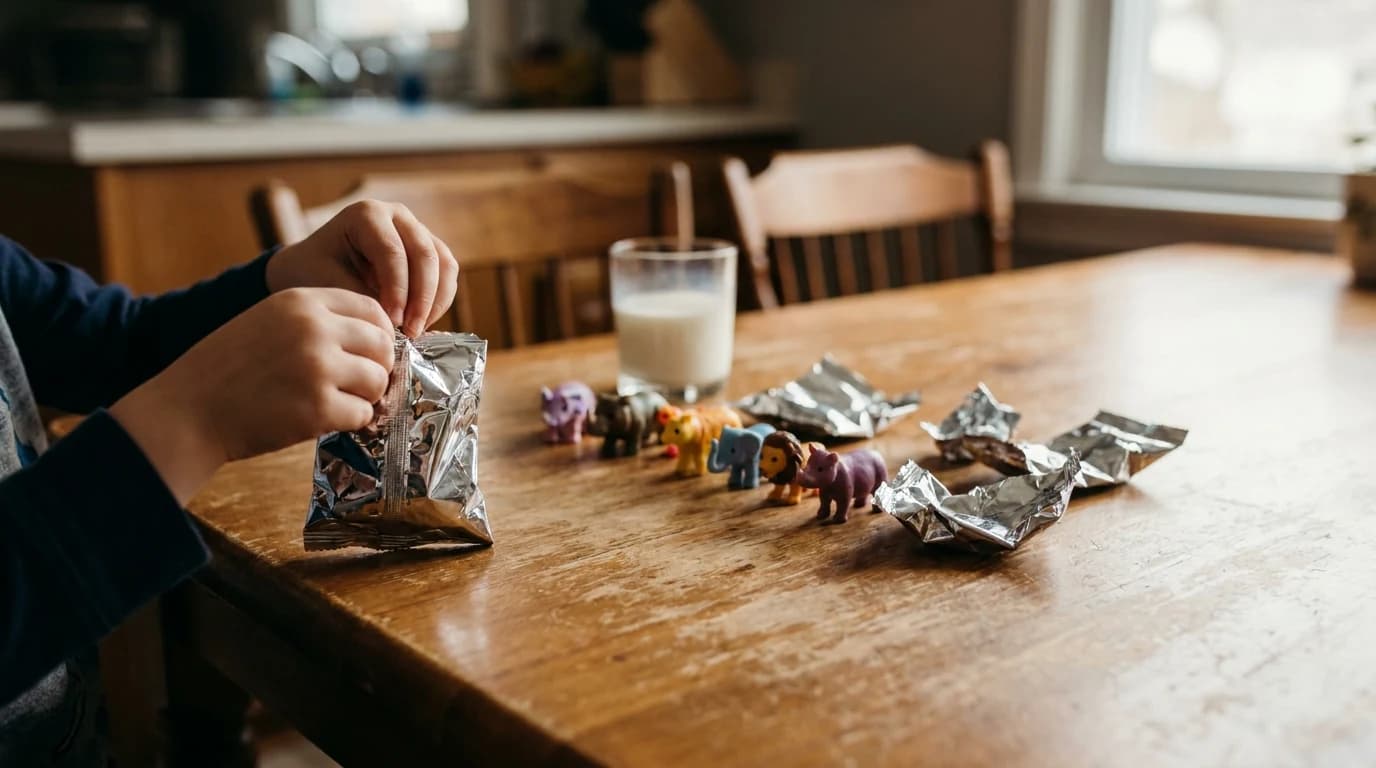
A loot box — and a physical blind box or foil card pack works identically — is, in the words of one addiction psychiatrist, essentially a "digital slot machine": real money for a random chance at a prize, no skill, just luck. The engine underneath is what psychologists call a variable-ratio reinforcement schedule — rewards arrive unpredictably, and that unpredictability is exactly what keeps a brain chasing the next attempt. As Northwell Health's director of addiction psychiatry puts it: "the uncertainty makes your brain crave more attempts."
That uncertainty triggers a dopamine response — the same spike tied to gambling — and children's developing brains are more susceptible to the conditioning: pairing spending with a randomized reward teaches the brain to link risk-taking with pleasure.
This is why "set a limit and stick to it" fails on the first try: the product is engineered to defeat that exact plan. Knowing that changes the approach — you're not correcting a character flaw, you're outmaneuvering a design.
What the research does not say: that every kid who opens a blind box is headed for a gambling problem. Most aren't. The honest, narrower claim is that the mechanic mimics gambling closely enough to be worth managing while a brain is still wiring up. Panic isn't the response — structure is.
The spending traps that quietly inflate the bill
The bill rarely balloons in one purchase — it creeps, through a few predictable moves. Here's what's happening and the one-line counter for each.
| The trap | What's really going on | Your counter |
|---|---|---|
| "It's only $5" | Small unit price hides the total — ten $5 packs is a $50 habit nobody decided to start | Track the monthly total, not the per-pack price |
| Hidden odds | The rare item you're chasing may be 1-in-100+; the odds usually aren't shown at the point of sale | Look up the published pull rates before chasing a "chase" item |
| The near-miss | "So close to the rare one!" feels like progress — it isn't, but the brain treats it as a reason to keep going | Name it: a near-miss is a miss |
| Restock urgency | "Limited," "exclusive," and "while supplies last" manufacture a fake now-or-never | There is almost always another wave; waiting costs nothing |
| The secondary market | Reselling or buying singles turns a toy into a speculative asset with no price ceiling | Decide upfront: playing or investing — don't blur them |
The FTC's review of these products flagged the core issue precisely: rewards "of little value" and packs that "don't clearly disclose the odds." When the odds are hidden, a kid can't make a real decision — which is exactly why the dollar guardrail has to come from you.
The guardrails that actually work
Skip the lecture. Build a structure that makes the limit automatic.
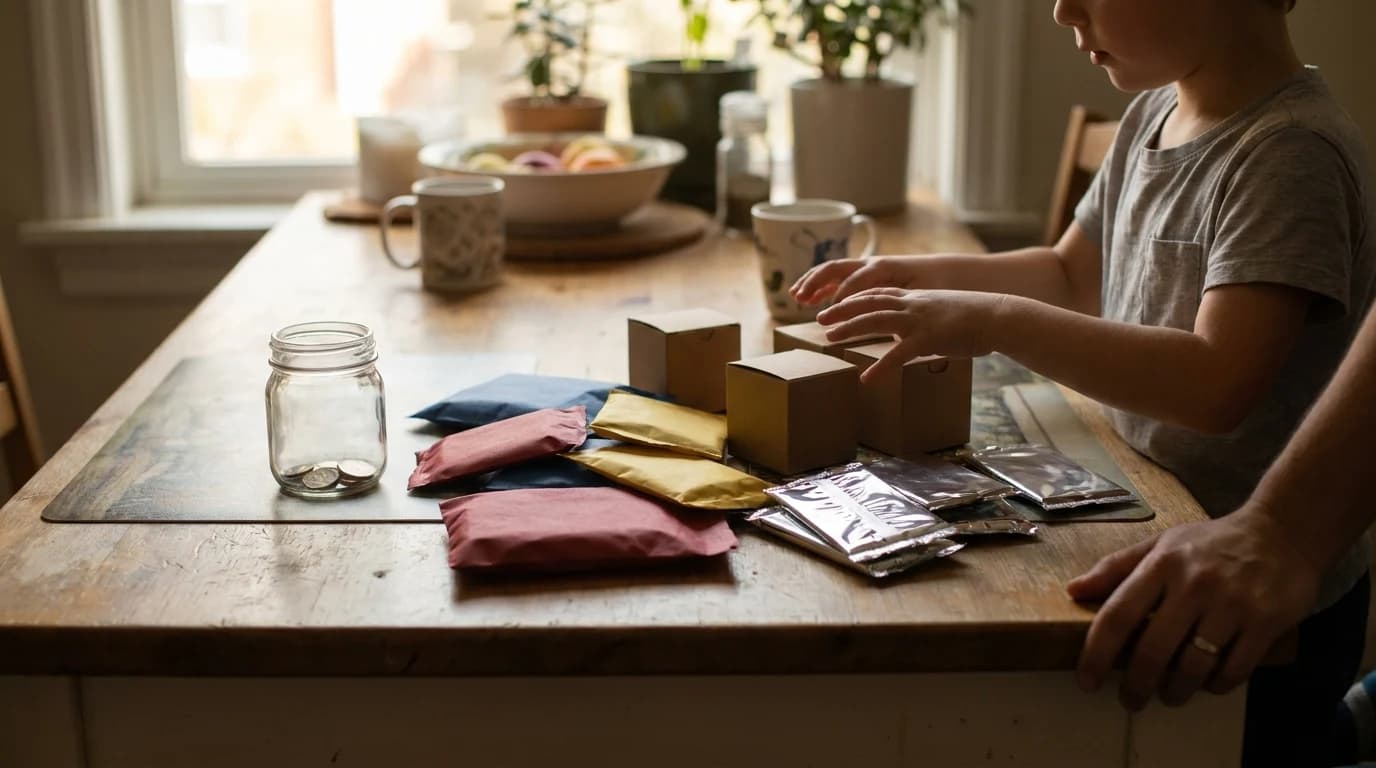
- Make the money genuinely theirs. The American Academy of Pediatrics is direct: let kids manage their own "spend" money, because "with limited funds, they will need to make choices." A pack bought with your card is free to the kid; one bought from their allowance forces a real trade-off.
- Use the save / spend / share split. AAP's framework gives every dollar a job, and mystery packs come out of "spend" only — when that bucket is empty, it's empty.
- Set an approval threshold. AAP suggests establishing "what size purchase requires your approval before buying." Singles, cases, or chase-item hunts above a set amount get a conversation first; below it, their call.
- Have the one conversation that matters. The most effective move costs nothing: explain the trick.
The three buckets, made visible
- Save — toward a real goal
- Spend — their call, and where mystery packs come from
- Share — for others
Jars or labeled envelopes make the ceiling visible to a young kid.
The script that does the work
Northwell's age-appropriate approach is to describe these as "mystery boxes" that cost money for a random reward, then ask the question that does the work — "Would you spend your allowance on something if you didn't know exactly what you'd get?"
Why naming it works: calling the unpredictability a deliberate marketing tactic, rather than a fun feature, hands the kid the same lens you have.
When it's just a hobby — and when to look closer
Collecting is genuinely good for kids: it builds focus, organizing, trading, and pride in a finished set. Most blind-box enthusiasm is a normal phase that burns bright and fades.
Signs it's a healthy hobby:
- The spend holds steady month to month
- A duplicate gets a shrug
- They talk about the ones they have
Signs it's shifted to chasing:
- The spend is climbing month over month, not holding steady.
- A common pull or duplicate triggers real distress, not a shrug.
- They're dipping into money meant for other things, or asking for advances.
- The talk is always about the rare one they don't have, rarely the ones they do.
If a couple of those are true, you don't need a ban — you need a tighter budget and a reset conversation. That's exactly what AAP means by removing the cycle of instant gratification: it makes a kid pause and ask whether they want the thing, or just want it because it's in front of them.
A simple monthly system
Make it boring and automatic, and the willpower battle mostly disappears:
- Set a monthly "mystery" line inside the spend bucket — one fixed number, agreed in advance.
- One purchase event, not a stream — buy on a set day, so it's a small ritual instead of a constant impulse.
- Log the total, not the unit — a tally on the fridge makes the real number visible.
- Cap the chase — once the line is spent, the answer is "next month," every time. (Exceptions are how the line stops meaning anything.)
- Celebrate the set, not the next pull — display what they have, so a collection they're proud of competes with the one they don't.
None of this demonizes a toy your kid loves. It just puts a handle back on the faucet — and teaches the most useful money lesson there is: the thrill of "one more" is exactly the moment to stop and decide on purpose.
Sources
- American Academy of Pediatrics, HealthyChildren.org — Kids & Money: Help Your Child Learn Good Financial Habits (the save/spend/share framework; letting kids manage their own spend money; approval thresholds; removing the instant-gratification cycle).
- Northwell Health, The Well — Are Loot Boxes Teaching Kids To Gamble? (variable-ratio reinforcement schedule; "digital slot machines"; dopamine response; developing-brain susceptibility; the age-appropriate conversation script).
- U.S. Federal Trade Commission — Loot boxes: What's in play? (randomized paid rewards; undisclosed odds; concern over kids' understanding of cost; ESRB's random-purchase disclosure).
Your next step
Channel the collecting itch into something display-worthy.
Common questions
Are physical blind boxes really the same as video-game loot boxes?
Should I just ban blind boxes and mystery packs entirely?
How much should a kid be allowed to spend on this?
When does collecting cross into a problem?
What's the single most effective thing I can do?
Research Sources
- American Academy of Pediatrics, HealthyChildren.org — Kids & Money: Help Your Child Learn Good Financial Habits (save/spend/share framework; letting kids manage their own spend money; "establish ground rules, like what size purchase requires your approval before buying"; allowances "removing the cycle of instant gratification")
- Northwell Health, The Well — Are Loot Boxes Teaching Kids To Gamble? (loot/blind boxes as "digital slot machines"; variable-ratio reinforcement schedule; dopamine response; developing brains "particularly susceptible"; age-appropriate conversation script)
- U.S. Federal Trade Commission — Loot boxes: What's in play? ("randomized virtual items that players can buy or earn"; rewards "of little value" and packs that "don't clearly disclose the odds"; concern about kids understanding the cost; ESRB random-purchase disclosure)