Key takeaways
- The two toy hazards that most often lead to surgery are not choking risks: they are button (coin) cell batteries and high-powered rare-earth magnets, and both can pass the choking-size test.
- The CPSC warns a swallowed button battery can burn through a child's throat or esophagus in as little as two hours, because saliva completes a circuit that burns tissue chemically, not mechanically.
- Two or more swallowed magnets pull together across the wall of the intestine and pinch the tissue; the AAP urges families with young children not to keep high-powered magnet sets in the home at all.
- Reese's Law (batteries) and the October 2022 federal magnet standard only govern newly sold products; older non-compliant toys and magnet sets in homes and hand-me-down bins are not covered.
On this page
Quick Answer
When parents check a toy for safety, the instinct is to check whether a piece is small enough to choke on. That matters — but the two hazards that actually send kids to surgery are not about size. They are button (coin) batteries and high-powered "rare-earth" magnets, and both can pass the choking-size test while being far more dangerous than anything they could simply choke on.
The habit to change: the question is not "is it too small?" It is "does it contain a loose battery or loose magnets, and is that compartment locked shut?"
A swallowed button battery can burn through a child's esophagus in as little as two hours, according to the U.S. Consumer Product Safety Commission (CPSC). Two or more swallowed magnets pull together through the wall of the intestine and can require surgery.
The two hazards that don't care about size
Most published toy-safety advice leads with choking, and choking is real. But the CPSC singles out batteries and magnets as the injuries that are increasing, serious, and sometimes fatal — and the danger doesn't scale with how big the piece is.
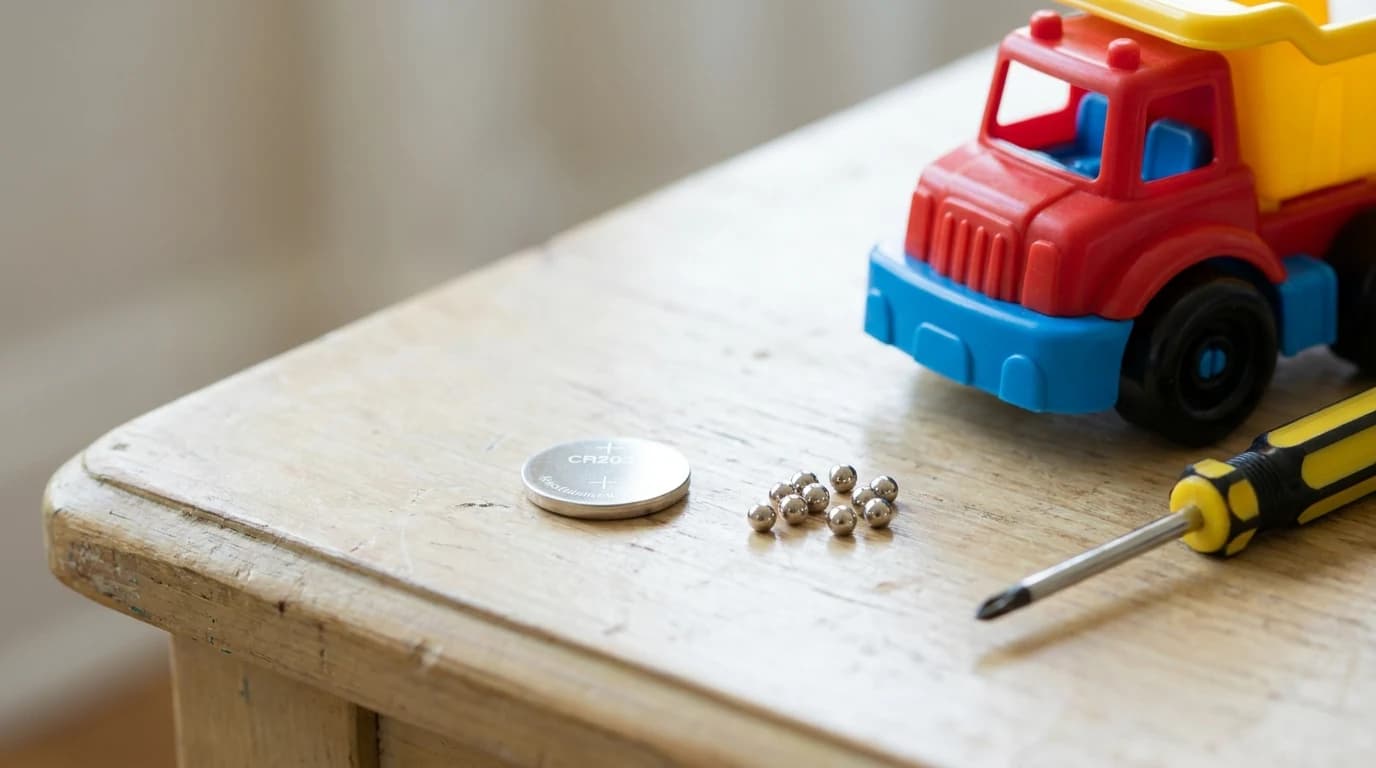
Button and coin cell batteries: the damage is chemical, not mechanical
These are the shiny silver discs hiding in ordinary household items:
- Remotes and key fobs
- Light-up toys and musical books
- Flameless candles
- Singing greeting cards
The CPSC is blunt: they are "associated with thousands of emergency department visits every year," and "a button cell battery can burn through a child's throat or esophagus in as little as two hours if swallowed."
The damage is chemical, not mechanical — saliva completes a circuit and generates a current that burns tissue, so it keeps causing harm even after the battery is "just sitting there."
High-powered magnets: two is the dangerous number
These are the small, intensely strong balls and cubes sold in sets of 100 or more (often marketed as "desk toys"), plus magnets hidden in some building toys and reusable water balloons. The CPSC notes they can be "up to eight times stronger than magnets that are used in toys."
Swallow one and it usually passes. Swallow two — or one magnet plus a metal object — and they snap together across loops of bowel, pinching the tissue between them until it dies.
The AAP's position: the American Academy of Pediatrics urges families with young children not to keep high-powered magnet sets in the home at all.
What most people get wrong
The common mental model is a ranking: choking is the scary one, and a battery or a couple of magnets feel minor by comparison because they're tiny and "they'll just pass."
That's the trap. A coin battery and a pair of magnets will often clear the airway and the choking-size test — and that is exactly why they're underestimated. The harm is delayed and internal.
The CPSC even warns that on an X-ray, "multiple magnetic pieces may appear as a single object," so the danger can be missed at the worst moment. And the early symptoms of magnet ingestion the AAP lists — abdominal pain, vomiting, fever — are so ordinary that parents often don't connect them to a swallowed toy part right away.
So the right question isn't "could my child choke on this?" It's "could my child get a battery or a magnet out of this — and what happens internally if they swallow it?"
The regulations exist for a reason (and don't fully cover you)
Two recent rules tell you where the real risk has been:
| Rule | What it requires | Why it matters |
|---|---|---|
| Reese's Law (button/coin batteries) | Toys must hold these batteries behind a closure that needs a screwdriver, coin, or tool to open | The law followed a wave of child deaths and injuries; a secured compartment is the whole point |
| Federal magnet standard (Oct 2022) | Loose, separable magnets must be too large to swallow or too weak to cause internal injury | Followed an estimated 2,500 magnet ingestions treated in U.S. emergency departments in 2021 |
What the standards cover, and what they miss
Covered by the rules:
- Products sold new today, under current standards
- A brand-new compliant toy with a screwed-shut battery door
Not covered, and still in the house:
- Hand-me-downs and anything already in the toy bin
- Toys at grandma's
- Items imported through a marketplace
- The 2018 musical book in the toy chest, and the "desk magnets" in a drawer
The CPSC and AAP both note that older non-compliant magnet sets and unsecured-battery products are still in millions of homes.
A 60-second safety check for any toy or gift
You don't need to know the specific child to do this. Before wrapping anything, run it:
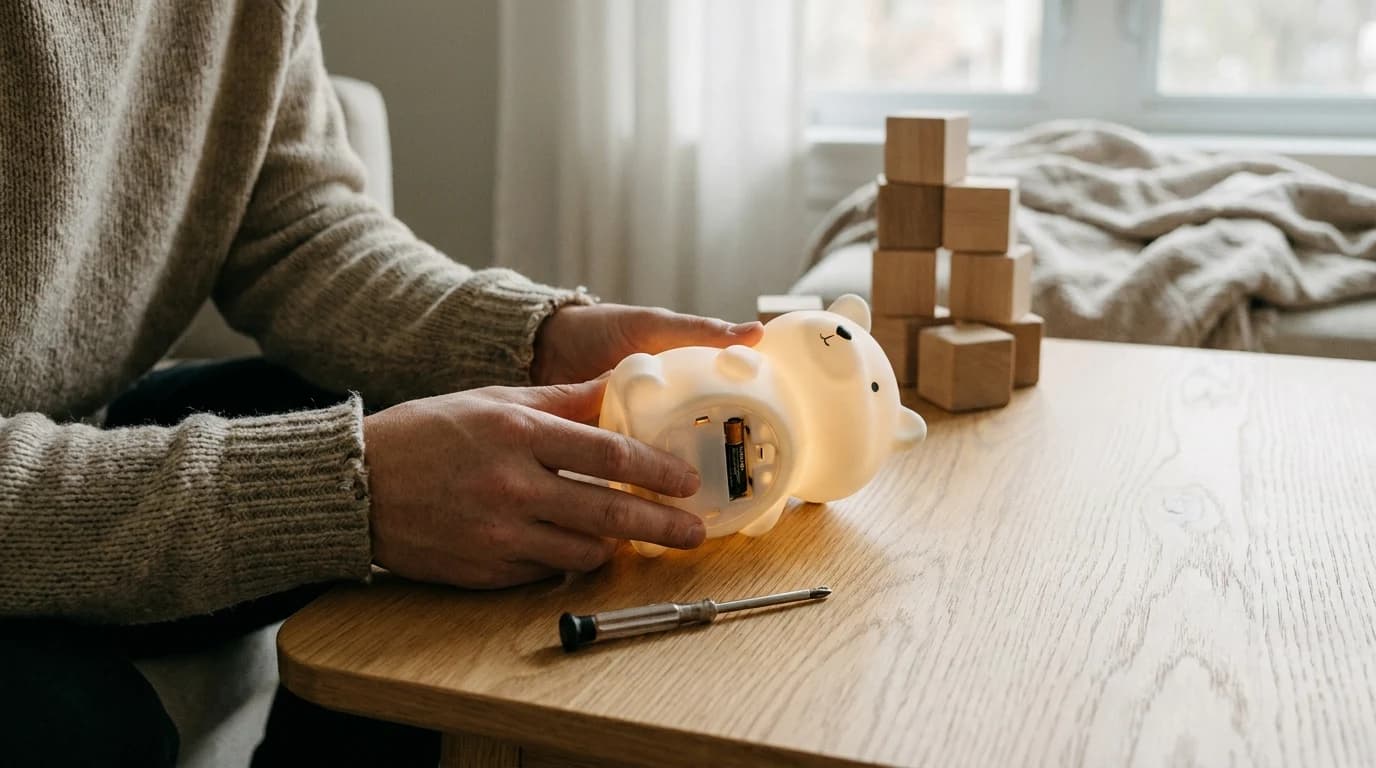
- Find the batteries. Any light, sound, or motion means a battery. If it's a button/coin cell, confirm the compartment needs a tool to open and the screw is actually there. If it pops open with a fingernail, it's not safe for a young child.
- Hunt for loose magnets. Be suspicious of "magnetic" building sets, magnetic dart/dress-up toys, fidget balls/cubes, and reusable water balloons. Check that magnets are sealed in and can't crack loose. The AAP's flat advice for homes with young kids: skip high-powered magnet sets entirely.
- Then do the choking check. The classic test still applies for under-3s: if a part fits through a toilet-paper tube (about 1.25 inches), it's a choking risk.
- Match the age label. A "3+" toy isn't snobbery — it usually signals small parts, batteries, or magnets unsafe for a younger sibling who shares the floor.
- Store the dangerous stuff locked and high. For batteries and any magnets you do keep, the CPSC recommends a locked container out of reach — not a kitchen drawer.
If it happens anyway
Speed beats everything here. If you think a child swallowed a button battery or magnets:
- Go to the emergency room immediately — don't wait for symptoms.
- Call the National Battery Ingestion Hotline at 800-498-8666 (or Poison Help at 800-222-1222) on the way.
For button batteries specifically, the National Capital Poison Center's protocol (echoed by the CPSC) is to give honey to children 12 months and older en route — 10 mL every 10 minutes, up to six doses — but only if it doesn't delay getting to the ER. For magnets, the AAP warns plainly that putting off treatment can lead to severe damage to the stomach and intestines.
None of this is a reason to fear toys. It's a reason to change the order of the checklist. Choking-size first is the habit most of us have. Batteries-and-magnets first is the one that matches where children actually get hurt.
Your next step
Ready to choose a gift instead? Here is where our research goes deepest.
Common questions
Why are button batteries and magnets more dangerous than choking-size parts?
How do I know if a toy's battery compartment is safe?
Are magnetic building toys safe for kids?
What should I do if my child swallows a button battery or magnets?
Research Sources
- U.S. Consumer Product Safety Commission - Button Cell and Coin Batteries Information Center (two-hour esophageal burn, secure-closure requirement, honey protocol, ingestion hotline)
- American Academy of Pediatrics (HealthyChildren.org) - How High-Powered Magnetic Toys Can Harm Children (rare-earth magnets, ~2,500 ER ingestions in 2021, October 2022 standard, AAP guidance to remove magnet sets)
- U.S. Consumer Product Safety Commission - Magnets Safety Education Center (high-powered magnets up to eight times stronger than toy magnets; multiple magnets may appear as one object on X-ray; surgery to remove)
- U.S. Consumer Product Safety Commission - Reese's Law Leads to New Federal Mandatory Safety Standard for Button Cell or Coin Batteries (2023)