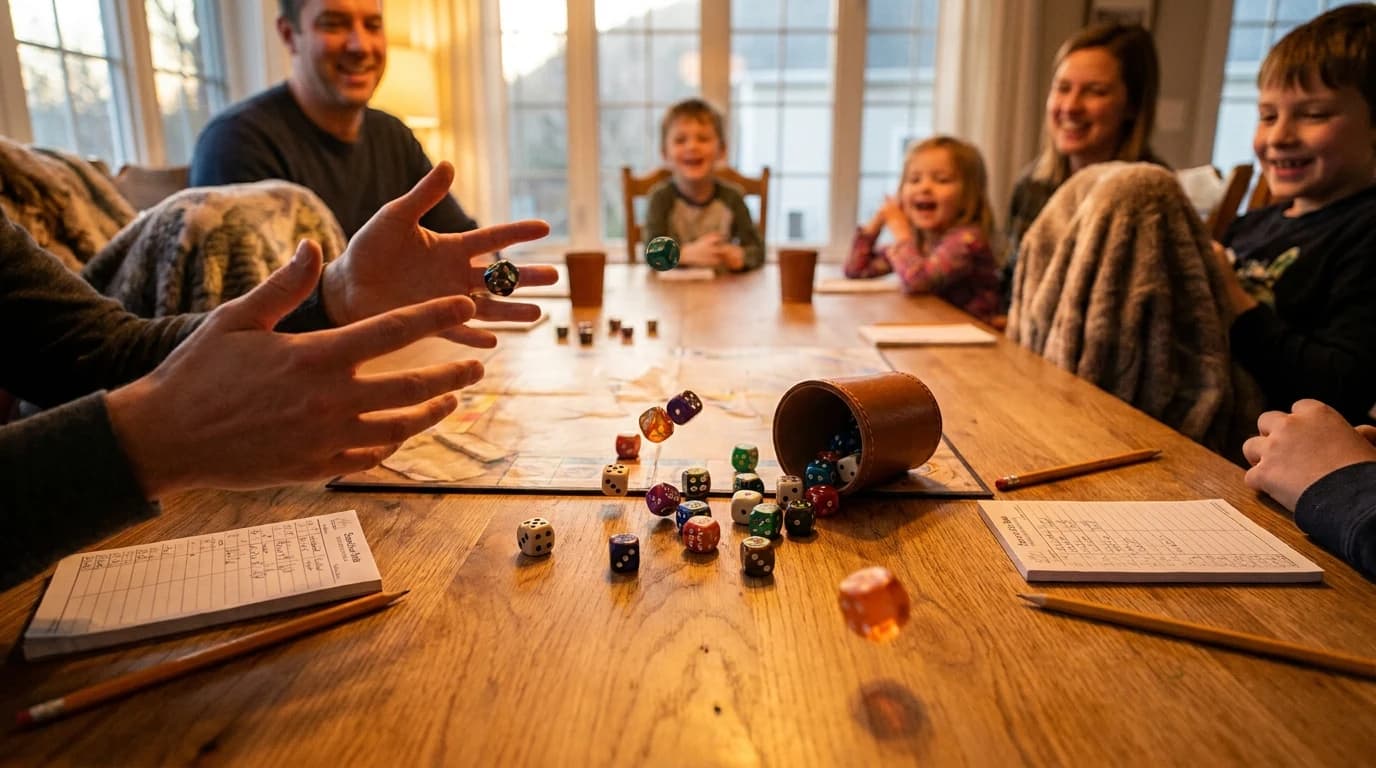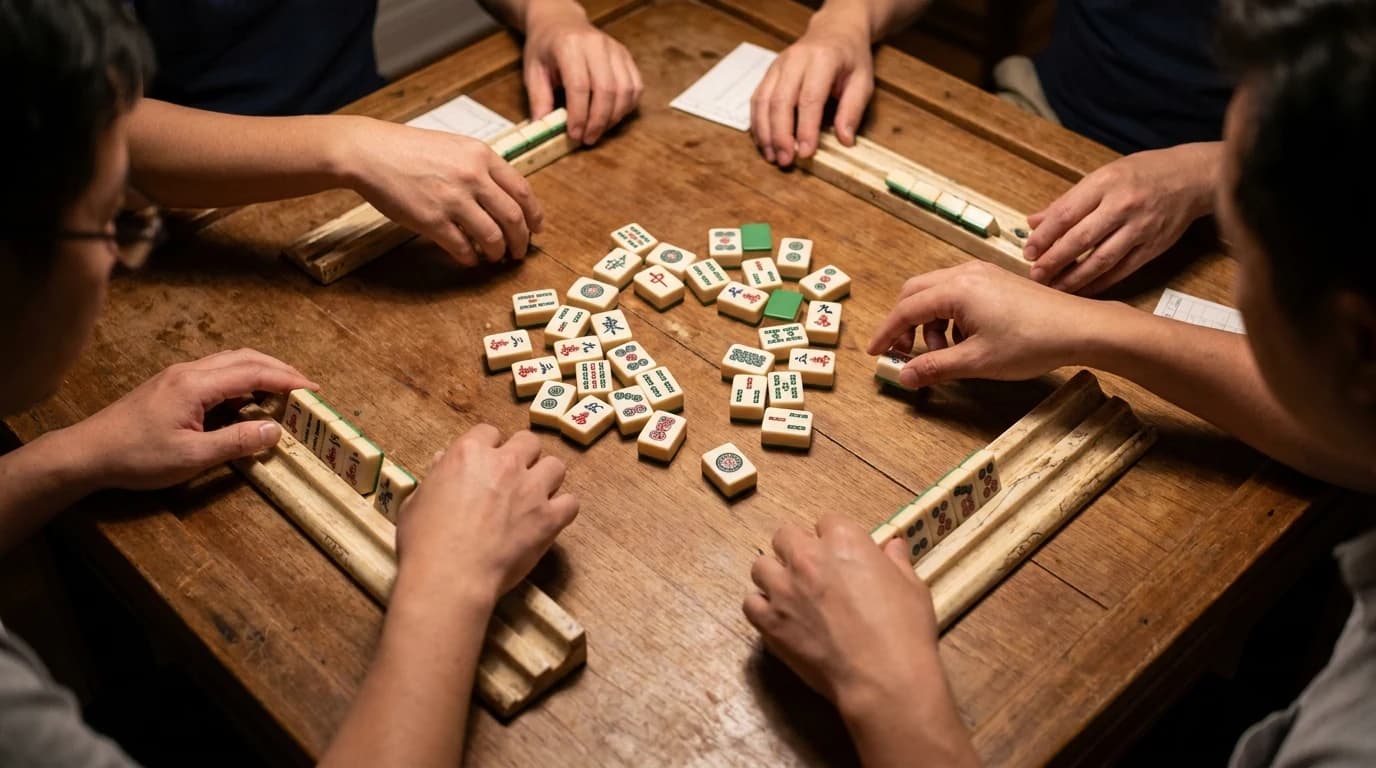
Quick Answer
Roll six dice, set aside at least one scoring die (single 1s are 100, single 5s are 50, three of a kind scores 100 times the face), then bank your running total or roll the rest. A roll with nothing scoring is a Farkle and wipes the turn. First to 10,000 triggers a last turn for everyone else. Agree on a scoring table first: published rules disagree on three 1s, straights and three pairs.
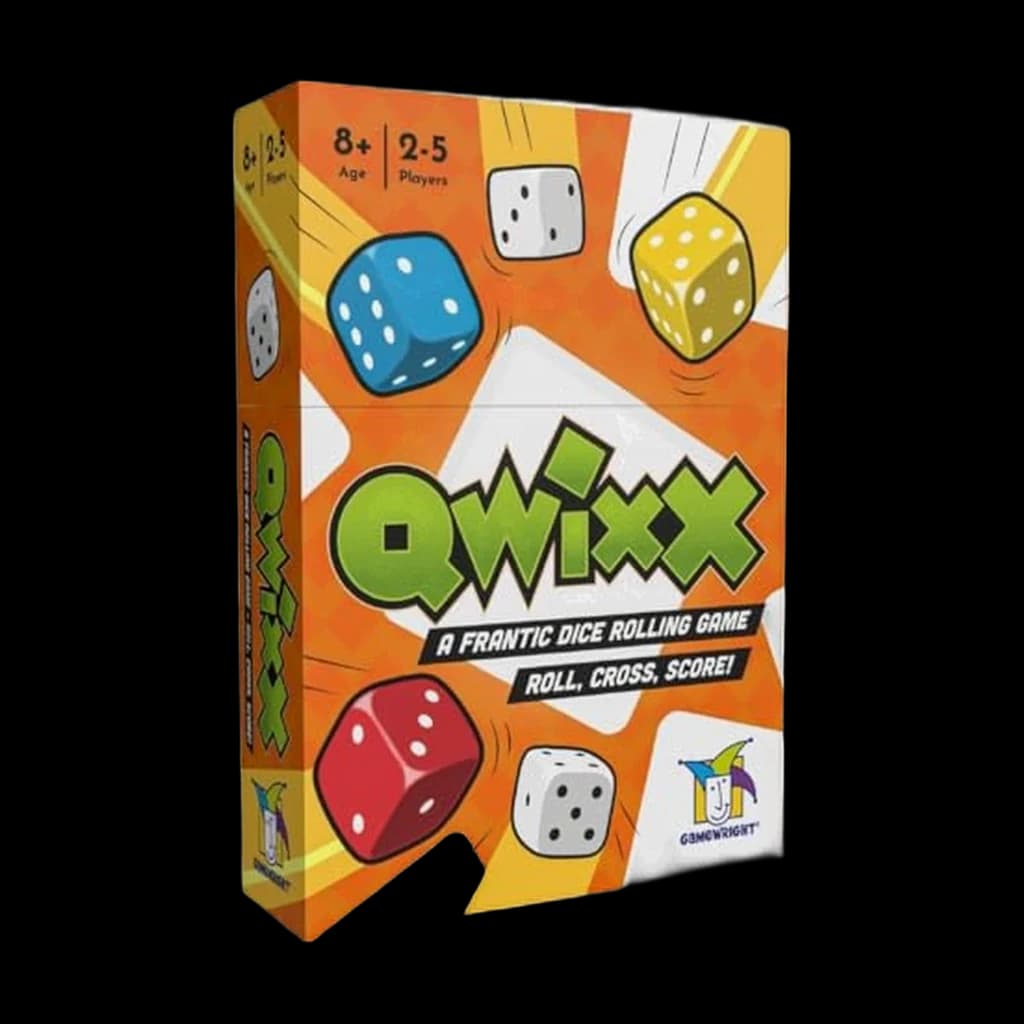
Gamewright Qwixx Fast Family Dice Game$11.99
Best for: Farkle fans who want zero downtime
Key takeaways
- PlayMonster's boxed rules score three 1s at 300, while the Wikipedia base table, freethedice and Smart Box Design all score them at 1,000.
- A 1-6 straight is worth 1,000, 1,500, 2,500 or 3,000 depending on the rule set, so settle it before the first roll.
- Dice from different rolls never combine: a 5 kept on one roll plus two 5s on the next is 150, not 500.
- Under the boxed rules your first banked score must be at least 500, and banked points can never be lost.
On this page
Side-by-side comparison
The pick for a Farkle table that wants something new: the same six-dice, roll-and-mark rhythm, but every player can score off every roll, so nobody waits through a long push-your-luck turn.
- Players
- 2-5
- Time
- 15 minutes
- Ages
- 8+
- Format
- Modern designer dice game
Best evidence
Every player participates on every roll - no waiting for your turn
Main trade-off
Score pad refills run out faster than expected with regular play
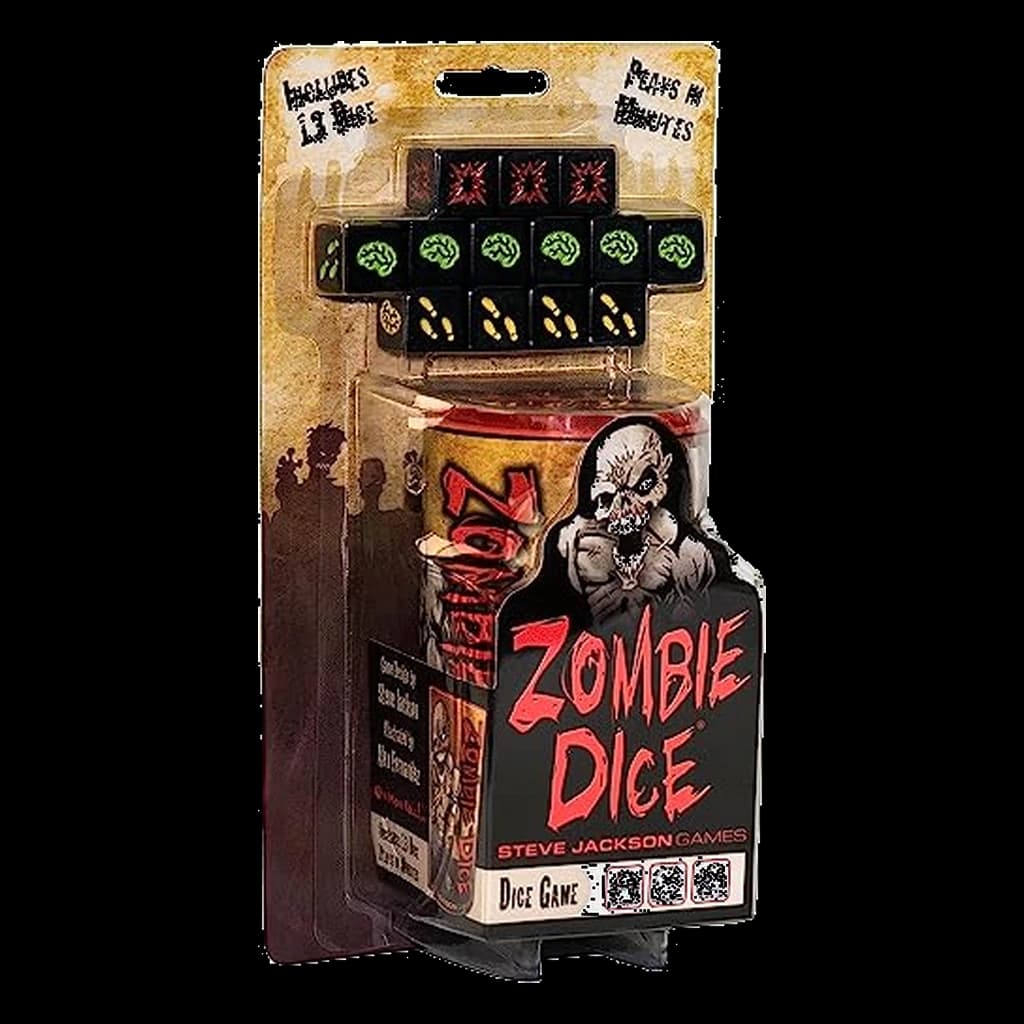
The closest cousin to Farkle's core decision. Each turn is the same stop-or-keep-rolling gamble, with custom dice instead of a scoring table to argue about.
- Players
- 2+
- Time
- 10-20 minutes
- Ages
- 10+
- Format
- Press-your-luck party dice
Best evidence
Decisions matter - press your luck mechanic creates real table tension
Main trade-off
Zombie theme can feel dated at this point
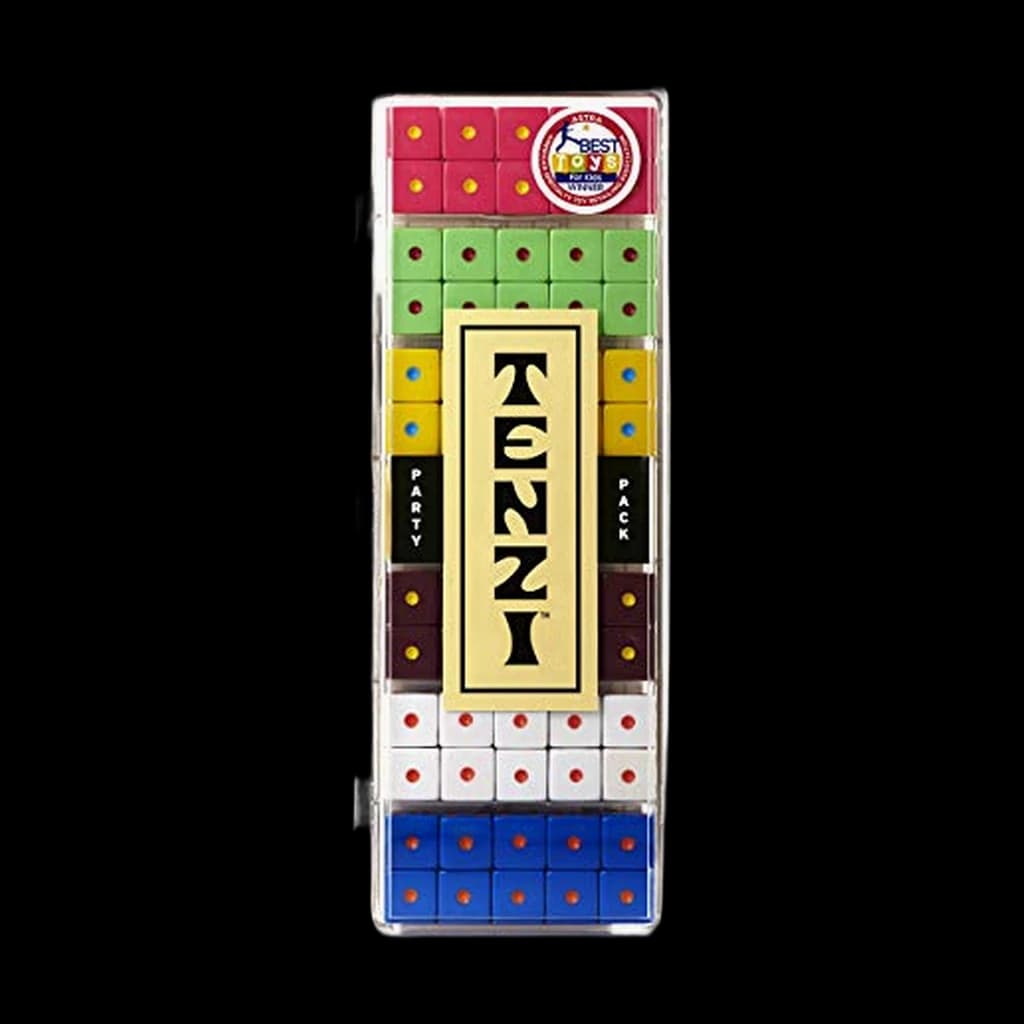
For big, loud tables where a Farkle turn feels too slow: everyone rolls at once and the first to match all ten dice wins, so there is no downtime at all.
- Players
- 1-6
- Time
- 2-5 minutes per round
- Ages
- 7+
- Format
- Party speed dice
Best evidence
Zero learning curve - explainable in 15 seconds, playable by ages 6 to 96
Main trade-off
Pure speed-and-luck mechanic offers little long-term strategic depth
* Prices are approximate. Tap Buy to see current pricing on Amazon.
| Comparison field | #1Gamewright Qwixx Fast Family Dice Game Owner rating | #2Steve Jackson Games Zombie Dice Owner rating | #3TENZI Party Pack Dice Game (6 Sets of 10 Colored Dice) Owner rating |
|---|---|---|---|
 |  |  | |
| CurioRank | |||
| Verdict | The pick for a Farkle table that wants something new: the same six-dice, roll-and-mark rhythm, but every player can score off every roll, so nobody waits through a long push-your-luck turn. | The closest cousin to Farkle's core decision. Each turn is the same stop-or-keep-rolling gamble, with custom dice instead of a scoring table to argue about. | For big, loud tables where a Farkle turn feels too slow: everyone rolls at once and the first to match all ten dice wins, so there is no downtime at all. |
| Price | |||
| Players | 2-5 | 2+ | 1-6 |
| Time | 15 minutes | 10-20 minutes | 2-5 minutes per round |
| Ages | 8+ | 10+ | 7+ |
| Format | Modern designer dice game | Press-your-luck party dice | Party speed dice |
| Material | 6 dice, score pads | 13 custom dice, dice cup | 60 colored dice, storage case |
| Buyer sentiment | Ease of use Family-friendly Game speed Portability Buyers praise ease of use, family-friendly, game speed and portability. Based on 2,140 user mentions | Gameplay Ease of use Game speed Portability Buyers praise gameplay, ease of use, game speed and portability. Based on 1,725 user mentions | Gameplay Family-friendly Ease of use Game quality Buyers praise gameplay, family-friendly, ease of use and game quality. Based on 967 user mentions |
| Pros |
|
|
|
| Cons |
|
|
|
* Prices are approximate. Click Buy to see current pricing on Amazon.
Gamewright Qwixx Fast Family Dice Game
- Every player participates on every roll - no waiting for your turn
- 15-minute play time hits perfectly between filler and main event
- Mensa Select winner with genuine strategic decision space
If Farkle is a hit, Qwixx keeps the six-dice, roll-and-mark rhythm but lets every player score off every roll, so there is no waiting through someone else's long turn.
What you need: six standard six-sided dice, a pencil and a score pad. The boxed edition from PlayMonster ships exactly that: six dice, a shaker cup and a score pad. The goal: finish with the highest score over 10,000.
Farkle is a folk game, and Wikipedia notes that variant rules differ between playing communities. This guide teaches the turn from PlayMonster's boxed rules, then lines up four published scoring tables side by side so your table can pick one before the first roll.
Set up in under a minute
- Choose a scorekeeper. One person records every banked score.
- Pick the first player. Everyone rolls one die; the highest roll starts and play passes to the left.
- Agree on a scoring table. Use the comparison below. This step settles most arguments in advance.
Play a turn, step by step
- Roll all six dice.
- Set aside at least one scoring die. Single 1s and 5s score; other numbers score only as three or more of a kind, or in the bigger combinations below. PlayMonster requires at least one die removed after every roll.
- Add it to your running total, then choose: bank the total, or roll the dice you have left.
- Farkle if nothing scores. If a roll shows no scoring dice, you lose the running total for that turn and pass the dice. It can happen on your very first roll.
- Use hot dice. Set aside all six and you may pick them all up and keep building the same running total.
The rule people forget: dice from different rolls never combine. A 5 set aside on one roll plus two 5s on the next is 150 points, not three 5s for 500.
Getting on the board
Under PlayMonster's rules, your first banked score must be at least 500. After that you can stop whenever you like, and banked points are safe for the rest of the game.
Ending the game
When someone's banked total reaches 10,000 or more, each other player gets one last turn to beat it, and the highest score wins. Freethedice's printable rules phrase it as finishing the round so everyone has the same number of turns.
Farkle scoring: four rule sets compared
Every number below comes from that source's own table. "Not listed" means the rule set does not score that combination in its base rules.
| Combination | PlayMonster box | Wikipedia base table | Freethedice | Smart Box Design |
|---|---|---|---|---|
| Single 1 | 100 | 100 | 100 | 100 |
| Single 5 | 50 | 50 | 50 | 50 |
| Three 1s | 300 | 1,000 | 1,000 | 1,000 |
| Three 2s to 6s | 100 × face | 100 × face | 100 × face | 100 × face |
| Four of a kind | 1,000 | 1,000 | Optional rule | Not listed |
| Five of a kind | 2,000 | 2,000 | Optional rule | Not listed |
| Six of a kind | 3,000 | 3,000 | Optional rule | Not listed |
| 1–6 straight | 1,500 | 2,500 ("run") | 3,000 | 1,000 |
| Three pairs | 1,500 | 1,500 | 1,500 | 500 |
| Four of a kind + pair | 1,500 | Not listed | Not listed | Not listed |
| Two triplets | 2,500 | Not listed | Not listed | Not listed |
| Opening threshold | 500 | Variant | Optional 500 | Not listed |
| Three farkles in a row | Not listed | Variant | Optional −1,000 | −1,000 |
Freethedice scores four, five and six of a kind only through optional rules that multiply the triple score.
Sources: PlayMonster rules PDF, Wikipedia's base table from Arnold's Playing Grandma's Games, freethedice.com rules PDF, Smart Box Design rules.
Pick one rule set before you roll. The four tables agree on single 1s, single 5s and triples of 2s through 6s. They split on three 1s, the straight and three pairs. A straight alone is worth anywhere from 1,000 to 3,000 depending on whose sheet you learned from. When two players disagree about a score, they are usually both reading a real table, just not the same one.
PlayMonster's 300 for three 1s is not a misprint. Wikipedia records that the commercial Pocket Farkel scores three ones at 300 rather than 1,000, and freethedice lists the same value as an optional "Pocket Farkle" rule. If you own the box, that is the rule printed inside it.
Two worked turns
One roll, two answers
You roll 1, 1, 1, 2, 4, 5 and keep the three 1s plus the 5:
- PlayMonster: 300 + 50 = 350
- Wikipedia base, freethedice or Smart Box: 1,000 + 50 = 1,050
Same dice, a 700-point gap. That is the whole case for agreeing on a table first.
A full turn with hot dice
This one follows the sample in PlayMonster's rules:
| Roll | Dice rolled | Kept | Running total |
|---|---|---|---|
| 1 | Six | One 5 (50) | 50 |
| 2 | Five | One 1 (100) + three 4s (400) | 550 |
| 3 | One | A 1 (100), now hot dice | 650 |
| 4 | Six | Three 3s (300), then stop | 950 banked |
Roll 3 is the gamble. With one die left, Wikipedia puts the odds of rolling a 1 or 5 at 1 in 3. Two times in three you farkle and lose the 550.
House variants worth naming out loud
- Opening threshold: 500 is common; Wikipedia also lists 1,000.
- Three-farkle penalty: −500 or −1,000, while the boxed rules list none.
- Forced hot-dice roll: some groups make you roll all six at least once after hot dice.
- No-score opening roll: freethedice's optional "Nobody Loses" rule turns a scoreless first roll into 300.
If your table likes Farkle
Farkle needs only the six dice you already own. If the group enjoys push-your-luck scoring, Zombie Dice runs on the same "stop or keep rolling" tension. Qwixx keeps everyone scoring on every roll, and TENZI Party Pack suits a big, loud table. The full field is in our dice games beyond Yahtzee roundup and the dice games category. For more rules walk-throughs, see how to play mancala and how to play American mahjong.
Common questions
What are hot dice in Farkle?
Can you Farkle on your first roll?
Do you have to keep every scoring die?
Can you add dice from different rolls together?
How many points do you need to get on the board?
Is there a penalty for three Farkles in a row?
Research Sources
- PlayMonster — Farkle official rules PDF (contents, turn rules, 500 opening score, scoring table, sample roll)
- Wikipedia — Farkle (base scoring table from Arnold's Playing Grandma's Games, scoring and play variations)
- freethedice.com — printable Farkle rules PDF (scoring combinations and optional rules)
- Smart Box Design — Farkle rules (three pairs 500, six-dice straight 1,000, three Farkles lose 1,000)