Quick Answer
To play Kalah mancala, put four stones in each small pit. Sow one at a time counterclockwise, using your store and skipping theirs. End in your store to move again; end in your empty pit opposite stones to capture them. When one side empties, sweep the other side into its owner’s store. Most stones wins.
AMEROUS Upgraded Wooden Mancala (Folding Board + Glass Stones)$26.99
Best for: Playing the rules in this guide
Key takeaways
- This guide teaches Kalah: two rows of six pits, four stones per pit, 48 total.
- Only the last stone decides an extra move or capture.
- Agree on empty-opposite captures and the final sweep before playing.
On this page
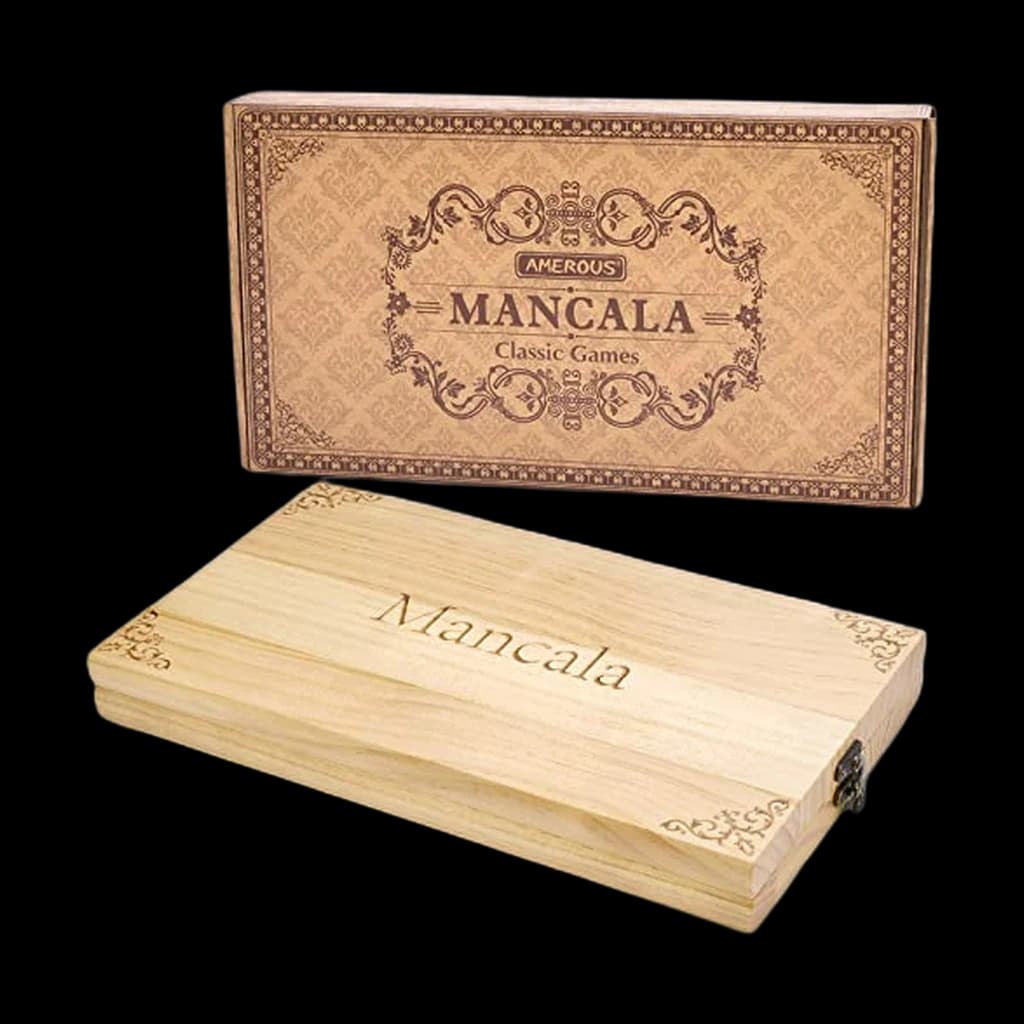
AMEROUS Upgraded Wooden Mancala (Folding Board + Glass Stones)
- Solid wood folding board (not pressed particle)
- 72 multi-color glass stones - visually striking
- Folds for compact storage
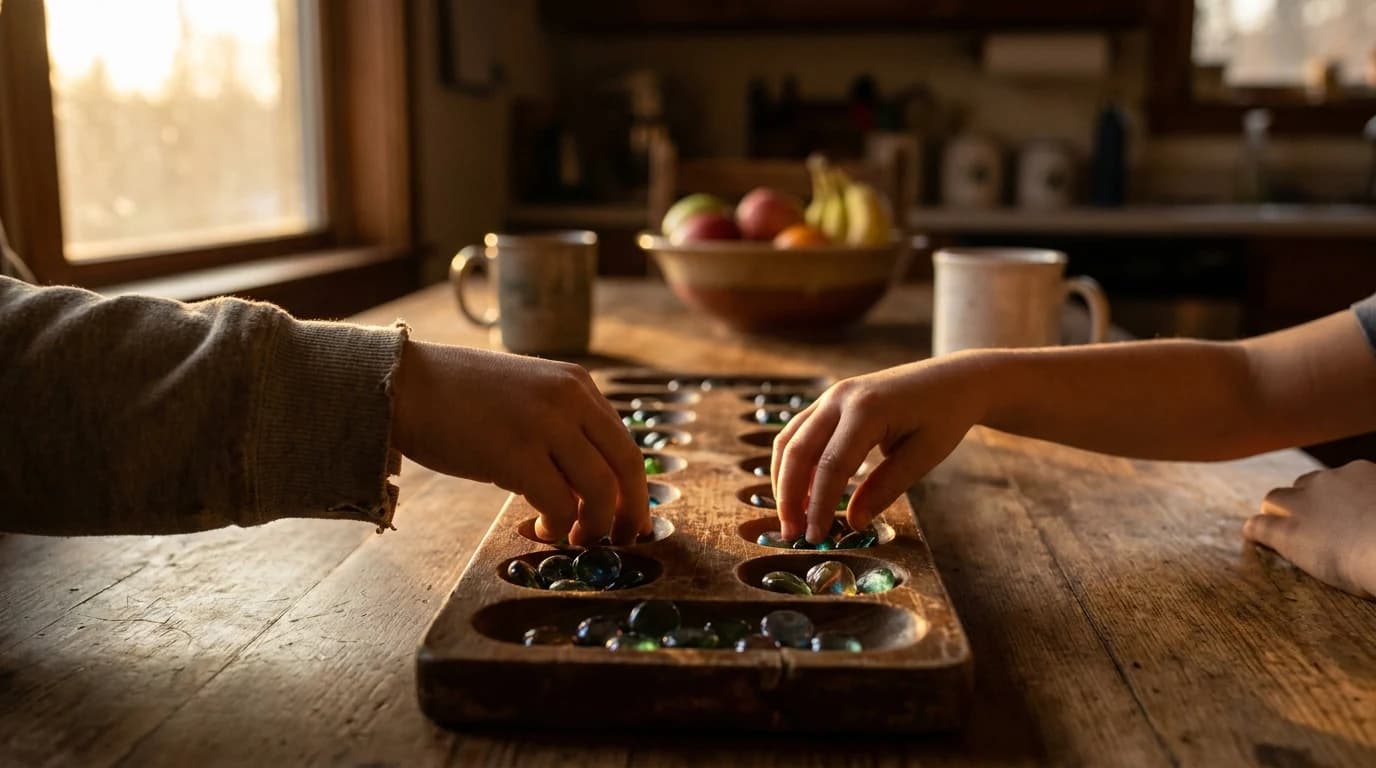
A folding wooden board with glass stones for the Kalah setup shown here. Count out 48 stones and put the extras aside.
Put the board the right way round
This guide teaches Kalah, the familiar two-row version with six pits per player and four stones per pit. Mancala is a family of sowing games, not one universal ruleset. Berkeley GamesCrafters explains that family distinction.
Sit opposite each other. Your six small pits are nearest you; your store is the large cup on your right. Stones have no player colors: ownership depends on their current pit. Put four in every small pit and none in the stores. That makes 48 stones.
We label your pits A1–A6, left to right, with A6 nearest your store. Opponent counts appear directly above the corresponding pits. Stores are listed separately because yours sits right of the board and theirs sits left.
| Row | A1 column | A2 | A3 | A4 | A5 | A6 |
|---|---|---|---|---|---|---|
| Opponent | 4 | 4 | 4 | 4 | 4 | 4 |
| You | 4 | 4 | 4 | 4 | 4 | 4 |
Stores: you 0, opponent 0.
Play one turn, then check how it ends
The basic movement and extra-turn rules follow Scholastic's classroom rules sheet. For this guide, a capture also requires stones in the opposite pit; the variant check below explains that choice.
- Choose a nonempty pit on your side. Lift every stone from it. Leave that starting pit empty.
- Sow one at a time. Begin in the next pit, moving counterclockwise: along your row toward your store, then along the opponent's row.
- Use your store; skip theirs. Drop one into your store when passing it. Never drop into the opponent's store. Continue around if stones remain.
- Check the final stone. Your store means another move. An empty pit on your side, opposite an occupied pit, means a capture: move the landing stone and all opposite stones into your store. Otherwise your turn ends.
- Check for an empty side. Once either player's six pits are empty, stop. The other player puts their remaining pit stones in their own store. Compare store totals; equal totals are a draw.
Stones already in a store stay there. You cannot start a move from a store, and landing in an occupied pit does not let you pick that pile up and continue in this version.
Turn check: Only the final stone triggers an extra move or capture. Passing through your store does not earn another turn.
Follow an extra turn and a capture
Opening move: A3 reaches your store
From the starting board, lift A3's four stones. Drop them into A4, A5, A6, then your store. Your store receives the final stone, so you move again.
| Row after A3 | A1 | A2 | A3 | A4 | A5 | A6 |
|---|---|---|---|---|---|---|
| Opponent | 4 | 4 | 4 | 4 | 4 | 4 |
| You | 4 | 4 | 0 | 5 | 5 | 5 |
Stores: you 1, opponent 0. There are still 48 stones: 24 above, 23 below, one in your store.
Capture example: the opposite pit matters
Use this separate practice position, not the position after that opening. Your store and the opponent's store each contain six stones. Your A1 holds two; A3 is empty; the opponent has five directly above A3.
| Before capture | A1 | A2 | A3 | A4 | A5 | A6 |
|---|---|---|---|---|---|---|
| Opponent | 3 | 4 | 5 | 2 | 3 | 4 |
| You | 2 | 3 | 0 | 1 | 4 | 5 |
Pick A1. One stone goes into A2, making four. The second lands in empty A3. Capture that stone plus the five opposite it: six go into your store.
| After capture | A1 | A2 | A3 | A4 | A5 | A6 |
|---|---|---|---|---|---|---|
| Opponent | 3 | 4 | 0 | 2 | 3 | 4 |
| You | 0 | 4 | 0 | 1 | 4 | 5 |
Stores: you 12, opponent 6. Both capture pits are now empty. The remaining pits contain 30 stones, so the total remains 48. A capture does not grant an extra turn: your final stone landed in a pit.
Agree on these two rules before starting
Scholastic's sheet does not explicitly require an occupied opposite pit. Kalah's documented variations distinguish an empty-opposite capture rule and alternative endgame scoring.
| Question | Rules used here | Alternative to check |
|---|---|---|
| Opposite pit is empty when you land in your own empty pit? | Leave the landing stone there; no capture. | Empty-capture rules move that lone stone into your store. |
| One player's row becomes empty? | The other player sweeps their own remaining stones into their own store. | Some rules award leftovers to the player who emptied their row, or leave them uncounted. |
Our endgame sweep follows the Scholastic sheet. Read your set's instructions and choose together before move one. For this 48-stone version with all stones counted, 25 wins outright; 24 each is a draw. Emptying your row first does not automatically win.
Give your first game a simple plan
These are counting prompts derived from the rules above, not a promise of optimal play:
- Count the route to your store. Initially A3 has four stones and is four drops away. Later counts change; predict the last landing spot before lifting a pile.
- Look at the nearest pit first. One stone in A6 reaches your store immediately. A larger pile passes through it, so proximity alone does not mean an extra turn.
- Check the opponent's empty pits. Could their next move land in one opposite your large pile? Count their route before making yours more vulnerable.
During the first game, count aloud and allow corrections before the next player moves. Our guide to teaching a board game offers a way to explain turns without interrupting every decision.
Use a wooden board or an egg carton
The AMEROUS wooden mancala set provides a folding board and glass stones. Use only 48 for this setup; the listed 72 plus eight bonus stones are not the starting count for these rules. An egg carton with twelve cups and two separate stores also works, as Scholastic's teaching plan describes.
The heritage-games category gathers other traditional games if you later want a different challenge. For now, play a few rounds on the same board and concentrate on predicting the final stone.