Quick Answer
Deal six cards each, discard two to the dealer's crib, and turn up a starter. Take turns playing cards to a running count of 31, pegging for 15s, pairs, runs and 31. Then count each hand with the starter, pone first, then dealer, then crib. First to 121 wins.
Key takeaways
- Points come twice each hand: pegging during play, then counting each hand and the crib with the starter card.
- One card can score in several combinations, so count every fifteen, pair and run separately.
- The dealer owns the crib, so the deal is worth a second hand: in our sample deal it adds 8 points and the dealer finishes 20 to 12.
- The pone counts first, so the pone can reach 121 before the dealer gets to count at all.
- A crib flush needs all five cards to match, while a hand flush scores 4 with just the four hand cards.
- The ACC sanctions only two-handed play and treats muggins as optional, so agree house rules before dealing.
On this page
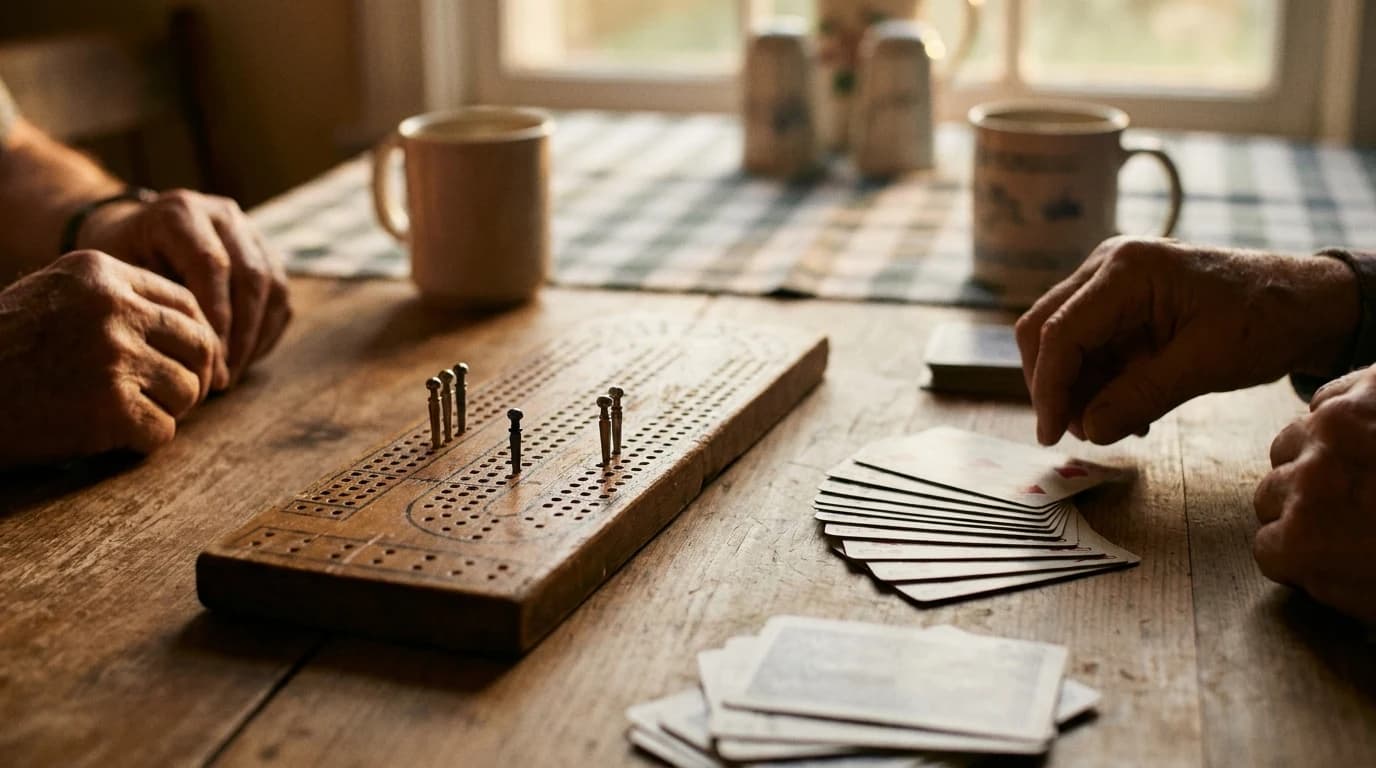
Cribbage is a race to 121 points, scored in two bursts each hand: pegging while cards are played, then counting your hand afterward. Deal six cards each, throw two into the dealer's crib, turn up a starter, play to a running count of 31, then count. Scoring is where people quit, so here is one complete hand, point by point.
What you need: two players, a standard 52-card deck with the jokers out, and a board with two pegs each. Those are the American Cribbage Congress tournament rules, and the sections below follow them unless noted.
Set up the hand in five moves
- Cut for deal. Low card deals, and the deal alternates after that.
- Deal six each, one at a time, starting with the pone (the non-dealer).
- Discard two each face down. Those four cards are the crib, and they score for the dealer.
- Turn the starter. The pone cuts and the dealer flips the top card of the lower packet. If it's a jack, the dealer pegs 2 at once, called his heels.
- Play, then count. The pone leads. Hands are counted pone first, dealer second, crib last.
Our sample deal, used through the rest of this guide:
| Keeps | Throws to crib | |
|---|---|---|
| Pone | 6♦ 7♥ 8♠ 9♣ | K♦ 2♣ |
| Dealer | J♠ Q♥ 5♦ A♣ | 3♦ 4♥ |
| Starter | 5♠ | not a jack, so no heels |
Pegging: play to 31 and score as you go
Say the running total aloud with each card. Aces count 1, face cards count 10, everything else its number. If you can't play without passing 31, say "go." Your opponent keeps playing whatever fits, and the count then restarts from zero.
| Card played | Count | Who pegs | Why |
|---|---|---|---|
| Pone 8♠ | 8 | ||
| Dealer A♣ | 9 | ||
| Pone 6♦ | 15 | Pone 2 | Reached exactly 15 |
| Dealer Q♥ | 25 | ||
| Pone says go | 25 | 7 or 9 would pass 31 | |
| Dealer 5♦ | 30 | Dealer 1 | Last card; J♠ would pass 31 |
| Pone 9♣ | 9 | New count, and the go-caller leads | |
| Dealer J♠ | 19 | ||
| Pone 7♥ | 26 | Pone 1 | Last card of the hand |
Pegging total: pone 3, dealer 1.
The same hand could have scored in other ways, so learn these too:
- Pairs in play: 2 for matching the previous card, 6 for a third, 12 for a fourth. A 10 and a queen are not a pair, even though both count 10.
- Runs in play: the order doesn't matter, but no other card can intervene. The ACC's example is 3-5-6-7-4, which scores 3 on the 7 and 5 on the 4.
- 31 or last card, never both. Hitting exactly 31 pegs 2 with no extra point for last card.
The show: count this hand three times
Now pick your cards back up. Each hand counts as five cards, its own four plus the starter, and one card can score in several combinations at once. That is the idea that trips up first-timers.
| Combination | In play | In hand or crib |
|---|---|---|
| Fifteen (any cards totaling 15) | 2 on reaching 15 | 2 each |
| Exactly 31 | 2 | none |
| Last card | 1 | none |
| Pair | 2 | 2 |
| Three of a kind | 6 | 6 |
| Four of a kind | 12 | 12 |
| Run of three or more | 1 per card | 1 per card |
| Flush, four cards | none | 4, hand only |
| Flush, five cards | none | 5, hand or crib |
| Nobs: jack matching the starter's suit | none | 1 |
| His heels: starter is a jack | 2 to dealer | none |
That chart condenses rule 1.7 of the ACC rulebook. Now apply it, with the 5♠ starter included in all three counts:
| Count | Cards | Fifteens | Pairs | Runs | Nobs | Total |
|---|---|---|---|---|---|---|
| Pone's hand | 6 7 8 9 + 5 | 7+8, 6+9 = 4 | 0 | 5-6-7-8-9 = 5 | 0 | 9 |
| Dealer's hand | J Q 5 A + 5 | J+5 twice, Q+5 twice = 8 | 5-5 = 2 | 0 | J♠ = 1 | 11 |
| Crib | K 2 3 4 + 5 | K+5, K+2+3 = 4 | 0 | 2-3-4-5 = 4 | 0 | 8 |
Add the pegging and the hand ends dealer 20, pone 12. That gap is the crib at work: the dealer gets a bonus count, and the alternating deal hands it to each of you in turn.
Count aloud, in this order: fifteens, pairs, runs, flush, nobs. The dealer's hand goes "fifteen two, four, six, eight, a pair is ten, and one for nobs is eleven." A fixed order stops you from skipping a combination.
Three scoring traps
- A long run only counts once. A 9-10-J-Q scores 4, not 4 plus the shorter runs inside it. Duplicates do multiply: 6-7-7-8 holds two runs of three.
- The crib flush is stricter. Hand flushes need four matching hand cards, and the starter makes it 5. A crib flush scores only if all five match. Three hand cards plus the starter never score.
- Check printed examples too. Bicycle's rules page scores an 8-7-7-6-2 hand at a correct 16, but lists 6+2 as a fifteen, and that sums to 8. The real fifteens are 8+7 twice and 7+6+2 twice.
Winning, skunks and muggins
Reaching 121 ends the game on the spot, even mid-count or on his heels, so the pone's first count can beat a dealer who was about to count ahead. Your optional house rules:
- Skunk: the ACC defines it as winning by 31 or more, so a loser stuck on 90 or below. Bicycle adds a double skunk when the loser fails to reach 61.
- Muggins: you claim points your opponent failed to peg. Bicycle says it is always on in competitive play, but the ACC's rule 10 calls it the only optional rule, on at the tournament director's choice. At home, agree on it first, since new players miss the most points.
Two players vs three
The ACC sanctions only the two-handed game, and three-handed play changes the arithmetic of the deal rather than the scoring.
| Two players | Three players | |
|---|---|---|
| Cards dealt | 6 each | 5 each, plus 1 straight into the crib |
| Discards | 2 each | 1 each |
| Who cuts and leads | Pone | Player to dealer's left |
| Count order | Pone, dealer, crib | From dealer's left, ending with dealer |
| After a go | Opponent plays on | Once two have said go, the third plays on |
Pagat's three-handed section has the details, and notes you really want a three-track board for it. Everyone plays independently, though Pagat notes the two trailing players may gang up on the leader.
What to do on your second hand
- Throw your opponent's crib cards that don't combine: Bicycle's guidance is to avoid giving up 5s, pairs and neighboring cards.
- Lead a 4 when you can. Bicycle calls it one of the safest leads, because no single card can answer it with a 15.
- Don't stop the count on 21, since any 10-value card answers with 31 for 2.
Teaching someone tonight? Run this exact deal face up first, then shuffle, using the approach in how to teach a game without ruining game night. If it clicks, compare cribbage with the dedicated decks in our two-player card game ranking.
Your next step