Quick Answer
Match tiles to the engine, playing one per turn on your train, the Mexican Train or any marked train. If you can't play, draw once, then mark your train. A double needs a follow-up tile and must be covered before other trains are playable. Lowest pip total wins. Rule sheets differ, so agree on one before dealing.
Key takeaways
- Published double-12 hand sizes agree least at seven and eight players, ranging from 8 to 11 tiles.
- At eight players, a hand of 11 leaves only 2 tiles in the boneyard, so draw 9 or 10 for a full table.
- Open doubles close one per turn in the order played, and a double stops restricting play once all 13 tiles of that number are out.
- Going out on a double is allowed on the rule sheets that address it, including Bauguess, Pagat and GSI.
- The Mexican Train can open on the first turn under Bauguess but only afterward under Pagat and Yellow Mountain.
On this page
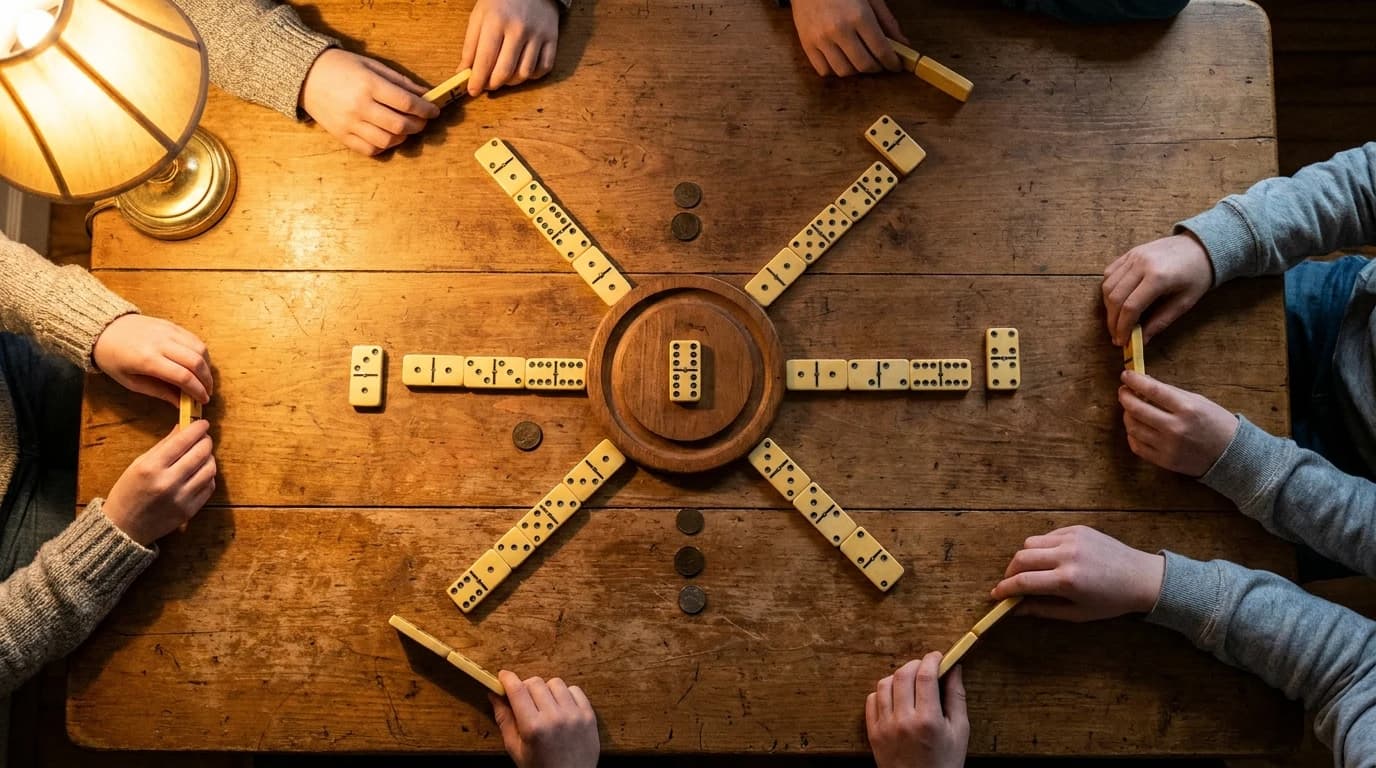
Mexican Train is a race to empty your hand: match tiles onto your own train, the shared Mexican Train or any marked train, one tile per turn, drawing when you can't play. A double earns a follow-up tile and must be covered before other play resumes. Lowest total after all rounds wins. Nearly every argument comes from rule sheets that differ.
Settle this before you deal: there is no single rulebook. Wikipedia catalogs numerous published versions, and the two 1994 originals it names, Parsons for Puremco and Galt for Cardinal, already differ. Pick one column from the dispute table below and stick to it for the night.
The game in six steps
- Set the engine. With a double-12 set, the double-12 goes in the center for round one.
- Draw your hand from the table below. Leftover tiles form the boneyard.
- Build outward. Every train must start with a tile matching the engine, and touching ends must match.
- Take your turn. Play on your train, the Mexican Train, or a train with a marker on it.
- Can't play? Draw one tile and play it if it fits. If it doesn't, put a marker on your train, which opens it to everyone until you play on it again.
- End the round. It stops when someone plays their last tile, or when the boneyard is empty and nobody can move. Count the pips left in your hand. Next round uses the next lower double, so a full double-12 game runs 13 rounds, ending on the blank double.
How many tiles each player draws
Most sheets deal 15 tiles at four players or fewer, then scatter. These are double-12 hand sizes.
| Players | Bauguess | University Games | Pagat, GSI | Galt, Yellow Mountain, mexicantrain.com | Fundex |
|---|---|---|---|---|---|
| 2 | 16 | 16 | 15 | 15 | 15 |
| 3 | 16 | 15 | 15 | 15 | 15 |
| 4 | 15 | 14 | 15 | 15 | 15 |
| 5 | 14 | 12 | 12 | 12 | 11 |
| 6 | 12 | 11 | 12 | 12 | 11 |
| 7 | 10 | 10 | 10 | 11 | 8 |
| 8 | 9 | 9 | 10 | 11 | 8 |
Read directly: Bauguess, Pagat, the GSI Outdoors set sheet, Yellow Mountain and mexicantrain.com. The University Games, Galt and Fundex columns come from Wikipedia's compiled table; we could not open those sheets ourselves.
Our arithmetic, and the number that matters: set the engine aside and 90 tiles remain. At eight players, a hand of 8 leaves 26 in the boneyard, 9 leaves 18, 10 leaves 10 and 11 leaves just 2. With 11 each, drawing is over almost as soon as it starts. For a full table, deal 9 or 10.
Playing with fewer people and want a shorter game? Bauguess suggests a double-9 set, or pulling the 36 tiles with 10 or more pips from a double-12 set, then drawing 15, 13 or 10 tiles for two, three or four players.
The dispute table
Each cell is what that sheet says. "Silent" means we found no statement on that page, so a table using it has to decide.
| Dispute | Bauguess | Pagat | Yellow Mountain | mexicantrain.com |
|---|---|---|---|---|
| First-turn tiles | One | As many as form a train | Any number | One |
| No tile to start your train | Draw, then marker | Marker, no draw | Marker, no draw stated | Draw 1, then marker |
| Mexican Train opens | Any turn, even the first | From your second turn | After the first turn, not while a double needs covering | After the first round of turns |
| Who starts a round | Rotates clockwise | Holder of the double | Holder of the double | Player 1's highest double |
| Going out on a double | Ends the round | Ends the game at once | Silent | Exempt from closing |
| Double blank scores | Pips (0) | Pips (0) | 50 | Pips (0) |
| Rounds | 13 | 13 | 13 | 3 |
When your train opens and closes
Your train opens only when you fail to play and take a marker, and the marker comes off when you play on your own train. That much the sheets share. Pagat lists the exceptions as variations: some groups let any player's tile clear a marker, others clear it when the owner plays anywhere.
- Marker on, you can still play elsewhere. A marker never blocks you from other eligible trains.
- Adding to someone's marked train leaves their marker in place under Pagat's rules.
- Boneyard empty? You pass and put a marker down, per Bauguess.
Unsatisfied doubles, settled
This is the rule that stops games. A double played sideways on a train must get a tile on it, and until it does, play is restricted.
- You play a double, then owe another tile. On Bauguess and the GSI sheet, it must be a non-double, on the double or on any eligible train. mexicantrain.com is stricter: the double must be closed before you play anywhere else.
- No tile? Draw one. If it doesn't fit, your train gets a marker and the turn passes.
- Now everyone is stuck on it. Every other train is off limits until someone covers the double, and each player who can't, even after drawing, takes a marker. Pagat adds that the next player must cover it even if that means playing on another player's private train.
- Several open doubles? Close them one per turn, in the order they were played. Pagat, Bauguess and Yellow Mountain all agree.
The escape hatch: on a double-12 set, each number appears on 13 tiles. If all 13 are on the table, nobody can cover that double, so it stops restricting play. Check before you draw the whole boneyard chasing it.
Playing more than one double in a turn is its own fight. Bauguess allows any number, ending on a non-double, and notes that this is a popular alternative rule. Wikipedia records an earlier version limiting a turn to two doubles, and Pagat lists "only one double per turn" as a variation.
Do this, not that
- Do tap the table or announce your last tile. Bauguess requires it, and mexicantrain.com says a one-tile draw penalty is common for forgetting, though house rules vary.
- Do decide whether blanks score zero. Wikipedia notes the option of 25 per blank and 50 for the double blank.
- Don't hold a playable tile to protect your train. If you can play, you must, and you may not draw instead.
- Don't play a tile on a closed train because it looks open. Keep markers accurate and fix mistakes as soon as anyone notices.
If your table wants something to follow it
We don't currently rank a domino set, so we are not pointing you at one. Any double-12 set has the 91 tiles you need, and coins work as markers. For the next game, try our mancala guide, the Farkle rule sets compared, or how to run a family game night.
Your next step
Ready to choose? Here's where to go next.
Common questions
Can you go out on a double in Mexican Train?
When can you start the Mexican Train?
What happens if nobody can cover a double?
How many points is the double blank worth?
Research Sources
- Bauguess, Mexican Train Rules, revised July 12, 2012 (based on the 1994 Parsons rules; library-hosted PDF)
- Pagat.com, Mexican Train (rules and listed variations)
- Yellow Mountain Imports, How to Play Mexican Train Dominoes
- mexicantrain.com, Mexican Train Rules and beginner's guide
- mexicantrain.com, Even more clarifying rules on doubles
- GSI Outdoors, Double-12 Dominoes instruction sheet (PDF)
- Wikipedia, Mexican Train (compiled table of hand sizes and rule variations)