Quick Answer
Jigsaw puzzles offer a screen-free activity, a manageable challenge and something to do together. They engage visual and spatial skills, but research does not establish that a month of puzzling improves general cognition or that jigsaws prevent dementia. Choose for enjoyment and fit, not a promised medical outcome.
Key takeaways
- Using a cognitive skill while puzzling does not prove a lasting improvement elsewhere.
- A randomized jigsaw trial improved puzzle skill without a clinically relevant overall cognitive advantage.
- Choose the image, difficulty and storage around the experience you want.
- Enjoyment and shared time are useful goals you can judge for yourself.
On this page
Enjoyment is a benefit you can actually judge
A jigsaw gives you a finite task: find a match, build a small region, then decide whether to continue. There is no feed to refresh and no requirement to share the finished picture. That makes it a useful candidate for a screen-free evening, provided the activity itself appeals to you.
The important distinction is between using a skill during an activity and improving that skill elsewhere. Looking for a blue edge uses visual attention. It does not establish that tomorrow's concentration at work will improve. Feeling absorbed is also different from treating anxiety.
Start with a goal you can observe: an enjoyable break, a shared activity, or a satisfying challenge. If the goal is broader, our guide to relaxing hobbies compares activities by setup, cleanup and the energy they require.
Useful test: judge the evening you had, rather than an invisible promise about your brain.
What the jigsaw research actually found
A 2018 randomized study by Fissler and colleagues enrolled 100 cognitively healthy adults aged 50 and older. One group did jigsaws for at least an hour a day on 30 days, alongside cognitive-health counseling; the comparison group received counseling alone.
Puzzle skill improved. The puzzle group did not show a clinically relevant advantage over the counseling group on the study's overall visuospatial cognition measure. Lifetime puzzling was associated with cognition, but that observational finding cannot show that puzzling caused it. The trial was funded by a puzzle manufacturer, a relevant disclosure in the paper.
That supports describing jigsaws as a cognitively engaging activity. It does not establish dementia prevention, an IQ increase or a treatment effect. Separately, the National Institute on Aging's cognitive-health guidance says evidence for lasting cognitive benefits from meaningful leisure activities remains inconclusive.
| Claim you may encounter | What to take from it |
|---|---|
| Jigsaws use visual and spatial skills | Engagement during the task is different from a lasting improvement |
| Experienced puzzlers have stronger cognitive scores | Association does not establish cause |
| A month of puzzling will sharpen your brain | The trial did not show the claimed general advantage |
| A puzzle is enjoyable or absorbing | A personal experience you can assess, without a medical promise |
Match the puzzle to the benefit you want
Our framework below is an editorial decision aid, not a prescribed dose or a validated health assessment. The right purchase is the one that makes your intended activity easier to repeat.
| Your goal | A useful starting setup | Change this if it stops working |
|---|---|---|
| A low-pressure break | A familiar image with distinct colored regions; a small area you can finish | Reduce difficulty if searching becomes irritating |
| A satisfying challenge | An image you like that includes some repeated textures | Keep an easier puzzle available for tired evenings |
| Time with someone else | A picture with several recognizable regions so each person can choose an area | Take turns choosing the image; avoid racing unless both want it |
| A screen-free habit | A surface that can stay occupied, or a way to pack the work away | Solve storage before buying another large box |
Piece count is only one difficulty variable. A scene with clear landmarks gives you more sorting clues than a large stretch of similar sky. Choose an image you want to look at for a while, and check the finished dimensions against your available surface.
For construction differences, use our jigsaw puzzle brand comparison. It considers published claims about board, cut and finish. Those properties help you choose the object; none is evidence of a stronger cognitive benefit.
Make stopping part of the setup
A hobby loses its appeal when it monopolizes the dining table or makes every interruption feel like failure. Decide how you will pause before opening the bag.
- Check that the finished puzzle fits, with room for sorting beside it.
- Put loose pieces in shallow containers you already own.
- Choose a place where spills and passing pets are less likely to disturb it.
- Agree that unfinished work is allowed to stay unfinished.
For an older adult, ask about preferred images, comfortable piece handling and visibility instead of choosing solely by age. Larger pieces or clearer contrast may suit a particular person; there is no single setup every senior needs. For children, use our age-and-difficulty guide and the box's age guidance rather than treating an adult puzzle as universal.
Try the activity before collecting the equipment
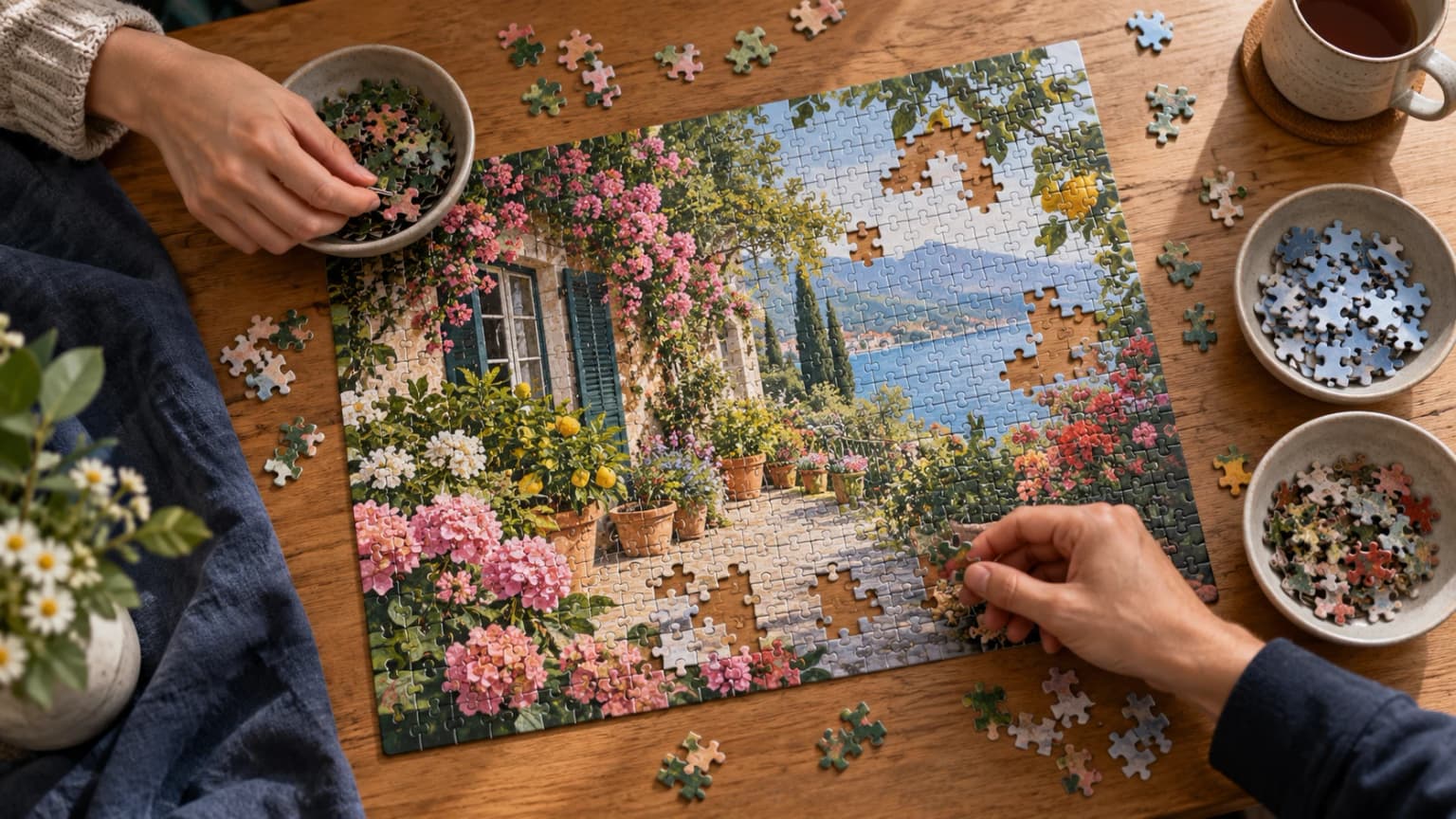
Borrow a complete puzzle, revisit one you own, or exchange a box with a friend. An expensive board or premium brand is unnecessary for finding out whether you like the process.
After a few attempts, ask:
- Did I enjoy sorting and matching, or only the idea of finishing?
- Could I stop comfortably when I needed to?
- Did the setup fit my home and the company I wanted?
- Would I choose this again without a promised health payoff?
If you liked it, the jigsaw category is the next place to compare existing options. If you disliked it, change the image, difficulty or setting once before deciding. Choosing a different hobby is also a perfectly useful result.
Keep the goal modest: enjoyment, challenge and shared time are enough reasons to puzzle. They do not need a dementia-prevention claim to count.
Your next step