Quick Answer
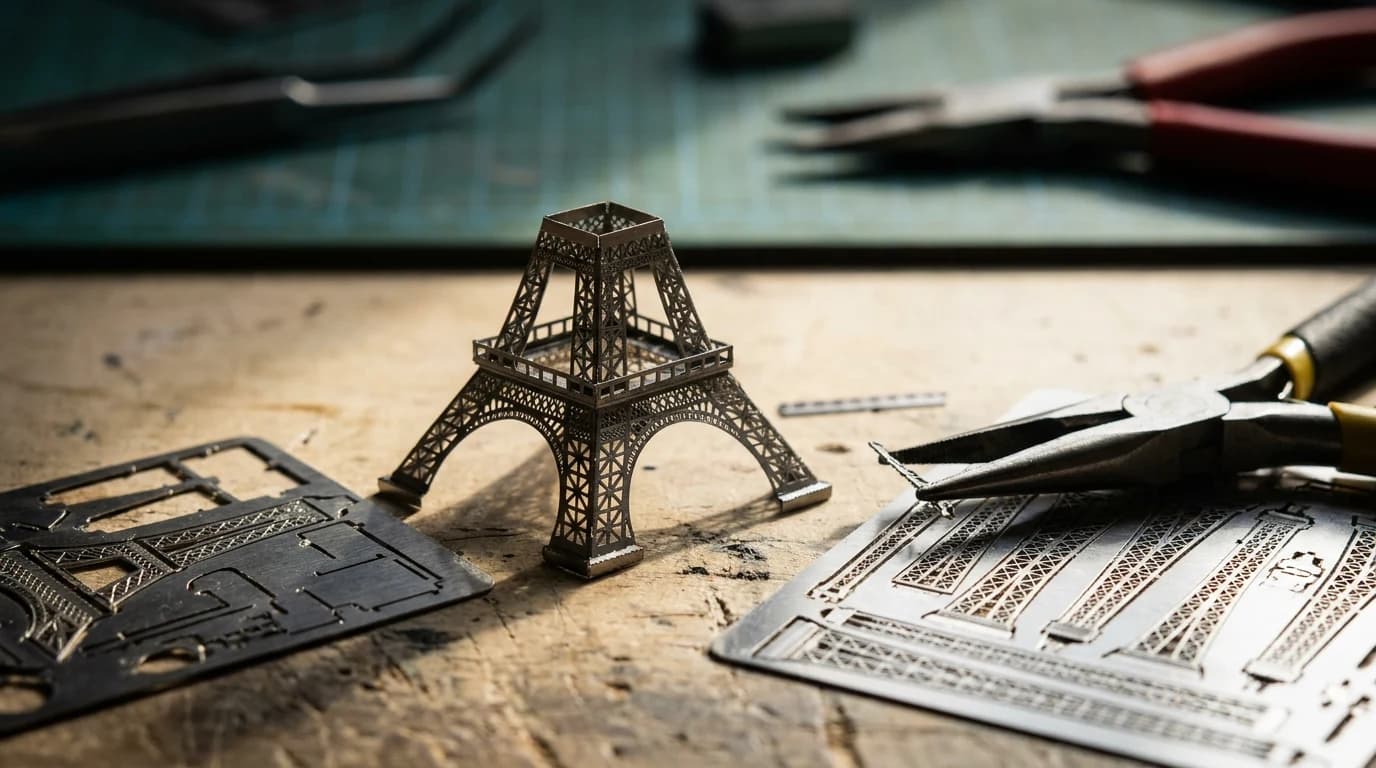
Start with an Easy-rated, single-sheet, mostly-flat kit like the Eiffel Tower — Fascinations' own system pegs Easy at up to 1 hour and Expert at an open-ended 6+ hours. The real difficulty predictor is geometry, not the label: flat panels are forgiving, cylinders and curves are what stall first-timers. Buy flush cutters and smooth-jawed pliers with your first kit, twist tabs a quarter turn only, and remember the published constraint — a part worked more than about twice weakens or breaks.
Key takeaways
- Fascinations publishes its difficulty system in full: Easy is a beginner kit at up to 1 hour, Moderate up to 4 hours, and Challenging and Expert are open-ended at 4+ and 6+ hours.
- Geometry beats part count: kits dominated by cylinders and curves are where first-timers stall, and the community treats the printed rating as directional, not predictive.
- Size and difficulty are unrelated — the Easy Eiffel Tower finishes taller than the Challenging Apollo Lunar Module, and both Millennium Falcons share a rating and sheet count while the Premium finishes 46% longer.
- Metal fatigue is the hard constraint: Fascinations warns that working a piece more than about twice weakens or breaks it, which is why the fold-vs-twist tab symbols and quarter-turn technique matter.
- Builders quit at fragile steps, not hard ones — delicate parts left unsupported across several instruction steps get snagged and sheared off.
- Piececool's 7-star scale is incompatible with Metal Earth's word ratings; its kits run larger on thicker, easier-bending sheets with better-regarded instructions.
On this page
Side-by-side comparison
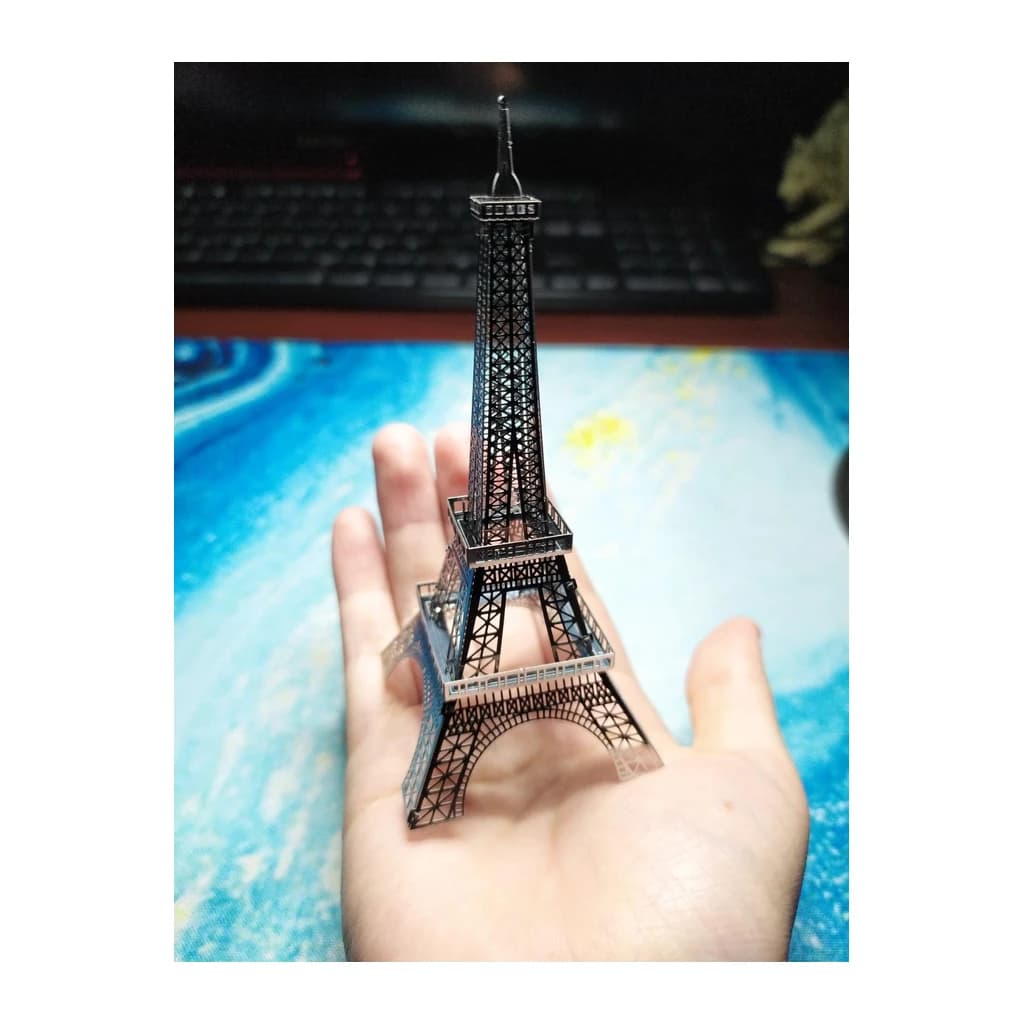
The default beginner kit — an inexpensive landmark that teaches the snip-and-bend technique without overwhelming a first-timer.
- Piece Count
- 1 sheet
- Build Time
- ~1-2 hours
- Material
- Laser-cut steel
- Difficulty
- Easy-Medium
Best evidence
Cheapest way to try the hobby
Main trade-off
Lattice tabs are tiny and easy to over-bend
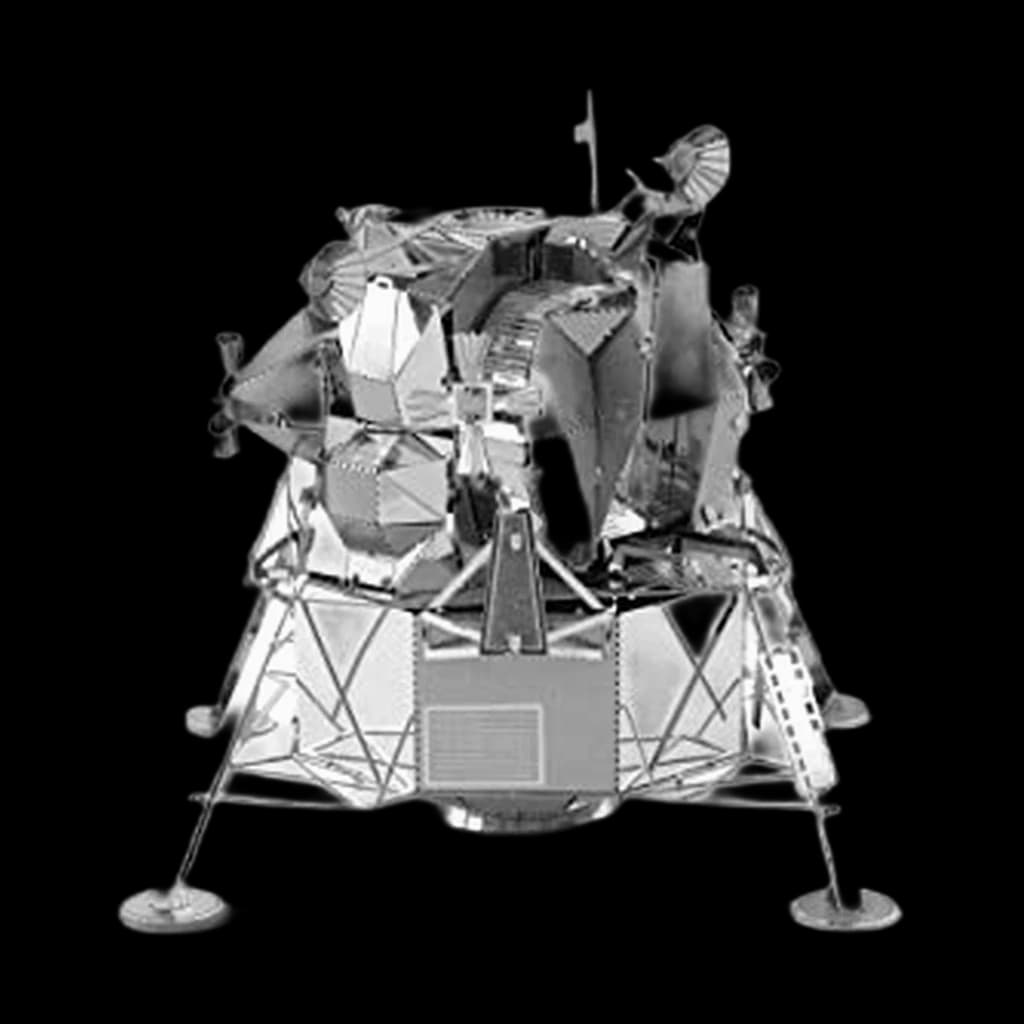
A low-cost, high-charm starter kit — the spider-legged lunar module is a great first taste of snip-and-bend steel building.
- Piece Count
- 1 sheet
- Build Time
- ~1.5-3 hours
- Material
- Laser-cut steel
- Difficulty
- Medium
Best evidence
Affordable entry into the category
Main trade-off
Spindly legs need careful, precise bending
The ICONX treatment makes this the Falcon to buy — detailed, solid, and the build experience most metal-kit fans recommend over the cheaper single-sheet version.
- Piece Count
- 2 sheets (multi-sheet)
- Build Time
- ~4-6 hours
- Material
- Laser-cut steel
- Difficulty
- Hard
Best evidence
Premium multi-sheet detail beyond the standard kit
Main trade-off
Genuinely challenging — not a beginner kit
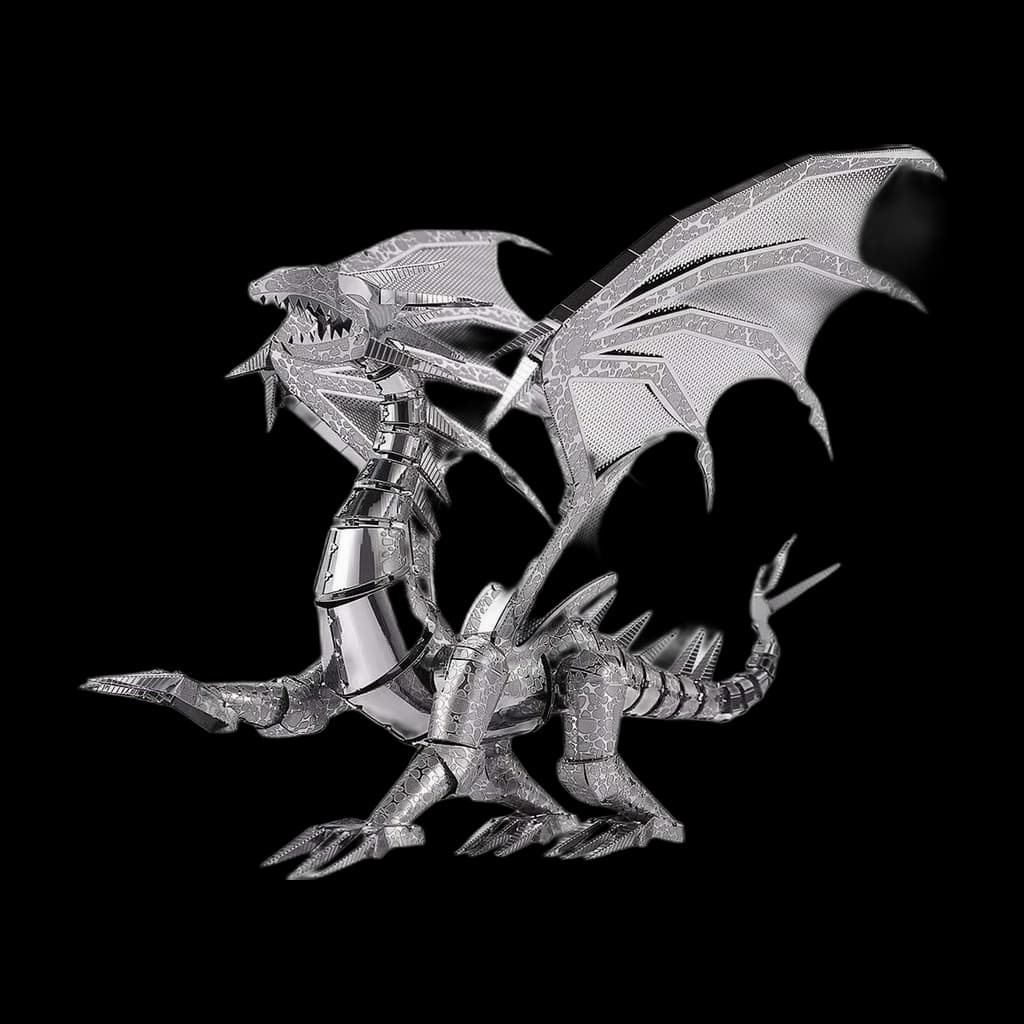
Piececool's flagship dragon delivers a finished sculpture with real shelf presence, but it's a build best left to people who've done a few metal kits already.
- Piece Count
- 115
- Build Time
- ~6-8 hours
- Material
- Stainless steel (silver finish)
- Difficulty
- Hard
Best evidence
Pre-colored anodized finish looks painted with no painting
Main trade-off
Genuinely difficult — many fine curved parts
* Prices are approximate. Tap Buy to see current pricing on Amazon.
| Comparison field | #1Metal Earth Eiffel Tower Owner rating | #2Metal Earth Apollo Lunar Module Owner rating | #3Metal Earth ICONX Star Wars Millennium Falcon Owner rating | #4Piececool Dragon Flame 3D Metal Model Kit Owner rating |
|---|---|---|---|---|
 |  |  |  | |
| CurioRank | ||||
| Verdict | The default beginner kit — an inexpensive landmark that teaches the snip-and-bend technique without overwhelming a first-timer. | A low-cost, high-charm starter kit — the spider-legged lunar module is a great first taste of snip-and-bend steel building. | The ICONX treatment makes this the Falcon to buy — detailed, solid, and the build experience most metal-kit fans recommend over the cheaper single-sheet version. | Piececool's flagship dragon delivers a finished sculpture with real shelf presence, but it's a build best left to people who've done a few metal kits already. |
| Price | ||||
| Piece Count | 1 sheet | 1 sheet | 2 sheets (multi-sheet) | 115 |
| Build Time | ~1-2 hours | ~1.5-3 hours | ~4-6 hours | ~6-8 hours |
| Material | Laser-cut steel | Laser-cut steel | Laser-cut steel | Stainless steel (silver finish) |
| Difficulty | Easy-Medium | Medium | Hard | Hard |
| Finished Size | ~tall, slim landmark | Palm-sized | ~4.25 x 3 x 2.75 in | Ornate display dragon |
| Buyer sentiment | Assembly Model quality Appearance Fragility Buyers praise assembly, model quality and appearance. Some flag fragility. Based on 190 user mentions | Model quality Appearance Entertaining Difficulty Fragility Instructions Buyers praise model quality, appearance and entertaining. Some flag difficulty and fragility. Based on 222 user mentions | Quality Assembly Appearance Detail Buyers praise quality, assembly, appearance and detail. Based on 49 user mentions | Quality Appearance Assembly Difficulty Durability Buyers praise quality and appearance. Some flag assembly and difficulty. Based on 95 user mentions |
| Pros |
|
|
|
|
| Cons |
|
|
|
|
* Prices are approximate. Click Buy to see current pricing on Amazon.
Metal Earth Eiffel Tower
- Cheapest way to try the hobby
- Classic landmark that looks great finished
- Fast, approachable build
Rated Easy by Fascinations' own system (beginner, up to 1 hour), one sheet, and mostly flat parts — the exact profile the community says first-timers should start on. Under ten dollars to find out if the hobby is for you.
What the difficulty labels actually mean
Unlike most model-kit brands, Fascinations publishes its Metal Earth difficulty system in full, with a builder type and a time band for each level: Easy is for beginners at up to 1 hour, Moderate for semi-casual builders at up to 4 hours, Challenging for casual builders at 4+ hours, and Expert for experienced hobbyists at 6+ hours. Notice the top two bands are open-ended — nothing promises a Challenging kit stops at five hours. And no product page carries a per-model estimate, so any "builds in 90 minutes" figure you read elsewhere is invented.
Here's the catch the label system can't capture, and the reason r/metalearth calls the ratings directional rather than predictive: difficulty lives in part geometry, not part count. Kits dominated by flat panels are forgiving. Kits dominated by cylinders, cones and compound curves are where first-timers stall — rolling a flat steel part into a clean tube is the hobby's signature skill, and nobody has it on day one.
The size trap, illustrated by Fascinations' own catalog
Three published comparisons make the point better than any review could:
| Kit | Rating | Sheets | Finished size |
|---|---|---|---|
| Eiffel Tower | Easy | 1 | 4.53 in tall |
| Apollo Lunar Module | Challenging | 2 | 2.36 in |
| Premium Series Millennium Falcon | Challenging | 2 | 4.13 in |
The Easy kit is the tallest — a beginner-friendly stack of flat lattice panels. The Lunar Module crams two full sheets into a body barely bigger than a golf ball: dense, curved, fiddly, and rated accordingly. And the Falcon comparison is the cleanest evidence in the catalog that labels don't encode part size: the standard-line Falcon and the Premium Series Falcon carry the same Challenging rating and the same two sheets, but the Premium finishes 46% longer — larger parts, which some builders actually find easier on the fingers. (Premium Series is the current name for what long-time builders know as ICONX — same line, rebranded — and note it starts at Moderate: there is no Easy Premium kit.)
Why people actually abandon builds
The community's most-named quit point isn't the hardest step — it's the fragile step. Instructions sometimes leave a delicate part attached and unsupported for several steps, where a sleeve or a stray finger snags it and shears it off. And a sheared tab is usually terminal, because of the constraint Fascinations itself publishes: working a piece back and forth more than about twice weakens or breaks the metal. That's also why the two tab symbols in every instruction sheet matter more than they look — one means fold 90 degrees, the other means twist 90 degrees, and confusing them wastes one of the tab's very few working cycles.
The technique consensus from r/metalearth, paraphrased: quarter-turn twists and no more; always twist the same direction so a mistake can be undone once; and roll cylinders progressively around a pen, drill bit or punch — never freehand.
Tools: the four official ones, plus the two that matter
Fascinations recommends needle-nose pliers, flat-nose pliers, clippers and tweezers, each with a stated job. The community adds the two upgrades that veterans say change the hobby: flush cutters (so parts leave the sheet without a sharp nub to file) and smooth-jawed jewelry pliers (textured jaws scratch the finish). A slotted tab-twisting tool earns repeated mentions for tight interior tabs. None of this is expensive, and "can I just use my fingers?" has a published answer: finger-removal bends the part — and two bends is the metal's budget.
Where Piececool fits
The other name on the shelf is Piececool, and the first thing to know is that the difficulty scales are incompatible — Piececool rates on 7 stars, Metal Earth in four words, and a number from one can't be compared to a word from the other. The community's practical read: Piececool models run physically larger on thicker sheets that bend more easily, and their instructions are generally rated better than Metal Earth's — while Metal Earth's smaller format on thinner steel is part of its jewel-box appeal. The Piececool Dragon Flame (115 pieces, rated 6 of 7 on Piececool's own scale) is a showpiece for experienced hands, and the brand's ornate animal kits sit lower on that scale — but check the manual's star rating against the retail copy before you gift one, because on Piececool kits the two sometimes disagree.
The buying path that survives contact
- First kit: Easy, one sheet, mostly flat. The Eiffel Tower is the verified example in our catalog; the community also perennially names the butterfly and lighthouse. You're learning to cut, fold and twist on parts that don't also need rolling.
- Second kit: add curves deliberately. A Moderate kit with some cylinders teaches rolling while the stakes are low.
- Then the showpieces. The Premium Falcon or the Lunar Module — knowing Challenging means 4+ open-ended hours, and that the module's two sheets condense into golf-ball density.
Buy the flush cutters with kit one, not kit three. And if steel turns out to be your medium's rival rather than your medium, the wooden end of this hobby — covered in our UGEARS vs ROKR guide — trades tweezers for glue-free joinery at ten times the part size; the plastic end lives in our Gunpla grades guide.
Common questions
What do Metal Earth difficulty ratings actually mean?
Which Metal Earth kit should a first-timer buy?
Do I really need tools?
Is the Premium Series harder than regular Metal Earth?
Is Piececool harder than Metal Earth?
Why do parts keep snapping off?
Research Sources
- Fascinations — Metal Earth help page (difficulty levels with builder types and time bands, four recommended tools, fold/twist tab symbols, metal-fatigue warning)
- Fascinations — Eiffel Tower MMS016 (Easy, 1 sheet, 4.53 in tall)
- Fascinations — Apollo Lunar Module MMS078 (Challenging, 2 sheets, 2.36 in)
- Fascinations — Premium Series Millennium Falcon ICX200B (Challenging, 2 sheets, 4.13 in)
- Fascinations — standard Millennium Falcon MMS251 (same rating and sheets, 2.83 in)
- Piececool — Dragon Flame P071 retailer spec (115 pieces, 3 sheets, 6/7 stars)
- r/metalearth — first build frustration thread (rolling curved parts as the stall point)
- r/metalearth — tools thread (flush cutters, smooth-jaw pliers, tab-twister consensus)