Key takeaways
- Pediatric guidance has shifted from keeping kids 'as safe as possible' to 'as safe as necessary' — eliminating every scrape also eliminates the play that builds risk judgment and resilience.
- The key distinction is risk vs hazard: a risk is a challenge the child can see and choose (how high to climb); a hazard is a danger they can't assess (a rotten branch). Remove hazards, allow risks.
- A 2024 Canadian Paediatric Society review links outdoor risky play to more physical activity, less sedentary time, better mental health, and stronger risk-assessment skills.
- The CDC recommends 60 minutes of activity a day for ages 6-17 — climbing and active outdoor play hit aerobic, muscle, and bone targets at once, no equipment needed.
On this page
Quick Answer
When a playground feels boring and over-padded, the instinct is that it's too safe. The research suggests that's closer to the truth than it sounds. Pediatric reviews have shifted the goal from keeping kids "as safe as possible" to "as safe as necessary", because eliminating every scrape also eliminates the thrilling, slightly-scary outdoor play that builds physical confidence, risk judgment, and resilience.
The distinction that does the work: a risk is a challenge a child can see and choose, like how high to climb. A hazard is a danger they can't assess, like a rotten branch. Remove the hazards, then let kids take the risks.
What "risky play" actually means
Risky play is the Canadian Paediatric Society's term for thrilling, exciting free play that involves uncertainty and a real possibility of a minor injury: climbing high, going fast, rough-and-tumble, playing near elements like water or a campfire, using real tools, or roaming a bit out of sight. It is not recklessness, and it is not leaving a child unsupervised near traffic or deep water.

Risk versus hazard, and who owns each
| What it is | The adult's job | |
|---|---|---|
| Risk | A challenge the child can recognize, evaluate, and choose based on their own skill, e.g. how high to climb or how fast to run downhill. | Step back. Let them decide and learn. |
| Hazard | A danger beyond the child's ability to notice or manage, e.g. an unanchored slide, a rotten tree limb, broken glass. | Find it and remove it. Always. |
Adults scan for hazards and clear them. Then they let the risk belong to the child. As the CPS puts it, the aim is to keep children "as safe as necessary," not "as safe as possible", a deliberate, evidence-based loosening of the all-injury-prevention reflex.
Why a little danger is good for kids
This isn't a vibe. A 2024 Canadian Paediatric Society position statement reviewed the evidence and found outdoor risky play linked to gains across physical, mental, and social development:
- More movement, less sitting. Adding loose parts (logs, crates, sand) and freedom to roam raised kids' moderate-to-vigorous physical activity and cut sedentary time.
- Better mental health. A school study that allowed rough-and-tumble play saw more pushing and shoving but fewer reports of actual bullying, plus gains in resilience and conflict resolution. A 3-month risky-play program left Grade 4 kids with lower conflict sensitivity and higher self-esteem and concentration.
- Real risk judgment. Loose-parts outdoor play lets kids build risk-assessment and fundamental movement skills through repetition, the foundation of lifelong "physical literacy."
NAEYC's developmental write-up lands in the same place: outdoor play builds gross motor skills, sleep, self-regulation, empathy, and the chance to "take appropriate risks", and it flags the stakes, noting US obesity runs about 14 percent for ages 2 to 5 and rises past 40 percent in middle age.
What most parents get wrong
Treating all discomfort as danger
What a cautious adult should actually remove:
- Broken glass, unstable structures, traffic, deep water
- Equipment that can fail in a way a child cannot see coming
- Genuine hazards, every time, before play starts
What gets removed instead, and shouldn't:
- The flicker of "can I do this?" that makes a climbing frame worth climbing
- Rough-and-tumble, tree-climbing, wall-balancing, treated as misbehaviour
- The reps at the one skill the whole exercise is meant to build — judging a risk and acting on it
The falsifiable version: a perfectly safe playground is a failed playground. If a child never feels manageable uncertainty, the equipment removed the exact ingredient that grows competence.
The data backs this direction, not the reflex. Outdoor free play, and active play specifically, has been declining for decades as structured activities and screens crowd it out; Canada's 2022 ParticipACTION report card gave kids a "D" for overall activity and a "D−" for active play. The risk wasn't the problem. The retreat from it was.
How much active play kids actually need
Risk and movement go together, and the movement target is concrete. The CDC's physical activity guidelines for ages 6 to 17:
- 60 minutes a day, every day, of mostly moderate-to-vigorous activity.
- On at least 3 of those days, include muscle-strengthening work (climbing, push-ups) and bone-strengthening work (jumping rope, gymnastics).
One tree covers all three targets
Climbing a tree is aerobic, muscle-strengthening, and bone-loading in one go, no equipment, no signup, no membership. For under-fives, Nemours (cited by NAEYC) suggests at least 30 minutes of adult-led plus 60 minutes of child-led physical activity daily.
A practical way to dial up the good kind of risk
Five defaults worth shifting
You don't need a forest or an "adventure playground."
- Scan, then step back. Before play, clear the genuine hazards (glass, unstable structures, traffic, water). After that, resist narrating every move. Let "be careful" become "I'm watching, you've got this."
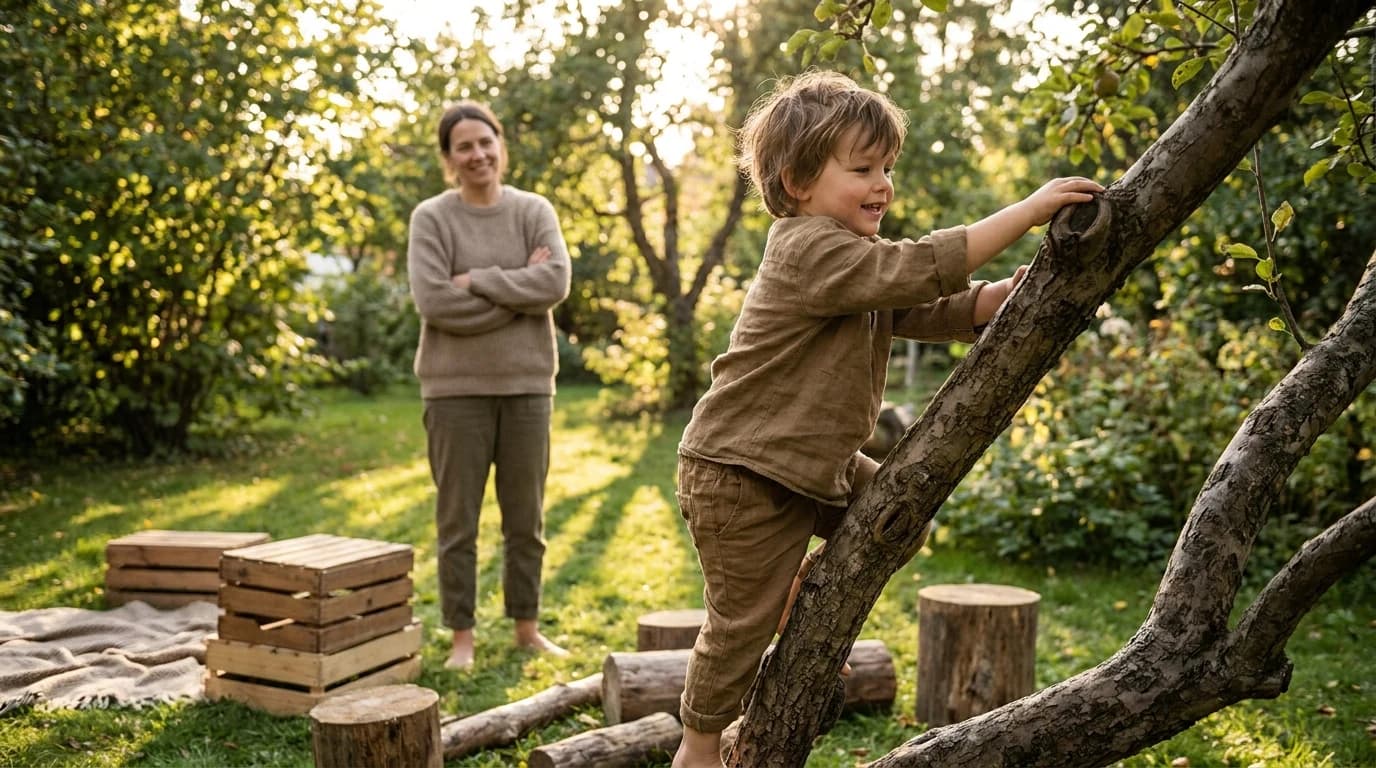
- Add loose parts. A pile of logs, crates, sticks, sand, or old tires invites more inventive, riskier, longer play than fixed equipment. Loose, movable, open-ended beats bolted-down.
- Let them get a little out of sight. Independent mobility, roaming the yard or block within known limits, is tied to more activity and stronger self-regulation. Calibrate the leash to the child, not your nerves.
- Allow the messy stuff. Rough-and-tumble, tree-climbing, balancing on the wall: these are categories of risky play, not misbehavior. Set a real-danger floor and let the rest run.
- Match the child, not the age. Risk tolerance tracks developmental stage, experience, and temperament more than birthday. The kid who's climbed a hundred trees can go higher than the one who hasn't, regardless of age.
None of this is anti-safety. It's a sharper kind of safety: kill the hazards, keep the thrill. A child who has practiced judging a real risk on a climbing frame is the one who makes a better call at the crosswalk, the lake, and the skate ramp later. That judgment isn't something you can buy. It's something they have to be allowed to build.
Your next step
Taking play outside? Start with the gear that actually gets used.
Common questions
Isn't 'risky play' just an excuse to under-supervise kids?
What's the difference between a risk and a hazard?
How much active outdoor play do kids actually need?
Won't more risky play mean more injuries?
Research Sources
- Canadian Paediatric Society - Healthy childhood development through outdoor risky play (2024 position statement: risk vs hazard, 'as safe as necessary,' physical/mental/social benefits, rough-and-tumble reduces bullying, ParticipACTION 2022 D/D- grades)
- CDC - Physical Activity Guidelines (ages 6-17: 60 minutes a day, muscle- and bone-strengthening on at least 3 days)
- NAEYC - Why Outdoor Play Is Essential for Healthy Development (gross motor, sleep, self-regulation, appropriate risk-taking; obesity 14% ages 2-5 rising past 40% in middle age; 30 min adult-led + 60 min child-led)
- Children & Nature Network - Research Digest: Risk-taking in natural environments (benefits include risk-assessment skills, mental health, physical activity, resilience; documented decline in risky play opportunities)