Key takeaways
- Executive function — working memory, inhibitory control, and cognitive flexibility — is built through practice, not born; a board game is just structured practice for it.
- The three components map to three game behaviors: remembering (working memory), waiting your turn (inhibitory control), and adapting to a rule change (cognitive flexibility).
- Age five is the rough readiness line for rule-based games — that's when most kids can adapt to a changed rule, the lab test that predicts readiness (3-year-olds usually can't).
- The benefit is the playing, not the winning: an adult who keeps the turns moving matters more than how clever the game is.
On this page
A board game is executive-function training in a box
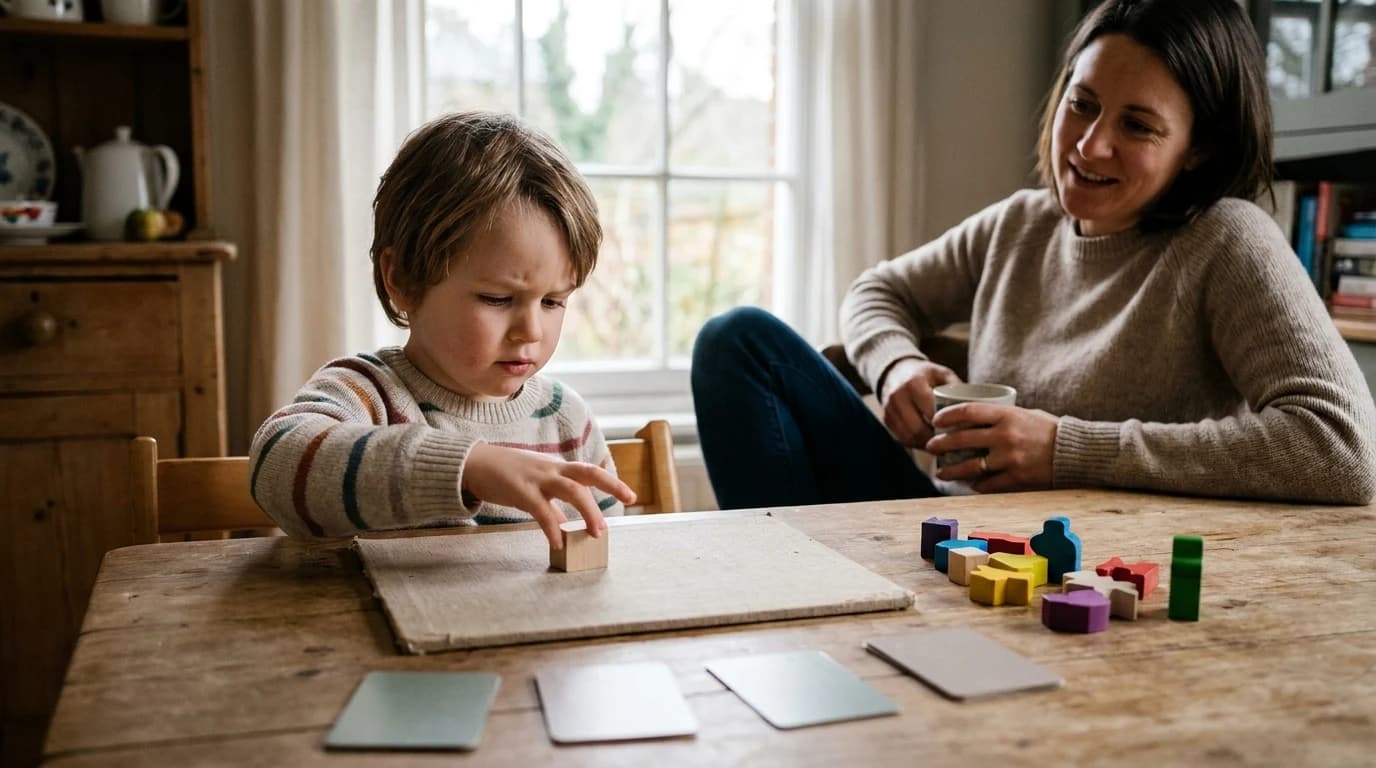
When a five-year-old plays a simple board game, something specific is happening in their brain. They are holding the rules in mind, waiting for their turn instead of grabbing a piece, and adjusting when the game throws a surprise. Researchers have a name for that cluster of skills: executive function. The Harvard Center on the Developing Child calls it the brain's "air traffic control system" — the part that helps us manage information, make decisions, and plan ahead.
Here is the reassuring part for parents: nobody is born with executive function. As Harvard puts it, "no one is born with these skills, but we are all born with the ability to develop them." Board games are one of the most ordinary, low-effort ways to give a child reps at building them. That is the real reason a $20 game can be worth more than another shelf of flashing plastic.
What "executive function" actually means
Executive function isn't a single trait. Learning scientists, as summarized in a Young Children (NAEYC, 2024) review, break it into three components. Every decent kids' game trains at least one.
| Component | What it is | How a game trains it |
|---|---|---|
| Working memory | Holding and updating information over short periods | Remembering where the matching card was, or what the current rule is |
| Inhibitory control | Suppressing an impulse or automatic response | Waiting your turn instead of moving early; not playing the "obvious" card |
| Cognitive flexibility | Shifting between rules or strategies when conditions change | Adapting when a new rule, card effect, or opponent move changes the plan |
A memory-match game is not a time-filler

Turning over two cards and recalling what was there is pure working-memory practice. A game where the rule flips mid-play — "now do the opposite" — is cognitive-flexibility practice. And the simple act of sitting through other players' turns is inhibitory control, the skill that quietly underwrites every classroom.
The single best readiness test (it's a card game)
Parents constantly ask when a kid is ready for a "real" board game with rules. There's a clean developmental marker, and it comes straight from the lab.
The lab test: researchers measure executive function by watching whether a child can adapt to a changed rule in a card-sorting game. Three-year-olds usually can't switch — they keep sorting by the old rule even after being told the new one. By age five, most children can. (Zelazo, summarized in NAEYC's 2024 review.)
That gap is the whole story of board-game readiness. A three-year-old isn't being difficult when they melt down because the rule changed — their prefrontal cortex literally isn't there yet. The pediatric milestones line up: the American Academy of Pediatrics lists "more likely to agree to rules" as a 4-to-5-year-old milestone, and the CDC's five-year checklist includes "follows rules or takes turns when playing games with other children."
Run the test at home, for free
Try a tiny game where the rule changes partway through: sort by color, then switch to sorting by shape. If your child can roll with the switch, they're ready for rule-based games. If they can't yet, that's normal — cooperativeco-opGame where all players win or lose together against the game's system. Pandemic, Spirit Island, and Gloomhaven are the canonical co-ops. Tends to outperform competitive games for couples and mixed-skill groups. or "no-rules" play is the right level for now.
Key things to know
- Executive function is built, not born. Harvard is explicit that children develop these skills through practice and supportive adults — a game is just structured practice.
- The three components map to three game behaviors: remembering (working memory), waiting your turn (inhibitory control), and adapting to a rule change (cognitive flexibility).
- Age five is the rough threshold for rule-based games, because that's when most kids can adapt to a changed rule — the lab test that predicts readiness.
- The benefit is the playing, not the winning. The reps come from turns taken and rules held in mind, which is why an adult who keeps the game moving matters more than a clever game.
What each game type actually trains
Once you see games as executive-function reps, picking one gets simpler. Match the skill you want to give practice on:
| Game type | Primary skill trained | Good age to start |
|---|---|---|
| Memory / matching | Working memory | 3–4 (with help) |
| Simple roll-and-move | Turn-taking, inhibitory control | 3–4 |
| "Do the opposite" / rule-switch games (Simon Says style) | Cognitive flexibility + inhibition | 4–5 |
| First strategy / set-collection games | All three, plus planning | 5–6 |
| Cooperative games | Inhibition + working memory, minus the loss-aversion meltdown | 4+ |
Worth knowing: none of these require the box to say "STEM" or "educational." The CDC's own parent tip for five-year-olds is plain — "Teach your child to follow rules in games. For example, play simple board games, card games, or Simon Says." The skill-building is in the structure, not the marketing.
What most people get wrong
The game is the excuse; the adult is the teaching
The popular belief is that the game does the teaching — buy a smart enough game and the brain-building happens automatically. The research does not support that. Two things matter more than the title on the box:
- The adult keeps it moving. NAEYC's review stresses that executive-function gains come from practice with "gentle encouragement and scaffolding." A parent who narrates the rule, models waiting, and lets a beginner take back a first-play mistake is doing the actual teaching.
- You can't shortcut development with a harder game. Handing a four-year-old a strategy game built for eight-year-olds doesn't accelerate their executive function — it produces frustration, because the rule-switching demand outruns their prefrontal wiring. The Harvard framing is that these skills develop "well into adolescence and adulthood."
The corollary: a cheap, plain, age-appropriate game played with a present adult beats an expensive "brain-training" game played alone. If you're choosing between spending more on the game and spending more time at the table, spend the time.
How to use this when you shop
Buy the reps, not the label
What to buy for:
- The age they are now, not the age they're growing into
- Turn-taking and memory for the under-5 set; rule-switching and light strategy around 5–6
- Games where adults play too — the scaffolding is the active ingredient
What to ignore on the box:
- The "educational" label, which is unregulated marketing
- Difficulty as a proxy for benefit — a too-hard game trains frustration, not flexibility
- Feature counts, when the rules are what actually exercise the skill (see the table above)
A board game won't make a child smarter on its own. But played at the right level, with an adult who keeps the turns moving, it's some of the cheapest, most enjoyable executive-function practice you can put on a table.
Sources
- Harvard University, Center on the Developing Child — A Guide to Executive Function ("air traffic control system"; skills are developed, not innate).
- NAEYC, Young Children (Summer 2024) — Building Executive Function Skills Through Games (working memory / inhibitory control / cognitive flexibility; the 3-vs-5 rule-switch finding; scaffolding matters).
- American Academy of Pediatrics, HealthyChildren.org — Developmental Milestones: 4 to 5 Year Olds ("more likely to agree to rules").
- CDC — Milestones by 5 Years ("follows rules or takes turns when playing games with other children"; parent tip on simple board games).
Your next step
Ready to put one on the table? Here is where to start.
Common questions
At what age can a kid play a real board game with rules?
Do board games actually make kids smarter?
What's the difference between working memory, inhibitory control, and cognitive flexibility?
Should I buy a harder game to push my kid's development?
Research Sources
- Harvard University, Center on the Developing Child — A Guide to Executive Function ("air traffic control system"; skills are developed, not innate)
- NAEYC, Young Children (Summer 2024) — Building Executive Function Skills Through Games (working memory / inhibitory control / cognitive flexibility; 3-vs-5 rule-switch finding; scaffolding)
- American Academy of Pediatrics, HealthyChildren.org — Developmental Milestones: 4 to 5 Year Olds ("more likely to agree to rules")
- CDC — Milestones by 5 Years ("follows rules or takes turns when playing games with other children"; parent tip on simple board games)