Quick Answer
Roll five dice up to three times a turn, setting aside any keepers between rolls, then fill one of 13 boxes on your score card, writing a zero if nothing fits. Upper boxes score the total of one number, and 63 or more there earns a 35-point bonus. Lower boxes score combinations: full house 25, small straight 30, large straight 40, Yahtzee 50. Highest total after 13 turns wins.
Hasbro Yahtzee (Collapsible Cup Edition)$9.99
Best for: Playing the rules in this guide
Key takeaways
- You can reroll any dice on your second and third rolls, including ones you set aside earlier.
- Every turn fills exactly one of the 13 boxes, so a bad turn costs a zero somewhere.
- Chasing a Yahtzee from the first roll succeeds about once in 22 turns, while a small straight lands about 62% of the time.
- A whole turn spent chasing one number averages about two matching dice, below the three-of-each pace behind the 63-point bonus.
On this page
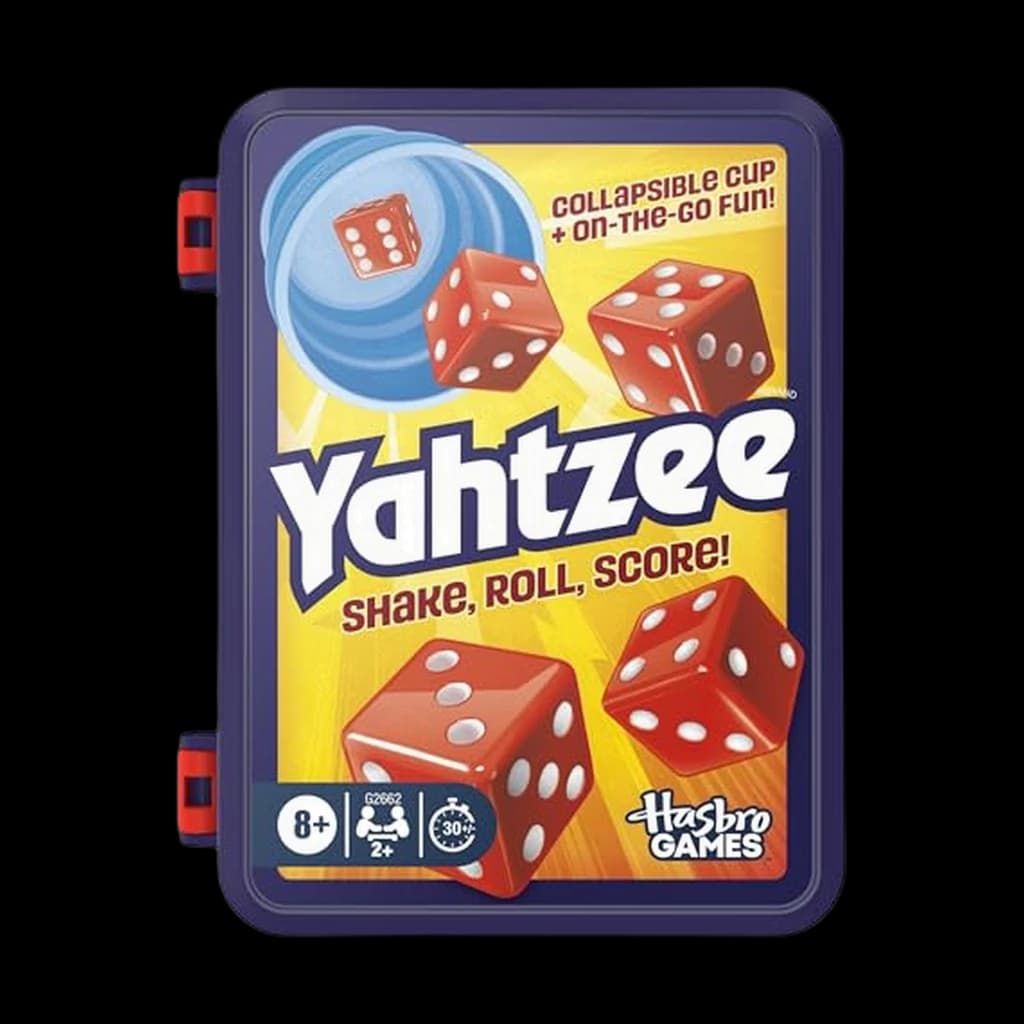
Hasbro Yahtzee (Collapsible Cup Edition)
- Universally familiar - almost nobody needs the rules explained
- Collapsible cup and case with a built-in rolling tray keep everything in one box
- 30-minute play time fits into any game night without dominating it
Hasbro's current edition of the game these rules come from: five dice, a collapsible cup and a case that doubles as a rolling tray.
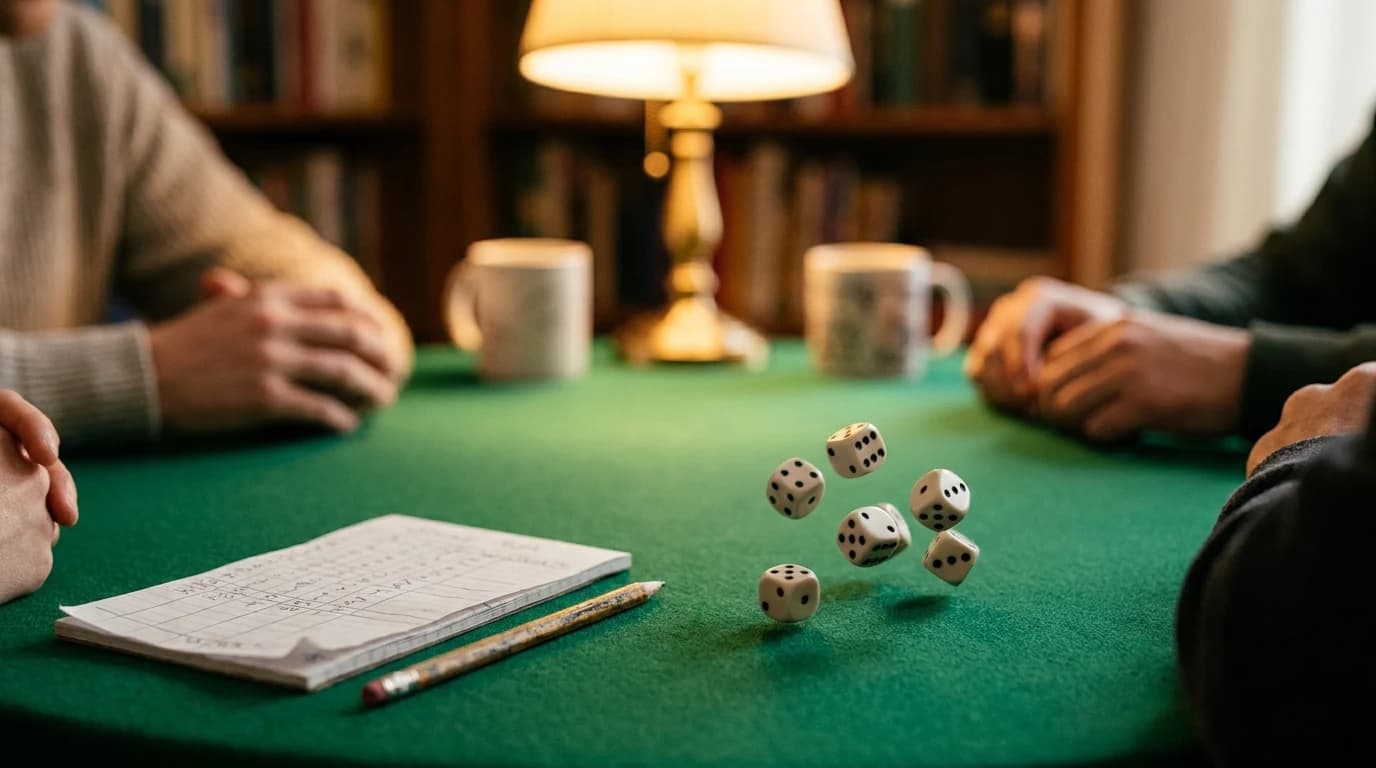
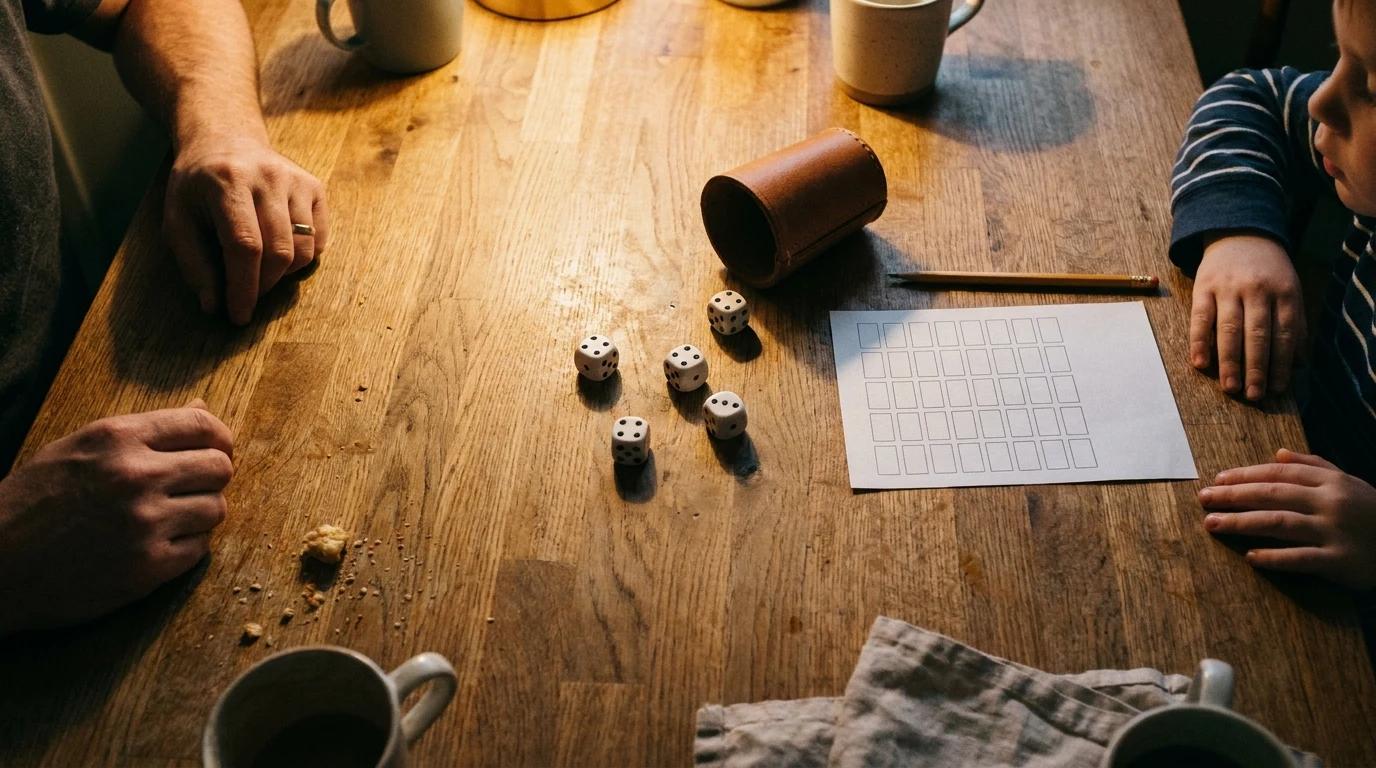
Yahtzee needs five six-sided dice, a pencil and a score card. Hasbro's official instructions list the boxed contents as 5 dice, a dice cup, 10 bonus chips and a score pad, and the game works for one player or more. Each player fills 13 boxes over 13 turns, and the highest grand total wins.
This guide teaches the turn and the score card from those instructions. Then it adds what the rules sheet leaves out: how often each box actually comes up.
A turn, roll by roll
- Roll all five dice. You may stop and score right away, or set aside any "keepers" and roll the rest.
- Roll again. Reroll any or all dice, including keepers from the last roll. You never have to announce what you are going for.
- Roll a third time, if you like. After the third roll you must fill a box.
- Fill exactly one box. Write the score, or a zero if the dice do not fit (or you choose a box they do not fit). Each box is used once per game, in any order.
To pick who starts, everyone rolls all five dice and the highest total goes first. Play passes to the left.
The rule people miss: keepers are not locked. A die you set aside on the first roll can go back in the cup on the second.
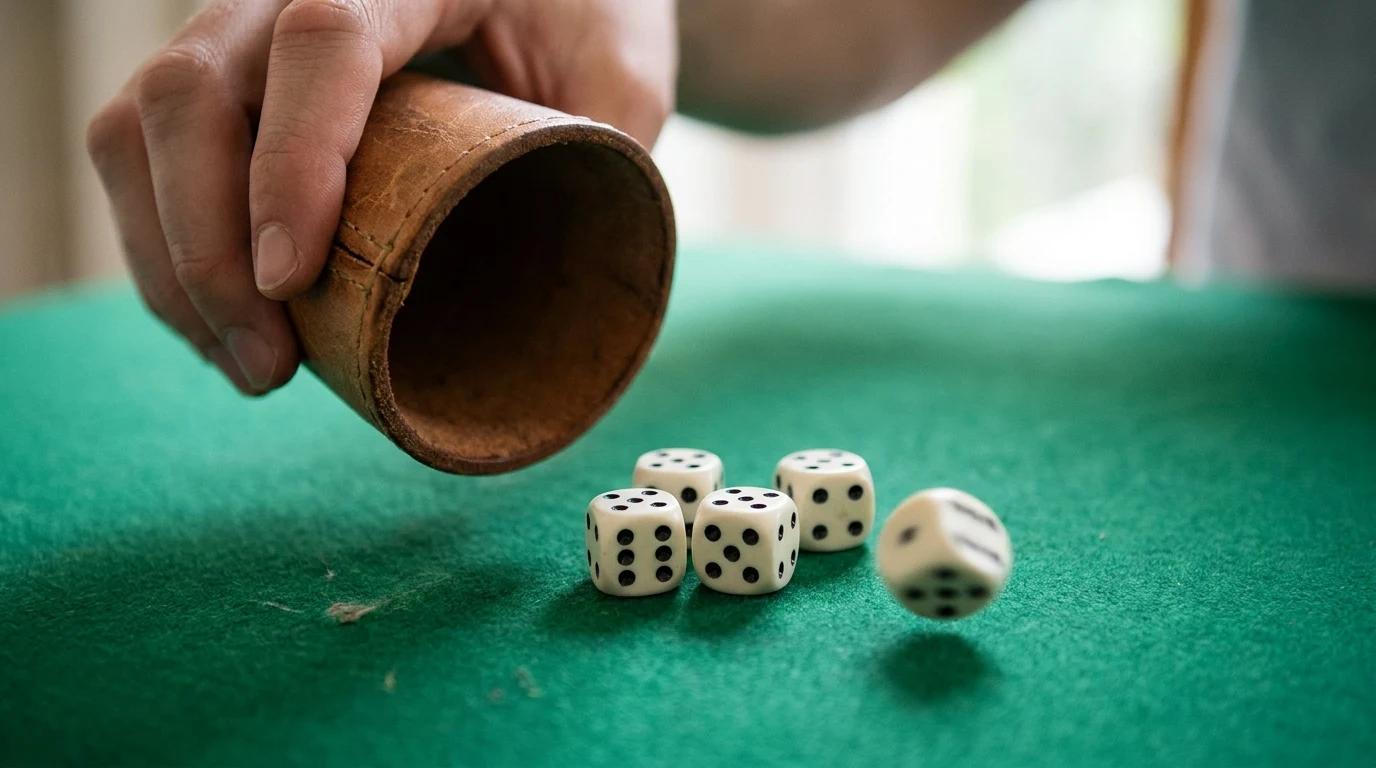
The 13 boxes, scored and ranked by odds
The upper section has six boxes, Aces (ones) through Sixes. Each scores the total of that one number only: three 4s in the Fours box is 12.
The lower section scores combinations. The two right-hand columns are our own calculation: we enumerated every possible roll and, for each box, took the best keep-and-reroll choice for that box alone.
| Box | Needs | Scores | First roll | Within one turn |
|---|---|---|---|---|
| 3 of a Kind | 3+ of one number | Total of all 5 dice | 21.3% | 74.3% |
| 4 of a Kind | 4+ of one number | Total of all 5 dice | 2.0% | 29.1% |
| Full House | 3 of one number + 2 of another | 25 | 3.9% | 36.3% |
| Small Straight | Any run of 4 | 30 | 15.4% | 61.5% |
| Large Straight | A run of 5 | 40 | 3.1% | 26.1% |
| Yahtzee | 5 of one number | 50 | 0.08% | 4.6% |
| Chance | Anything | Total of all 5 dice | 100% | 100% |
The Yahtzee figure matches the Yahtzee Manifesto odds page, which gives 4.61%, or about 1 in 22. Its full house (28.6%) and large straight (32%) figures differ from ours. That is what happens when two calculations assume different keep strategies, so treat any single "odds of a full house" figure as tied to its method.
How to read it: a Yahtzee is roughly a 1-in-22 turn even when you chase it from the first roll. A small straight lands more often than not.
Why 63 is harder than three of each
Score 63 or more in the upper section and you earn a 35-point bonus. Hasbro frames 63 as three of each number, but any mix that adds up counts.
| Box | Three of them (par) | Four of them | Over par |
|---|---|---|---|
| Aces | 3 | 4 | +1 |
| Twos | 6 | 8 | +2 |
| Threes | 9 | 12 | +3 |
| Fours | 12 | 16 | +4 |
| Fives | 15 | 20 | +5 |
| Sixes | 18 | 24 | +6 |
Now the uncomfortable number. If you spend a whole turn chasing one number, keeping every match and rerolling the rest, each die has about a 42% chance of ending on it. That averages 2.1 matching dice, not three.
Here is how that one-number chase ends, by our binomial calculation:
- Three or more matches: 35.5% of turns
- Exactly two: 34.4%
- One or none: 30.1%
So par is not the typical outcome of a dedicated turn. The bonus is usually built from rolls that hand you four of a number, especially Fives and Sixes, where one over-par box covers a missed low one.
Bank an upper box when:
- you hold four of a number, which puts that box over par by its face value
- you hold three of a number you still need, which is exactly par
Hold off when:
- you have only two of a number, which leaves that box one face value under par
- Chance or a lower box can take the turn without costing you par
A second Yahtzee: bonus first, then the Joker
If your Yahtzee box already holds a 50, every further Yahtzee earns a 100-point bonus. Take a bonus chip and tick the Yahtzee Bonus box. You still fill a box that turn, under Hasbro's Joker rules:
- Matching upper box open? Score the five dice there. Five 4s go in Fours for 20.
- Already filled? Use any open lower box at full value. A Joker scores 25 as a Full House, 30 as a Small Straight or 40 as a Large Straight, even though five of a kind is none of those.
- Matching upper box and every lower box filled? Enter a zero in any open upper box.
The zero trap: if you scratched your Yahtzee box with a zero, a later Yahtzee earns no 100 bonus. The Joker rules above still apply.
The free-choice variant
Wikipedia's Yahtzee entry calls the official order the Forced Joker rule. It also describes a free-choice version, where you may score anywhere. Under that version, the Joker values for Full House and the straights count only once the matching upper box is used.
Settle these before the first roll
- Joker rule: forced (the box rules) or free choice?
- Five of a kind as a Full House: not in the official rules. A full house needs three of one number and two of another.
- Ties: the rules do not say. Pick a tiebreak, such as a single roll-off.
The theoretical ceiling is 1,575: thirteen Yahtzees, twelve 100-point bonuses and Jokers in the three fixed-score boxes, per Wikipedia's maximum-score section. The same entry notes that Phil Woodward solved the game by computer in 2003, with optimal play averaging about 255.
How this was sourced
This is research and arithmetic, not a play-test. Rules come from Hasbro's instruction sheet, read November 6, 2026. The odds come from our own exact calculation over every possible roll.
Our dice pick for this is the Hasbro Yahtzee collapsible cup edition. If your table wants push-your-luck instead, the Farkle rules guide compares four scoring tables, and dice games beyond Yahtzee ranks what to play next.
Common questions
Does a Yahtzee count as a full house?
What if I already put a zero in the Yahtzee box?
Do I have to say what I am rolling for?
Can I score after my first roll?
What is the highest possible Yahtzee score?
Research Sources
- Hasbro — Yahtzee instructions PDF (turn rules, score card boxes, 63-point bonus, Yahtzee bonus and Joker rules)
- Wikipedia — Yahtzee: Forced and free-choice Joker rules
- Wikipedia — Yahtzee: maximum score of 1,575 and the 2003 computer solution
- Yahtzee Manifesto — Yahtzee odds and probability (4.61% Yahtzee in one turn)