Key takeaways
- Most of what damages a collection is mechanical — crushed corners, sagging lids, worn card edges — and none of it is fixed by a storage bin.
- The Library of Congress target for this material is 70F or below and 30-55% relative humidity, in a room that does not swing, and never a basement, attic or garage.
- Mould on clean paper and board typically needs 80-85% relative humidity; a dirty or sticky surface moulds at far lower levels, so cleaning a box is preservation, not tidying.
- Fading is the only failure with no recovery path, and light damage scales with intensity: direct sun is roughly 1,000 times harsher than good museum display lighting.
- Put the empty punch frames back under the plastic insert. It stops the contents shifting, which makes vertical versus horizontal storage a non-question.
On this page
Most advice about storing board games is really advice about shelving them. Shelving is a space problem. Keeping a collection in the condition you bought it is a materials problem, and the two have different answers.
The materials answer has been published for decades, because a game box is the same stuff a library worries about: printed, coated, glued paperboard. The Library of Congress puts safe storage for that material at 70 degrees Fahrenheit or below and 30 to 55 percent relative humidity, in a room without frequent extreme swings, with minimal light — and it names basements, attics and garages as unsuitable outright. That one sentence settles more storage arguments than any bin recommendation.
What actually goes wrong first
Before choosing a shelf, know what you are protecting against. These are the failure modes a collection actually accumulates, and whether you can walk any of them back.
| Part of the game | How it fails | Can you undo it? |
|---|---|---|
| Box corners and edges | Crushing and corner splits from stacking, and from tugging a box off a packed shelf | No — structural |
| Box lid and base | Bowing and sag when weight rests on an unsupported lid | Sometimes, if caught early |
| Punchboard and tiles | Soft, furred edges from punching and handling | No |
| Cards | Edge wear, bends and creases from shuffling | No |
| Printed box art, fabric bags | Fading | No — cumulative |
| Any of the above, in damp air | Warping first, then mould | Warping sometimes; mould, no |
Every line of that table applies just as squarely to a jigsaw collection, which is the same coated board in a thinner box — the brands we rank in the premium jigsaw comparison differ mainly in how much of that board they put behind the printed face. Notice how little of that list is a humidity problem. Most of it is mechanical, and mechanical damage is decided by how the box is packed and loaded — not by which room it sits in.
The vertical-versus-horizontal argument is the wrong argument
Both work. Standing boxes on edge avoids crush from a pile; laying them flat avoids sag on a weak lid but loads the bottom box. Pick whichever your shelf depth supports.
What is inside the box matters far more. Writing for MeeplemeepleWooden person-shaped game token, named for the original Carcassonne workers. Now genericized to describe any small wooden character token. Mountain, former board game café curator Kurt Refling makes the point that a game is packaged to ship, not to store: once the punchboards are empty, the insert sits low and the contents rattle under a half-empty lid. Slide the empty punch frames back underneath the insert and the tray rises flush against the lid. Nothing shifts, in any orientation.
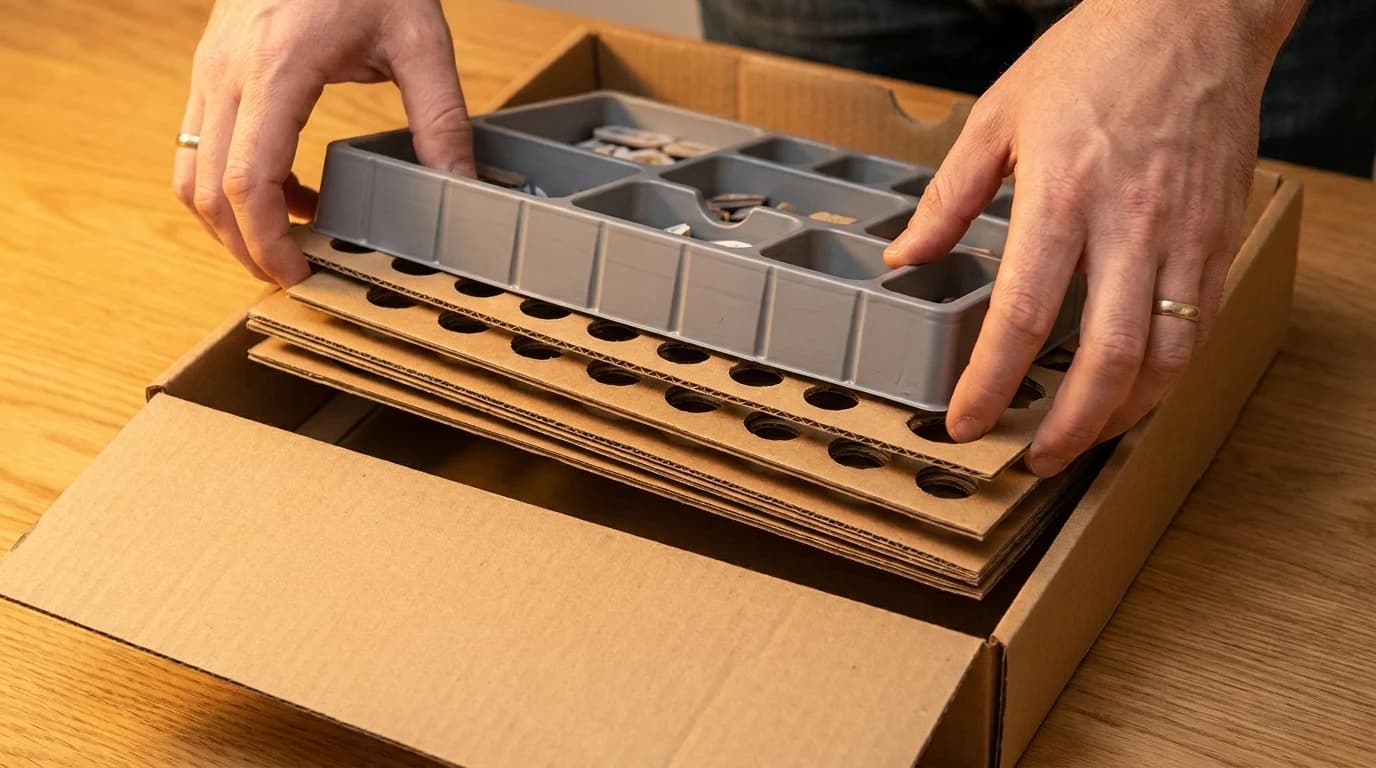
Rule of thumb: orientation decides whether a box gets crushed or sags. What is inside the box decides whether either one ever matters.
Set the room, not the shelf
Those targets are a room specification, not a shelf specification. Moving the shelf to a better room beats any gadget added to a bad one.
| Where games commonly live | Against the published target | Worth it? |
|---|---|---|
| Interior closet or living-room shelf, out of direct sun | Heated and cooled with the rest of the house; swings are small | Yes — the default answer |
| Spare bedroom against an exterior wall | Fine on temperature; watch for a cold wall and a sunny window | Yes, with the shelf pulled off the wall |
| Basement | Named unsuitable by the Library of Congress; flood and leak risk | No |
| Attic or garage | Named unsuitable; the widest temperature and humidity swings in the building | No |
The Canadian Conservation Institute's guidance on incorrect relative humidity also quantifies how much a swing has to be before it matters: its damage table shows plus or minus 5 to 10 percent RH producing no damage to tiny damage across most sensitivity classes, while the severe outcomes sit at plus or minus 40 percent. Chasing a perfectly flat number in a normal home is effort spent on the wrong threat.
The mould number nobody quotes
"Humidity ruins games" is repeated everywhere without a threshold, which makes it unusable. The same CCI guidance gives one. Damp begins above 75 percent RH. For clean plant-based material — clean paper, clean wood, clean textiles, which is most of a board game — mould growth typically requires 80 to 85 percent RH before it is likely at all.
The interesting half is the exception. Paper and board with a surface rich in starch, sugar or plain dirt moulds far sooner: CCI's table gives roughly 100 days at 70 percent RH, about 10 days at 80 percent, and around 2 days at 90 to 100 percent. A grubby box is a different material from a clean one.
The counter-claim: in a house you heat and cool, humidity is usually not the active threat. Wiping a sticky box down does more for its mould resistance than a desiccant pack does, because a clean surface needs far more moisture before anything grows.
Light is the damage that does not undo
Fading is the one failure with no recovery path, and it is the one people design their shelving around — straight into the brightest wall in the house.
CCI's note on light, ultraviolet and infrared puts it simply: the rate of light damage is proportional to intensity, and the step from good museum display levels to direct sunlight is a factor of about 1,000. Dose is intensity multiplied by time, so a box in a sunbeam accumulates in days what a box across the room takes years to reach.
- Move the shelf, not the box. A wall opposite a window is dramatically kinder than the wall beside it.
- Close the curtains in rooms you do not sit in. Dose accrues whether or not anyone is home.
- Treat display pieces as a deliberate trade. A game on show is being spent — a fine choice, made knowingly.
What earns its place, and what does not
Actually protects a collection:
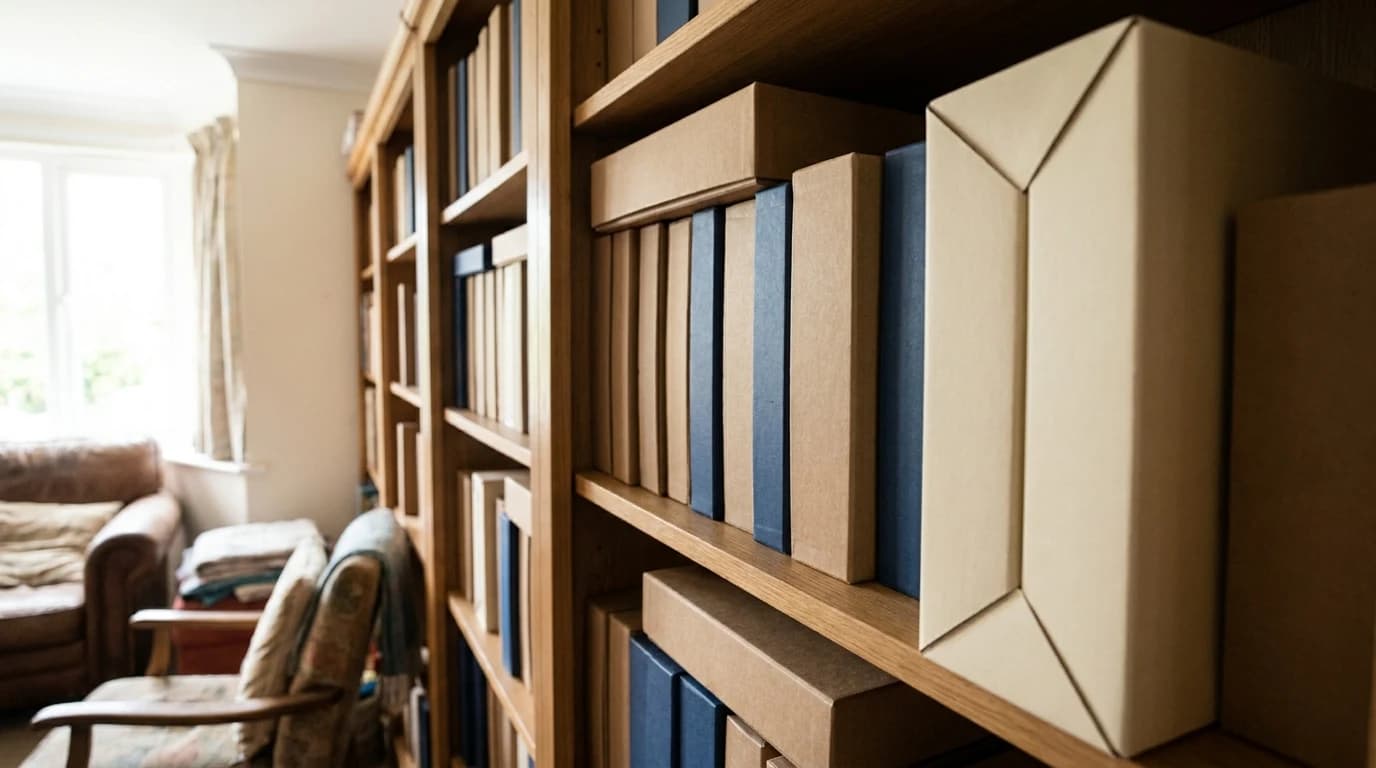
- A shelf in a room you already heat and cool, out of direct sun.
- Empty punch frames left in the box, under the insert.
- A tray organiser for games whose insert has given up, so components stop grinding against each other — the Smonex universal organiser is the version we rate for that job.
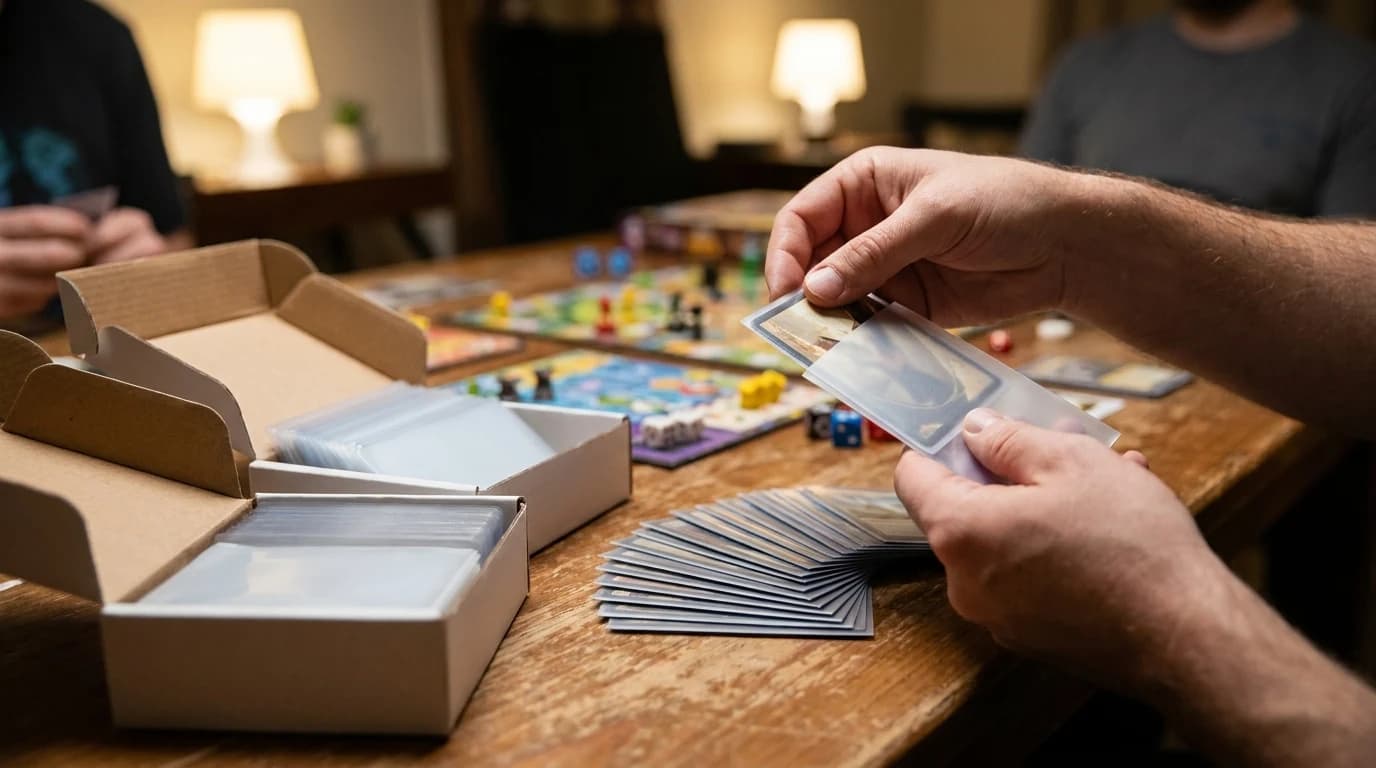
- Sleeves on the two or three games you shuffle hardest. Dragon Shield matte sleeves are the default pick; the rest of what we have evaluated sits in board game accessories.
- Clean hands, and a clean box surface.
Rarely earns its place:
- Desiccant packs in a climate-controlled room, which is already far below the mould threshold.
- Shrink-wrapping or vacuum-bagging a box. Sealing does not dry anything; it traps whatever air the room had at the moment you closed it.
- Sturdy bins on a garage or basement floor. The container does not fix the location, and the location is the part the published guidance rules out.
- Sleeving an entire collection. Sleeves earn their cost where shuffling is heavy, not on a game played twice a year.
The ten-minute shelf audit
Run this once and most of the work is done permanently.
- Stand in the room at midday and find which shelves take direct sun. Move those games first.
- Pull the shelf an inch or two off an exterior wall so air moves behind it.
- Open the five heaviest boxes and put the punch frames back under the insert.
- Take anything currently in the basement, attic or garage out of it today.
- Wipe down the boxes that feel tacky — those are the ones with the low mould threshold.
- Pick the two games your group shuffles most and sleeve only those.
None of that is a purchase, which is the honest headline. If you are protecting resale value rather than play value, the sealed-set economics matter more than the shelf — and if the shelf is full, the harder question is which expansions were worth buying.
Your next step
Protecting what's already on the shelf? Start with the kit that earns it.
Common questions
Should board games be stored vertically or horizontally?
What humidity level actually causes mould on board games?
Is it safe to store board games in a basement, attic or garage?
Do I need to sleeve all my board game cards?
Does sunlight really fade board game boxes that much?
Research Sources
- Library of Congress - Storing Your Books: 70F or below, 30-55% relative humidity, minimal light, and basements, attics and garages named unsuitable
- Canadian Conservation Institute - Agent of Deterioration: Incorrect Relative Humidity (damp above 75% RH; mould thresholds for clean versus contaminated organic material; RH fluctuation damage table)
- Canadian Conservation Institute - Agent of Deterioration: Light, Ultraviolet and Infrared (damage rate proportional to intensity; roughly 1,000x from museum levels to sunlight; dose as intensity x time)
- Meeple Mountain, Kurt Refling - Protecting Your Game Collection: games are packaged to ship rather than to store, and empty punch frames belong under the insert