Key takeaways
- Do not buy expansions for a game you have not worn out. More content is not the same as more fun.
- The best expansion solves a named friction: stale openings, samey factions, weak 2-player mode, or exhausted scenarios.
- Fixer expansions are a warning sign. If the base game needs a patch to feel good, buy a different base game first.
- Setup and teach time are real costs. An expansion that adds 20 minutes before play can be anti-value for family game night.
On this page
Quick answer
Do not buy a board game expansion until the base game has a named problem. "We like it" is not a problem. "The same two factions keep winning," "we have solved the opening," "we need it to work better at two," or "we finished the campaign" are problems.
The one rule: buy when the base game asks for help, not when the shelf looks unfinished. That prevents the most common money trap in board games - buying more box before the table has asked for more game.
The 5 expansion types
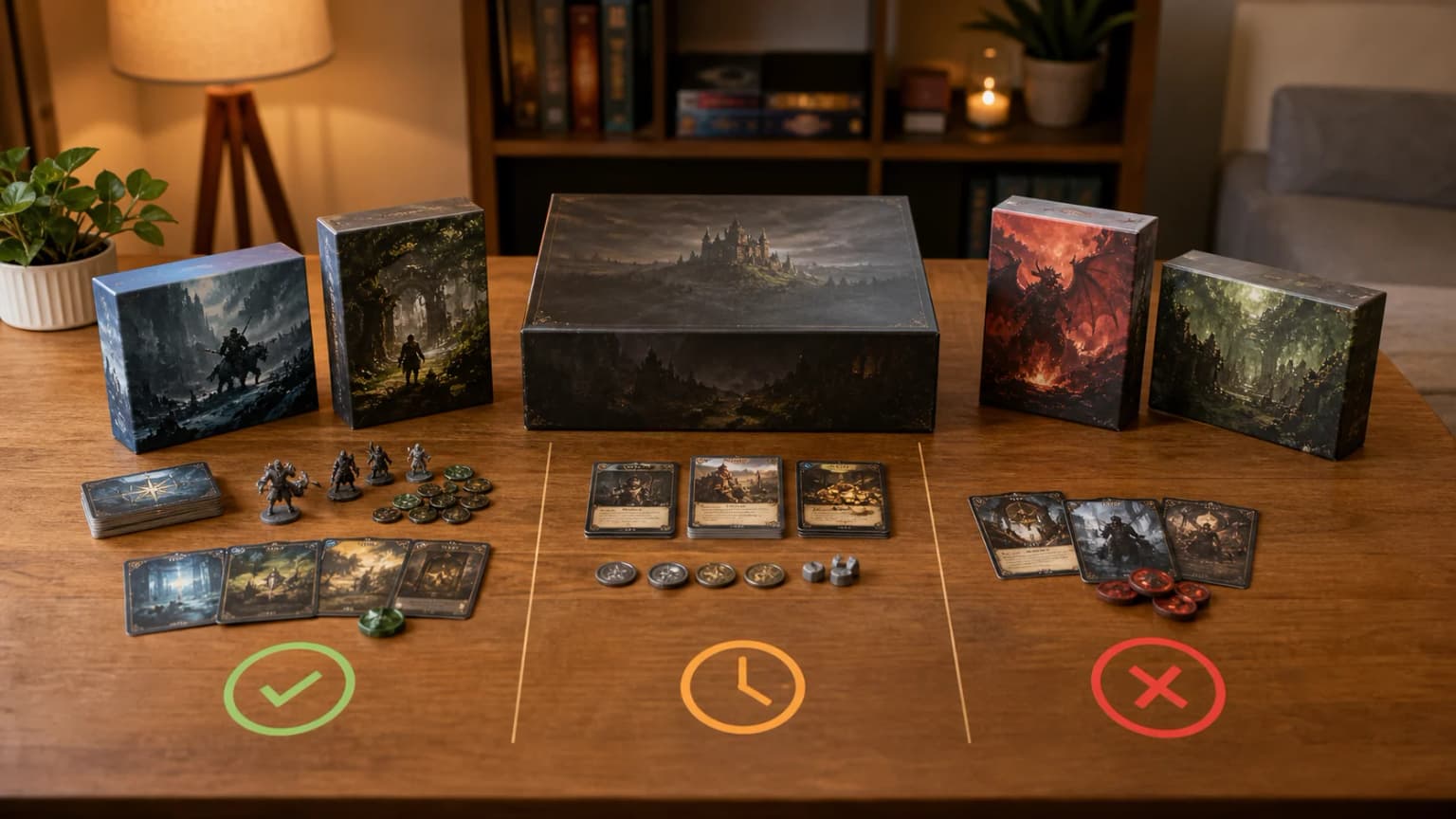
Use the table below before buying. Expansions are not one category. Some add real replay value. Some add storage, setup time, and another rule explanation before anyone is having fun.
| Type | Buy it when | Skip it when |
|---|---|---|
| More-of-the-same | Base game is familiar | Most of the box is unseen |
| Modular variety | You want fresh surprises | Rarely - usually the best type |
| Campaign / legacy | The same people meet regularly | Your group changes constantly |
| Quality-of-life box | The game is already a staple | You're forcing yourself to play |
| Fixer expansion | You accept the base game's flaw | A different game would serve better |
1. More-of-the-same content
New cards, maps, enemies, and scenarios are valuable when the base game is familiar. They are wasteful when the group has not seen most of the original box. Wait until the base game has at least 10 plays or your group can name the stale part.
2. Modular variety
These are often the best expansions. They change setup, powers, goals, or modules so the base system keeps surprising the table. The key is optionality: you can add a module without teaching a second game.
3. Campaign or legacy continuation
Great for committed groups, bad for aspirational shelves. If the same people will meet regularly, this can be the highest-value expansion type. If your group changes constantly, a campaign box turns into homework.
4. Quality-of-life and upgrade boxes
Better trays, coins, miniatures, and deluxe bits feel good. They rarely create more game nights. Buy these after a game is already a staple, not as a way to make yourself play it.
5. Fixer expansions
Be careful. If an expansion is famous because it fixes the base game, ask why you are buying the flawed base in the first place. Sometimes the answer is valid. Often the better answer is a different game.
Signs you are ready
You are ready for an expansion when someone at the table can finish this sentence: "I wish this game had more _____."
Good ways to finish that sentence:
- More routes, more factions, more hard scenarios
- Better two-player tension
- A shorter setup tray
Reasons that are fear, not play value:
- Fear the base game will go out of print
- Fear you are missing the complete experience
- Fear the collection looks unfinished
The blank matters. Fear-buying is collecting, not play value. Collecting is fine - just do not confuse it with a smarter buy.
Concrete examples
For gateway games, expansions are often best after the base has become a family default. If your group is still learning modern games, start with the picks in our gateway board games guide before adding modules.
For two-player games, an expansion only helps if it supports the player count you actually use. A brilliant four-player module is dead weight for a couple that plays weeknights. Use our best 2-player board games list as the base-game filter first.
For complexity, check the weight jump. If an expansion turns a 2.2-weight family game into a 3.1-weight teach, that is not free replay value. Read how to read a board game weight rating before assuming heavier means better.
The bloat test
Before checkout, ask four questions:
- Does this solve a problem we have named?
- Does it add less than five minutes to setup?
- Can we teach it in one sentence?
- Will it get used in the next two sessions?
If you get three yes answers, buy. If not, wait. The expansion will still be there, and if it is not, you just saved yourself from a box you were not actually playing.
Bottom line
The best expansion is not the one with the most content. It is the one that removes a specific friction from a game your group already loves.
Worth remembering: buy when the base game asks for help. Skip when the shelf is the only thing asking.
Your next step