Key takeaways
- Independent play means the child directs their own play — it is NOT a screen handoff, which is passive and does the opposite job.
- A 2023 Journal of Pediatrics review (Gray et al.) links the decades-long decline in children's independent, self-directed activity to the parallel rise in childhood anxiety and depression.
- The mechanism is internal locus of control: kids build the sense they can solve their own problems only by being allowed to, without an adult swooping in.
- There's no certified daily dose; the research supports a trajectory — short supervised stretches early, longer and more independent blocks as the child grows, with boredom treated as a creativity prompt, not an emergency.
On this page
The short answer: more than most parents currently allow
If you are wondering how much your child should be playing by themselves — without you directing, narrating, or hovering — the research points in one direction: more than they probably get now. The decline in children's free, unsupervised, self-directed time over the last few decades tracks closely with a long-running rise in childhood anxiety and depression. The fix is not a better toy or a more enriching adult-led activity. It is stepping back and letting a child run their own play.
This is the part that trips people up.
What independent play is:
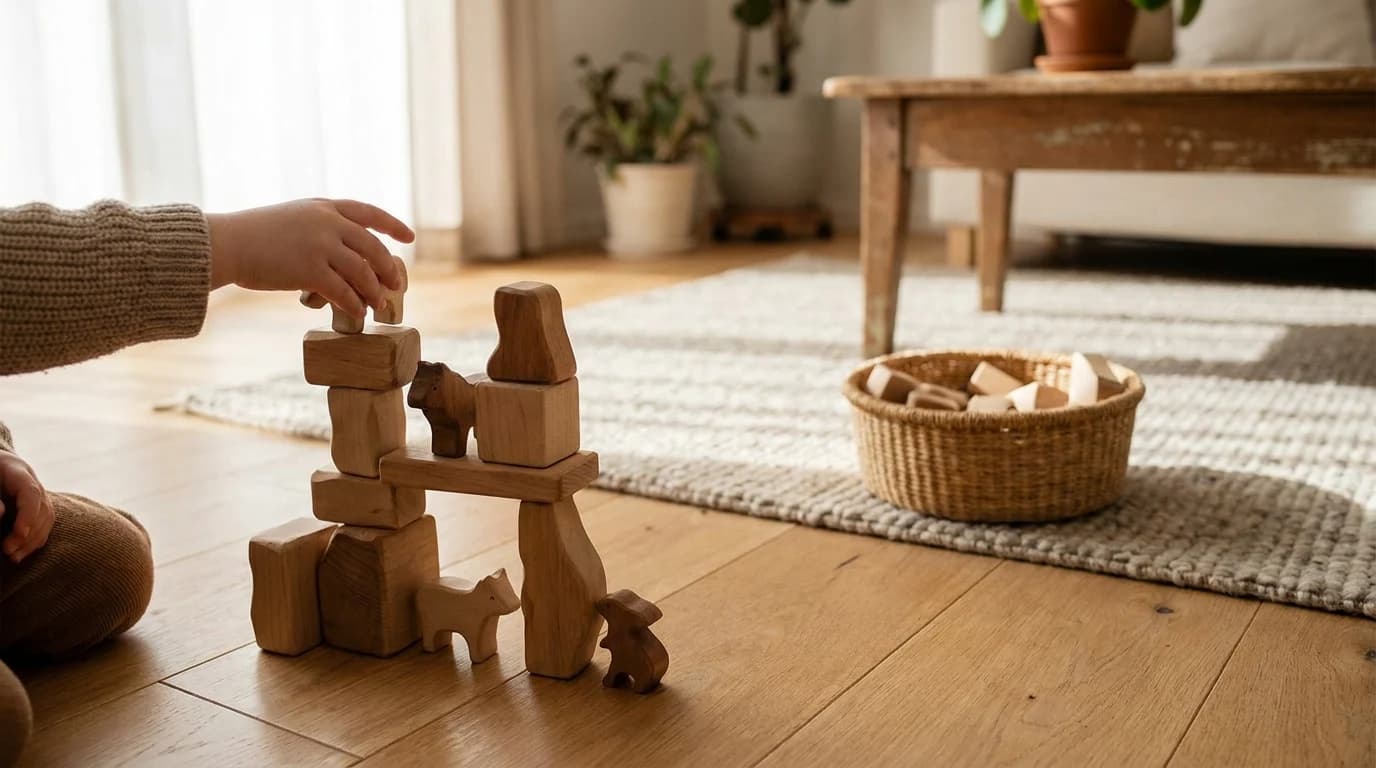
- The child chooses what to do and sets their own rules
- They hit small problems and solve them without an adult swooping in
- It can be boring, unsupervised, and occasionally frustrating
What it is not:
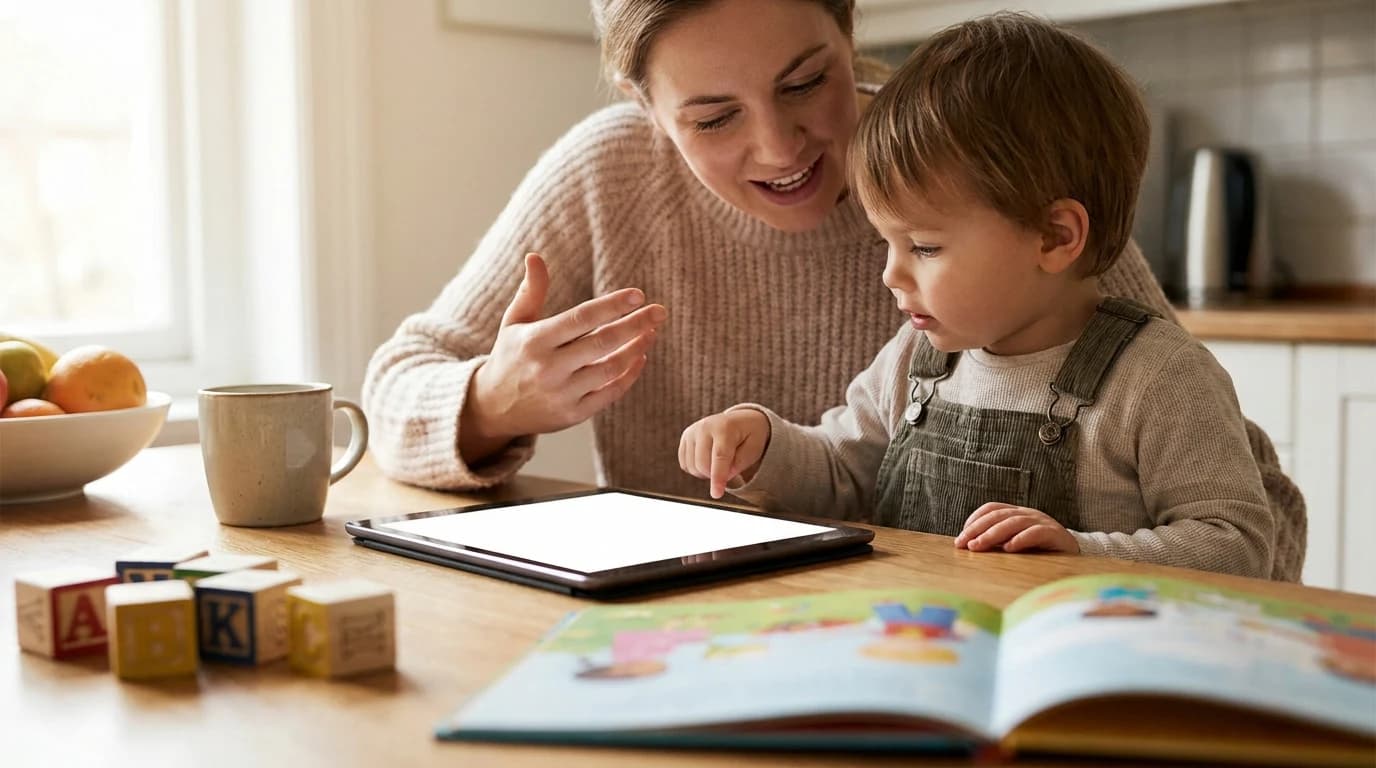
- Handing over a tablet so you get a break
- An adult-led activity with the child following along
That first kind of experience is doing the developmental work that no structured class can replicate.
What the research actually says
The strongest recent statement of the case is a 2023 review in The Journal of Pediatrics by psychologist Peter Gray and colleagues, titled Decline in Independent Activity as a Cause of Decline in Children's Mental Well-being. Their argument, drawing together decades of evidence: as children's opportunities for independent activity have shrunk — more adult supervision, more structured schedules, fewer chances to roam, decide, and self-direct — measures of children's mental health have worsened over the same period.
The proposed mechanism is a sense of control
The mechanism is internal locus of control — the sense that you can affect what happens to you. In a Harvard Graduate School of Education interview, Gray puts it bluntly:
"If you don't have a strong internal locus of control, that sets you up for anxiety and depression... that's the kind of sense of helplessness that gets created when we deprive children of the opportunity to learn that they can do things, they can solve problems on their own."
Self-directed play is where that control is built. UNICEF's child-development guidance makes the same point from the skills side: during free play, "they can try to solve a problem or come up with a solution on their own while playing... those skills develop when a child is playing independently."
The distinction worth holding onto: a class teaches the lesson the adult planned. Independent play teaches the child to run the lesson.
What most parents get wrong
Three assumptions are worth puncturing:
- "Independent play = screen time." A child watching a tablet is not playing independently — they are being entertained passively. The benefits above come from active, self-directed play: building, pretending, drawing, taking things apart. The screen does the deciding; that is the opposite of what builds locus of control. Audio is the honest middle ground here — a story player occupies the ears and leaves the hands and the deciding to the child, and the screen-free audio players we rank are built for exactly that.
- "More enrichment is always better." A schedule packed with adult-led classes, however good each one is, leaves no room for the unsupervised time that does this particular job. The AAP's Power of Play guidance is explicit that "boredom allows for creativity" and that playful learning should be "where children take the lead and follow their own curiosity." Boredom is not a failure state to be solved with another activity — it is the on-ramp to invention.
- "They need me in there playing with them." Sometimes, yes — guided play with a caregiver is genuinely valuable. But it is a different tool. If an adult is always in the play, the child never practices being the one in charge. The skill being built when you step back is precisely the skill you cannot teach by staying in.
How much, by age
There is no certified daily-minutes prescription, and any number that claims to be one is marketing. What the developmental sources support is a trajectory: short, supervised stretches early, expanding into longer, more independent blocks as the child grows.
| Age | What "independent play" looks like | Your role |
|---|---|---|
| 6–18 mo | A few minutes of solo exploration with you nearby and visible | Stay in the room, resist narrating every move |
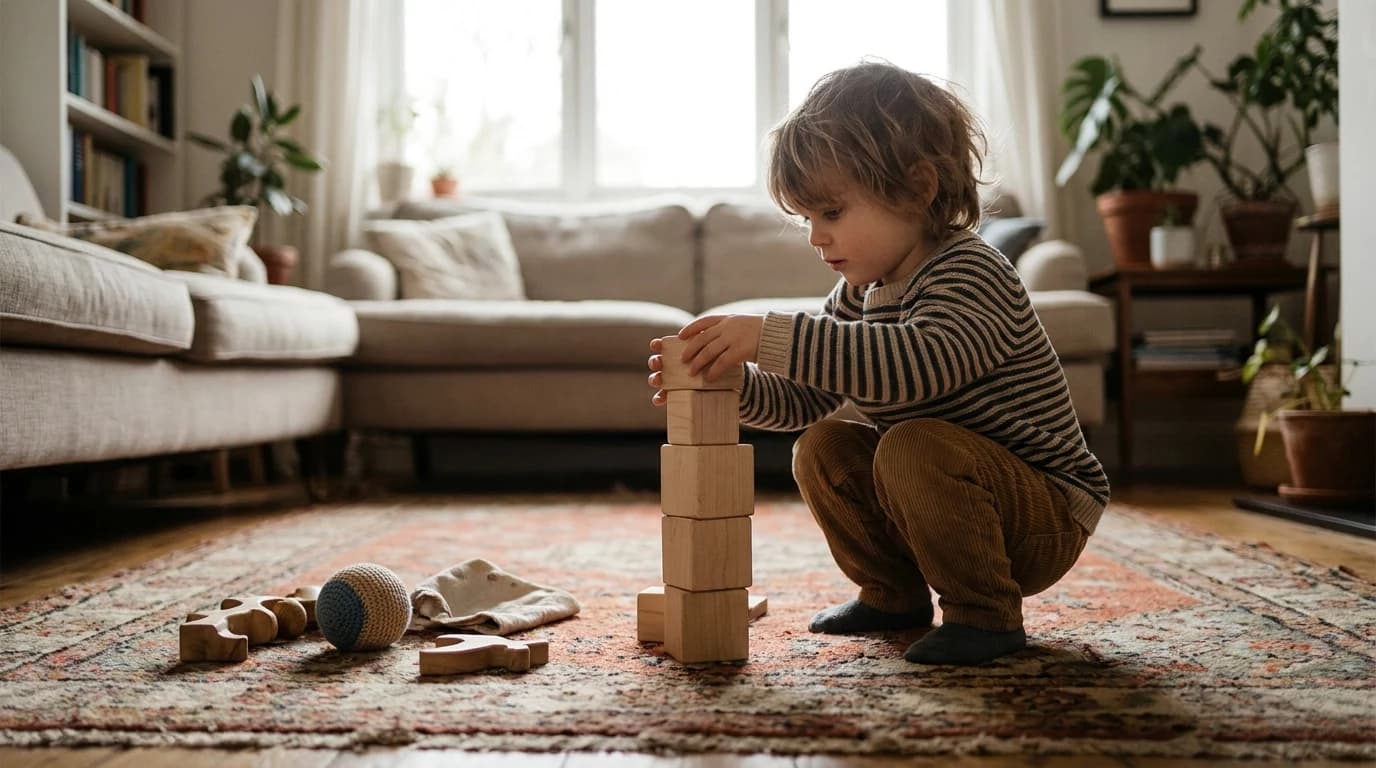
| 18 mo–3 yr | 10–30 min stretches; open-ended toys (blocks, figures, cups) | Supervise from a distance; let small struggles play out |
| 3–5 yr | 30–60 min of self-chosen pretend, building, art | Provide props, not plots; tolerate mess and boredom |
| 6–9 yr | Long, self-organized play; outdoor and with peers | Step back further; allow manageable risk and problem-solving |
UNICEF notes that supervised free play can start as early as 6 months — the supervision is for safety, not direction. The shift over time is not "more play," it is more independence within the play and a steadily smaller adult footprint.
How to actually do it (the part that's free)
You do not buy your way into this. You subtract.
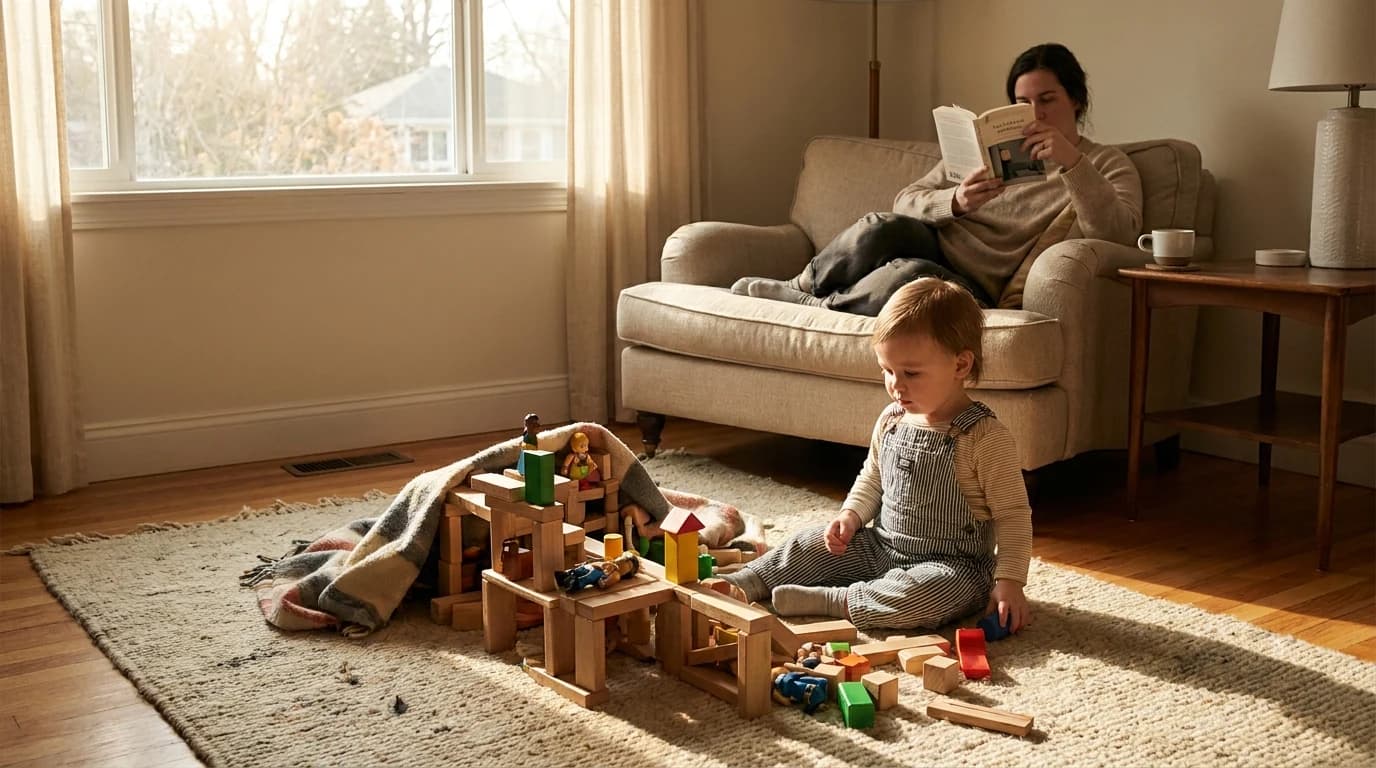
- Set the stage, then leave it. Put out a small set of open-ended materials, say "I'll be right over here," and physically step back. Availability without supervision is the target.
- Don't rescue the first frustration. The moment a tower falls or two kids disagree is the moment the work happens. Give it a beat before you intervene.
- Let boredom sit. "I'm bored" is not an emergency to fix with a new activity or a screen. The AAP treats boredom as a creativity prompt — most kids invent something within a few minutes if nothing is handed to them.
- Protect unscheduled time. The single highest-return move is leaving blank space in the week. If every afternoon is booked, there is no room for the thing that matters most here.
- Keep guided play as a separate slot. Playing with your child is great — just don't let it be the only kind of play they get, or they never practice steering.
The honest caveat
Independent does not mean unsupervised in a dangerous sense, and it does not mean neglect. Young children still need an adult within earshot, and the developmentally appropriate amount of freedom scales with age and the specific child.
What the evidence can and cannot show
- The research is largely correlational and historical.
- It links the decline in independent activity to the decline in well-being across populations.
- It is not a randomized trial proving a dose.
What it is, is a strong and consistent signal, echoed by the AAP and UNICEF, that the modern default — more supervision, more structure, less self-direction — has overcorrected. For most families, the useful move is in one direction: hand a little more of the play back to the kid.
Sources & Research
Your next step
Looking for something a kid will stick with alone? Start here.
Common questions
Does independent play mean leaving my child completely unsupervised?
Is screen time the same as independent play?
How much independent play does a child need each day?
Should I still play with my child, then?
My kid says they're bored when left to play alone. What do I do?
Research Sources
- Gray P, Lancy DF, Bjorklund DF (2023), The Journal of Pediatrics 260:113352 — "Decline in Independent Activity as a Cause of Decline in Children's Mental Well-being: Summary of the Evidence"
- Harvard Graduate School of Education (EdCast, Feb 2024) — "Improving Mental Health Through Independent Play" (interview with psychologist Peter Gray on independent play, locus of control, and anxiety)
- UNICEF Parenting — "What is free play and why should you encourage it at home?" (free play builds problem-solving; can begin with supervision around 6 months)
- American Academy of Pediatrics (HealthyChildren.org) — "The Power of Play: How Fun and Games Help Children Thrive" (child-led play, "boredom allows for creativity," prescription for play)