Key takeaways
- "Educational," "STEM," "learning," and "Montessori" are unregulated marketing words — no agency certifies a toy as educational, so the label tells you almost nothing.
- A 2016 JAMA Pediatrics study found electronic "learning" toys produced fewer parent words, fewer conversational turns, and fewer child vocalizations than traditional toys or books.
- The AAP's 2018 Power of Play report links traditional, open-ended toys to richer language than electronic toys — and points to caregiver back-and-forth as the active ingredient.
- The label-proof test: does the toy leave the thinking to the child (good) or do the thinking for them by talking, singing, and praising (weaker)?
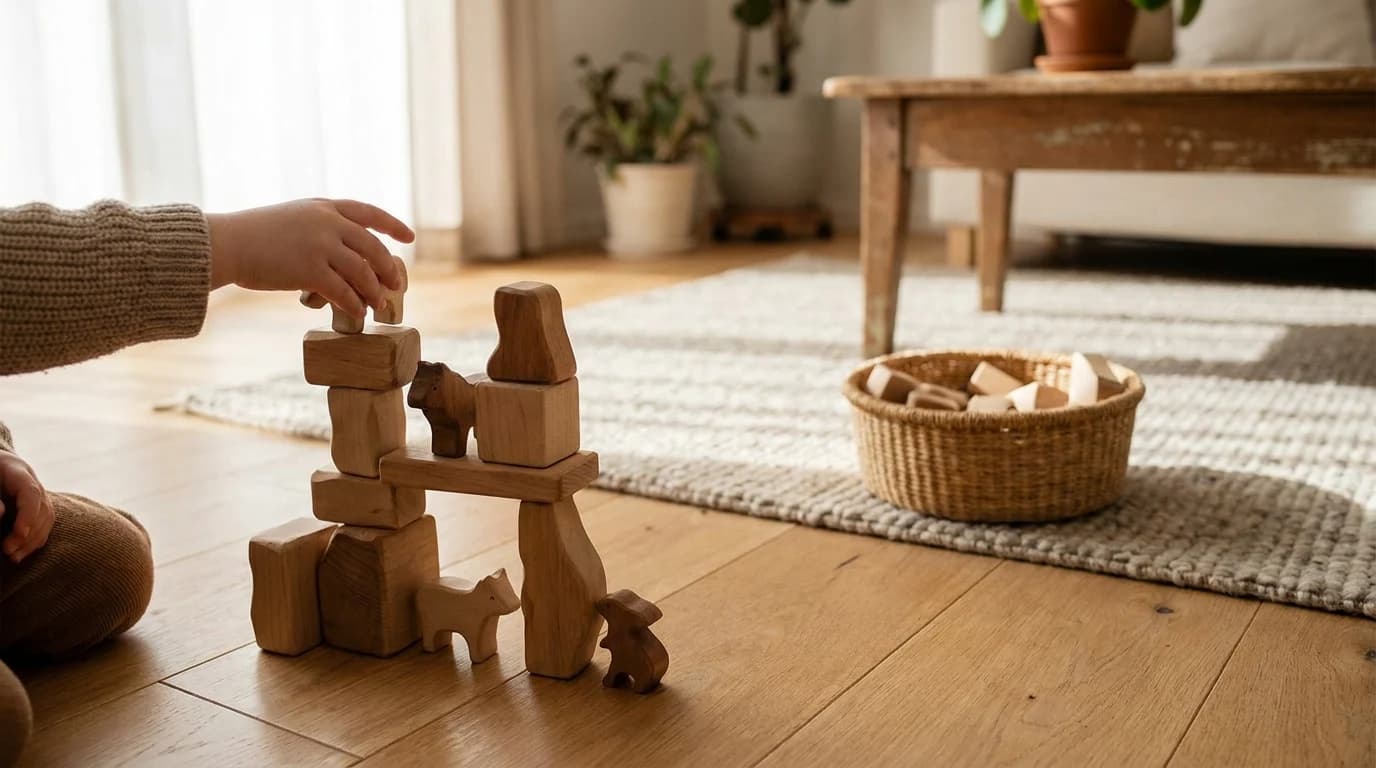
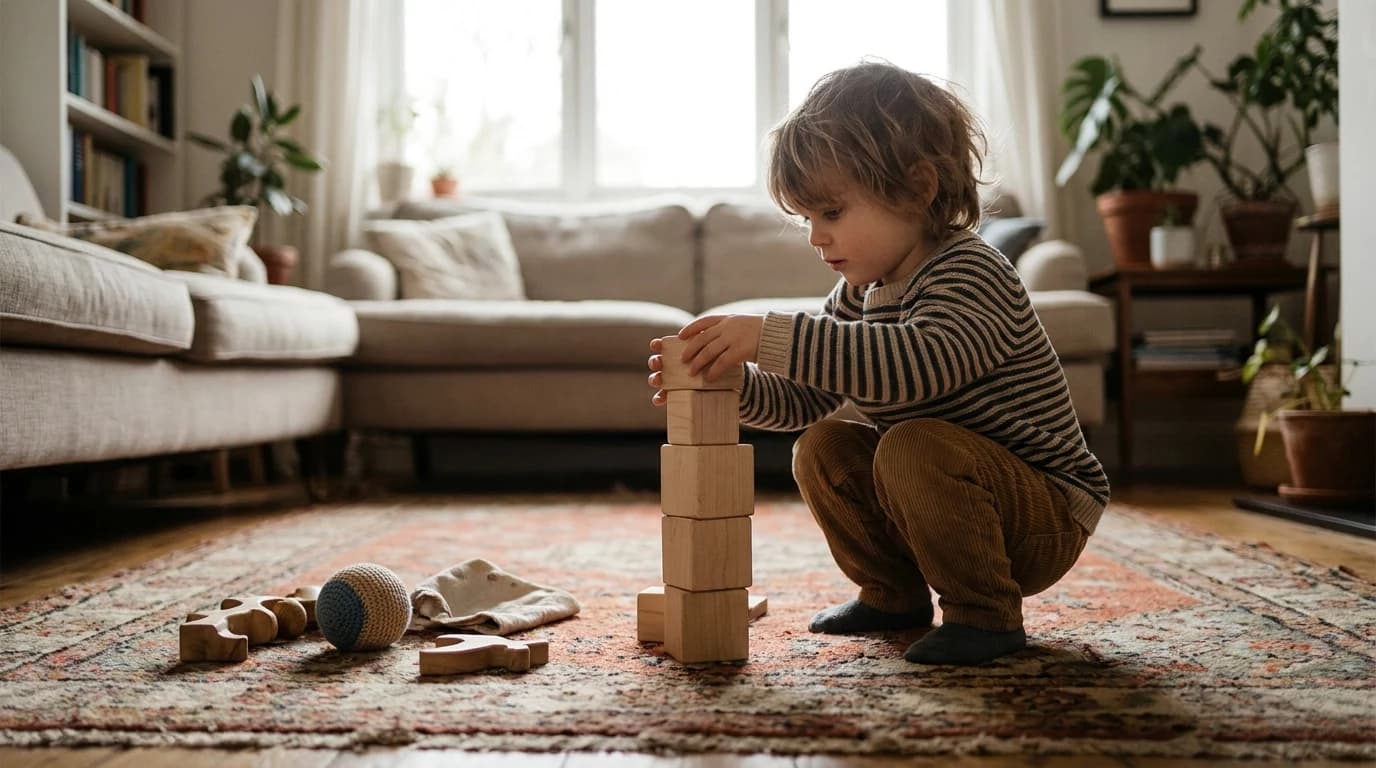
- Open-ended, quiet, finishable toys — even cardboard boxes and blocks — tend to out-teach glowing, battery-powered "developmental" plastic, for far less money.
On this page
"Educational" on a toy box is a marketing word, not a guarantee
Walk down any toy aisle and the boxes shout the same vocabulary: educational, STEM, learning, developmental, Montessori-inspired, brain-building. Here is the part the packaging will not tell you: none of those words have a regulated meaning. No agency certifies a toy as "educational."
A plastic dog that lights up and recites the alphabet can print "EDUCATIONAL" in big letters next to a wooden puzzle that says nothing, and the law treats both labels the same — as decoration.
The label-proof test: does the toy leave room for the child to do the thinking, or does it do the thinking for them? That question survives every marketing word on the front of the box.
The one finding that should reframe your shopping
The most useful study on this came out of the University of Northern Arizona and was published in JAMA Pediatrics in 2016. Researcher Anna Sosa recorded 26 families with 10-to-16-month-olds playing with three kinds of toys:
- Electronic toys — a baby laptop, a talking farm, a talking phone
- Traditional toys — wooden puzzle, blocks, shape-sorter
- Books
The electronic toys lost, and not by a little. Compared with traditional toys and books, play with the electronic "learning" toys produced:
| Measure | Electronic toys vs. traditional toys/books |
|---|---|
| Adult words spoken | Fewer |
| Conversational turns (back-and-forth) | Fewer |
| Parent responses to the child | Fewer |
| Child vocalizations | Fewer |
| Content-specific words (animals, colors, shapes) | Fewer |
In the researcher's words: the electronic toys were "associated with decreased quantity and quality of language input" during play. The toy that talked actually quieted the room — the parent stepped back and let the gadget narrate.
The AAP folded this into its own guidance
The American Academy of Pediatrics took it seriously enough to include in its 2018 clinical report The Power of Play (Yogman et al., Pediatrics), which states plainly that play with traditional toys was linked to better quantity and quality of language than play with electronic toys. The AAP's practical advice runs the opposite direction from the toy box: lean toward simple, open-ended toys, and remember that you — the back-and-forth with a caregiver — are the active ingredient, not the speaker inside the toy.
Why "doing the thinking for the child" backfires
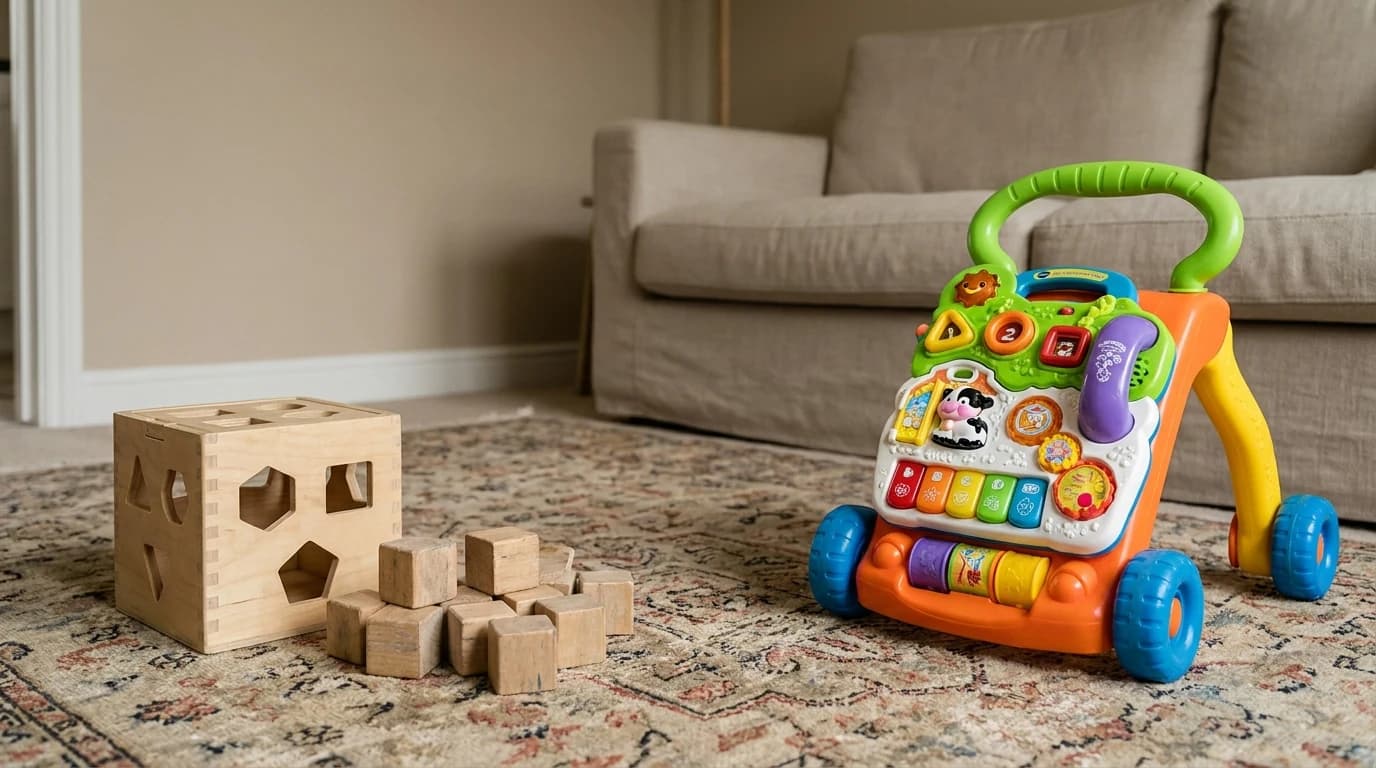
The mechanism is intuitive once you see it. A toy that sings the song, counts the blocks, and announces "Great job!" has already performed every cognitive step. The child becomes an audience.
A wooden shape-sorter says nothing, so the child has to test, fail, rotate, and try again — and the adult fills the silence with words: "Turn it. Try the round one. You did it." That narration is where vocabulary and problem-solving actually grow.
HealthyChildren.org, the AAP's parent-facing site, makes the point bluntly in its toy-buying guidance: the best toys are the ones that match your child's developmental skills and interests — and it notes that things as simple as cardboard boxes and pads of paper still make great toys. A cardboard box scores zero on the marketing checklist and high on the only test that matters.
A label-proof checklist
Ignore the front of the box. Flip these questions instead:
Five questions that survive the marketing
- Who finishes the play — the child or the toy? If the toy talks, sings, and praises on its own, it is doing the work. Quieter is usually better.
- Can it be played with more than one way? Blocks become a tower, a road, a wall, a zoo. A single-button gadget does one thing forever. Open-ended beats single-use.
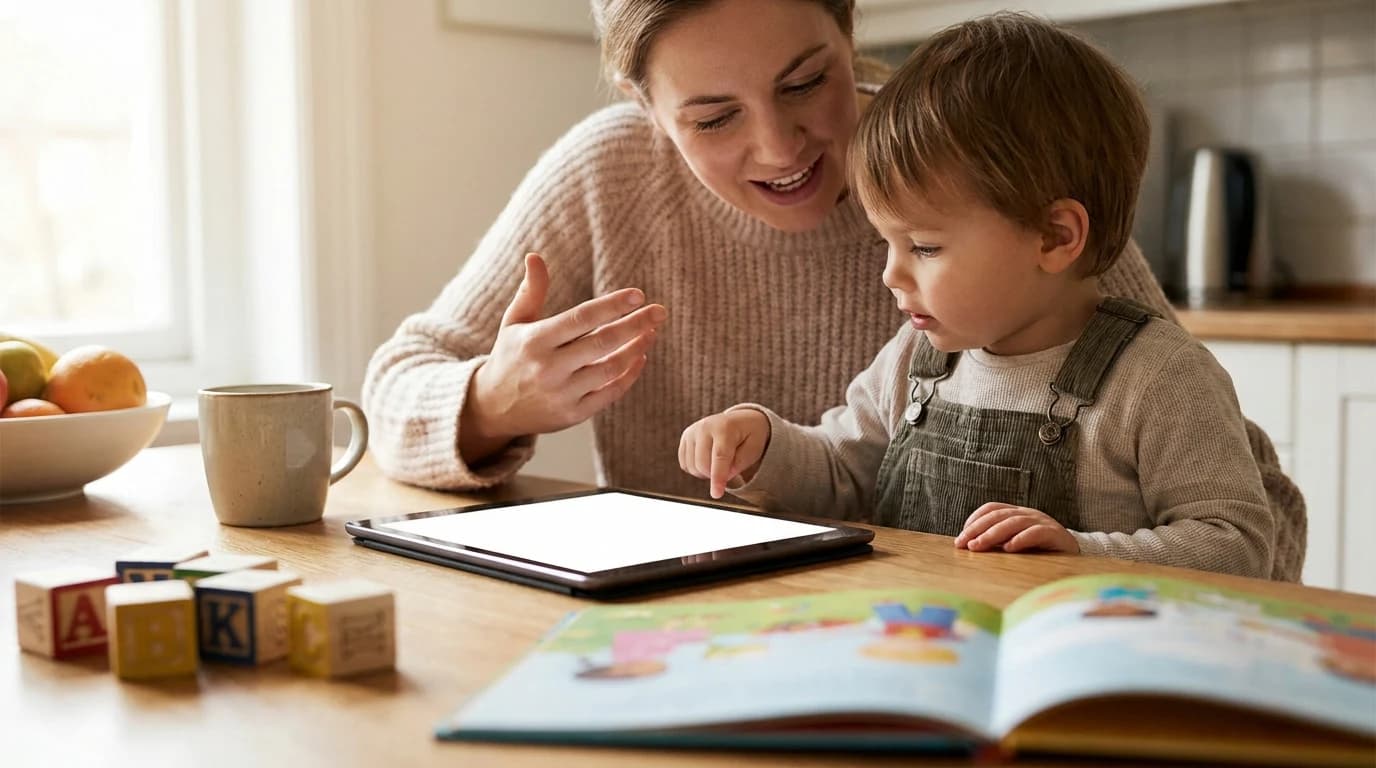
- Does it invite a grown-up in? The toys that teach most pull a caregiver into back-and-forth talk. A screen or a self-narrating gadget tends to push the adult out.
- Does it match what the child can almost do? A toy that is finishable with a little struggle keeps a kid engaged. Too easy gets ignored; too hard gets abandoned. This is also why "ahead of their age" rarely helps.
- Would it survive without batteries? If the educational value disappears when the toy goes silent, the value was the noise, not the learning.
The National Association for the Education of Young Children (NAEYC) makes the same case in its guidance on choosing toys: open-ended materials — blocks, dolls, art supplies, play silks — support creativity and problem-solving precisely because the child supplies the script.
What the evidence does NOT show
It is worth being honest about the limits here, because the easy version of this story overshoots.
Four limits worth stating plainly
- It does not show electronic toys are harmful. Sosa's study found less rich language during play, not damage. A talking toy in the mix is not a problem; relying on it to teach is the miss.
- It is a small, short study. Twenty-six families, observed briefly. It is suggestive and it lines up with the broader literature, but it is not the final word, and it measured language input during play — not long-term IQ or school outcomes.
- No toy makes a child smarter on its own. The research consistently points back to the interaction, not the object. A "STEM kitSTEM kitEducational engineering kit that teaches a reusable principle (circuits, mechanics, programming). Real STEM kits are reusable and curriculum-aligned; 'STEM-themed' craft kits are one-time activities dressed in engineering vocabulary." with an engaged adult and an ignored wooden block with an engaged adult both win; the difference is the adult, not the sticker.
- "Montessori" and "Montessori-inspired" are not the same thing. The word is unregulated. Some genuinely simple, self-correcting toys carry it; so do battery-powered gadgets that have nothing to do with the method.
The bottom line
The signals that predict teaching, and the ones that don't
Reliable signals, all unglamorous:
- Open-ended — playable ten different ways
- Quiet — no built-in narration
- Finishable with a little struggle
- Pulls an adult into the conversation
Signals that predict nothing:
- "Educational," "STEM," "developmental," "brain-building" on the front
- "Montessori-inspired," which is an unregulated phrase
- A feature list built around what the toy does by itself
By that measure, a bin of wooden blocks and a stack of library books out-teach most of the glowing, talking, "developmental" plastic on the shelf, and they do it for a fraction of the price.
Read the back of the box for the safety and age-range information. For the marketing words on the front, the most useful thing to do is ignore them.
Your next step
Want a kit that teaches something real? These are the ones we researched.
Common questions
Is "educational" a regulated label on toys?
Are electronic learning toys bad for kids?
What makes a toy actually educational?
Does "Montessori" on a toy mean anything?
Research Sources
- Sosa AV (2016), JAMA Pediatrics — "Association of the Type of Toy Used During Play With the Quantity and Quality of Parent-Infant Communication" (26 families, infants 10–16 mo; electronic toys associated with fewer parent words, conversational turns, and child vocalizations than traditional toys or books)
- Yogman M, Garner A, et al. (2018), Pediatrics — AAP Clinical Report "The Power of Play: A Pediatric Role in Enhancing Development in Young Children" (notes traditional toys linked to greater quantity and quality of language than electronic toys; recommends simple, open-ended play)
- American Academy of Pediatrics, HealthyChildren.org — "Toy Buying Tips for Babies & Young Children: AAP Report Explained" (best toys match a child's developmental skills; even cardboard boxes and paper make great toys)
- National Association for the Education of Young Children (NAEYC) — "Good Toys for Young Children by Age and Stage" (open-ended materials support creativity and problem-solving; match toys to developmental stage)