Key takeaways
- FIDE recommends a 9.5 cm king (3.74 inches) and squares of 5 to 6 cm, and lets both vary by up to 10 percent as long as the pieces keep their order of height.
- The proportion that governs fit is one line: a piece's base diameter should be 40 to 50 percent of its height.
- The four-pawn test is the whole standard in portable form - four pawn bases should fit inside one square with no overhang.
- An advertised board size includes the border, so subtract the frame before dividing by eight to get your real square size.
- The widely repeated US king and square figures are not in a free primary source: US Chess keeps equipment standards in Chapter 4, which is not one of its free online chapters.
On this page
Most chess sets are sold as a set, and a set that ships together usually fits together. The sizing problem starts the moment those two things come apart: you buy a handsome board and use the pieces you already own, you inherit a set and want something better under it, or you are choosing between a 15-inch folding board and a 21-inch one with no idea which your pieces belong on.
Fit is not a matter of taste here. It is a published specification, and there is a check you can run with the set in your hands in about four seconds.
The numbers the governing body actually publishes
FIDE's Standards of Chess Equipment recommends a height for every piece, plus one proportion that quietly governs everything else: the diameter of a piece's base should measure 40 to 50 percent of its height. The document allows all of it to vary by up to 10 percent, provided the order survives - king taller than queen, queen taller than bishop, and so on.
| Piece | Recommended height | In inches | Base at 40-50% of height |
|---|---|---|---|
| King | 9.5 cm | 3.74 | 3.8-4.8 cm |
| Queen | 8.5 cm | 3.35 | 3.4-4.3 cm |
| Bishop | 7 cm | 2.76 | 2.8-3.5 cm |
| Knight | 6 cm | 2.36 | 2.4-3.0 cm |
| Rook | 5.5 cm | 2.17 | 2.2-2.8 cm |
| Pawn | 5 cm | 1.97 | 2.0-2.5 cm |
The board side of the standard is a single line: each square should measure 5 to 6 cm, or roughly 1.97 to 2.36 inches. Inch conversions and base ranges above are our arithmetic on FIDE's own figures.
The four-pawn test
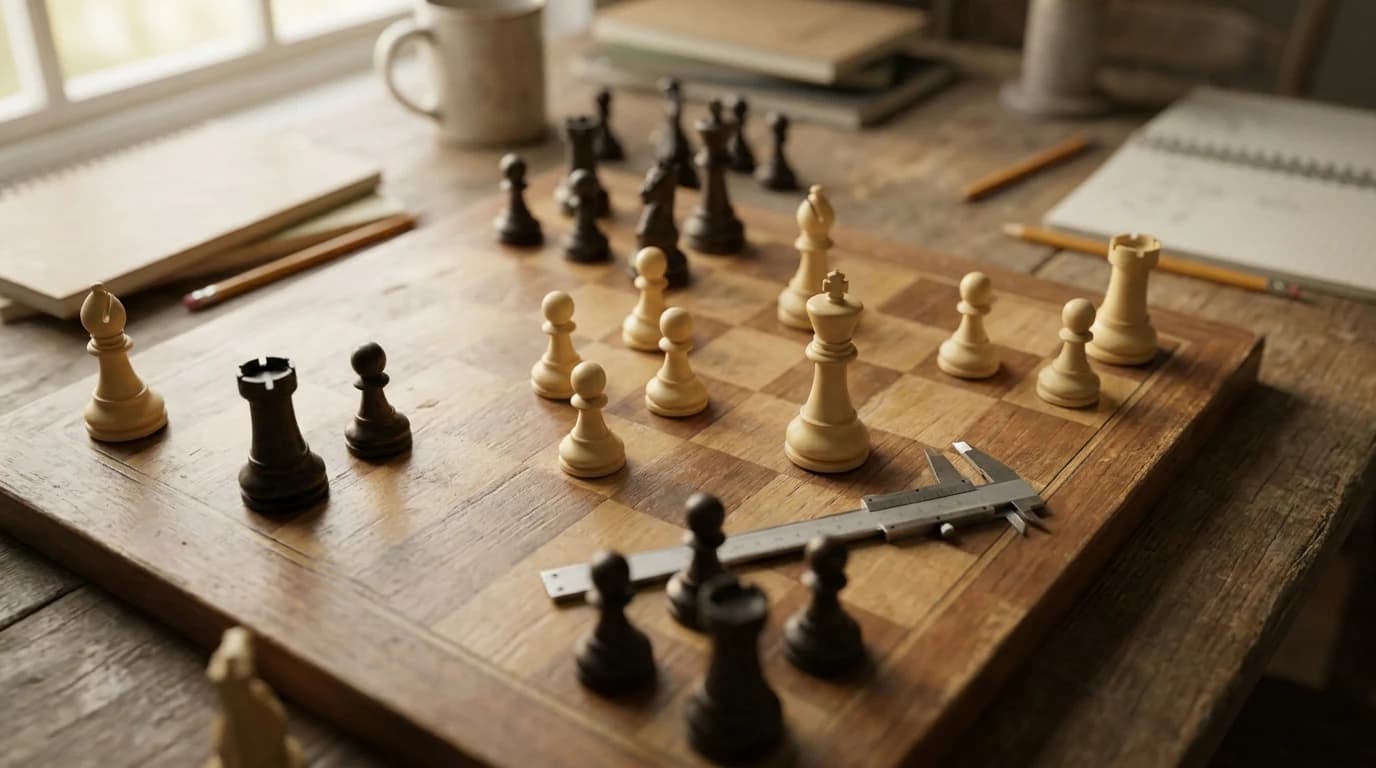
The clever part of the standard is that the board rule is written as a relationship, not a measurement. The side of a square should be at least twice the diameter of a pawn's base - and FIDE spells out what that looks like on the table: four pawns on one square.
The test: stand four of your own pawns inside a single square. If they fit with their bases touching and nothing overhanging the edge, the pieces and the board are matched. If they spill over, the pieces are oversized for that board - which is almost always the direction the mismatch runs.

Why pawns rather than the king? The pawn base is the smallest and most numerous footprint on the board, and a real middlegame crowds pawns harder than anything else. If four of them are already touching the square's edges in an empty position, a live one will be a nuisance.
Turning a product listing into a fit answer
Listings give you two numbers, usually a king height and an overall board dimension. FIDE's ratios get you from either one to the thing you actually want to know.
| What the listing tells you | The arithmetic | What you learn |
|---|---|---|
| King height | Base is 40-50% of height | A 3.75-inch king carries a base of roughly 1.5 to 1.9 inches |
| Square size | Eight squares of playing surface | 5-6 cm squares make 40-48 cm (15.7-18.9 inches) of squares, before any border |
| Both | King base divided by square side | A pairing that is legal at both extremes lands anywhere from 63% to 95% |
That last row explains why two sets can both sit inside the standard and feel nothing alike. At 63 percent a king looks marooned; at 95 percent you knock a neighbour over every time you castle. The comfortable middle is around three-quarters.
Three reads that follow from it:
- A board's advertised size includes its border. Subtract the frame before dividing by eight, or you will overestimate your squares by an inch of decorative wood.
- A 15-inch travel board cannot carry a full-size tournament king, and a good travel set does not try - it scales the pieces down with the squares.
- Piece height on its own tells you nothing. Two 3.75-inch kings with different base diameters belong on different boards.
Where the American numbers come from
Search this topic and you will meet a set of US figures repeated everywhere: a king of 3.375 to 4.5 inches, squares of 2 to 2.5 inches. We could not trace them to a free primary source. US Chess keeps its equipment standards in Chapter 4 of the Official Rules of Chess, and Chapter 4 is not among the chapters US Chess publishes free - that set is chapters 1, 2, 9, 10 and 11. Everything freely readable online traces back to retailer guides, which is not the same thing as a rulebook.
That is not a reason to distrust the American numbers; converted, they sit comfortably around FIDE's. It is a reason to cite FIDE when precision matters, and to buy the rulebook if you are directing tournaments.
The specs that decide whether a well-sized set is playable
Size is the part everyone researches. The standard spends just as much room on things no listing headline mentions.
What the standard asks for:
- Pieces shaped so as to be clearly distinguishable from one another, with the top of the king distinctly different from the queen's.
- A dull or neutral finish on both pieces and board. The document says never shiny, twice.
- Dark pieces in brown or black, light pieces in white or cream, with natural wood tones allowed.
- A rigid board.
What that quietly rules out, whatever the sizing says:
- High-gloss lacquered display boards, because the glare from a desk lamp lands exactly where you are reading.
- Themed figurine sets, where a wizard and an armoured knight are not distinguishable at a glance the way a Staunton king and queen are.
- Thin flexible vinyl boards that curl at the corners and lift pieces off true.
- Very low-contrast modern colourways that look superb in a photograph and blur in play.
Rule of thumb: if you can name every piece from a metre away and no lamp glares off a square, the set is playable. Sizing decides comfort; contrast and finish decide whether you can read the position at all.
One last free check, straight from the Laws of Chess: the board is placed so that the near corner square to each player's right is light. If a board is printed with fixed coordinates and its a1 corner is a light square, the printing is wrong and it will confuse anyone learning notation on it.
Which set for which table
- Playing seriously, at a club or against a clock: weighted Staunton plastic on a roll-up board sized to it, like the Best Chess Set Ever 3X Tournament or the quadruple-weighted House of Staunton World's Greatest. The board comes matched, so the four-pawn test is already passed.
- A set that lives out on the table: the Wegiel Handmade European Tournament folding wooden board, which is large enough to take full-size pieces rather than shrinking them to fit a coffee table.
- Travel: the AMEROUS 15-inch Magnetic Wooden set sits deliberately under FIDE's square size, with pieces scaled to match. That is the correct trade for a plane tray, and the wrong one for a club.
Our full scoring and sub-score breakdown for every set we have researched is on the chess sets page. Whichever you land on, the four-pawn test settles the question the specification sheet was trying to answer.
Your next step
Got your measurements? Here are the sets that fit them.
Common questions
What size chess set should I buy?
How do I know if my pieces are too big for my board?
Can I use tournament pieces on a 15-inch travel board?
Is a heavier or more expensive chess set better to play on?
Research Sources
- FIDE Handbook C.02, Standards of Chess Equipment - recommended piece heights (king 9.5 cm), base diameter at 40-50% of height with 10% tolerance, square side 5-6 cm, square at least twice a pawn's base diameter, and the dull non-shiny finish requirement
- FIDE Laws of Chess (in force from 1 January 2023), Article 2 - the 8x8 grid and the rule that the near corner square to each player's right is light
- US Chess - 7th Edition Rule Book Free Chapters: the free downloads are chapters 1, 2, 9, 10 and 11, so Chapter 4 (Equipment Standards) is not freely published