Key takeaways
- Filling the 980-sticker FIFA World Cup 2026 album from random packets takes about 1,045 packets on average - roughly 7,300 stickers for a set of 980.
- The spend is wildly uneven. The first quarter of the packets buys about 85% of the album; the last quarter buys three stickers.
- The only published test of the rare-sticker claim, run on the 660-sticker 2010 album, could not reject a uniform print run. The rarity you feel is the tail, not the print run.
- Swapping is the biggest lever: optimal swapping in a group pushes expected packets per person toward 140 on a 980-sticker album, against 1,045 alone.
- Buy the tail by name. Getting the last 23 stickers out of packets runs about $1,044 at list price; ordering those 23 from Panini costs $16.10.
On this page
The last 23 stickers cost more than the first 957
A sticker album is not a shopping list. It is a lottery you re-enter every packet, and your odds get worse each time you win.
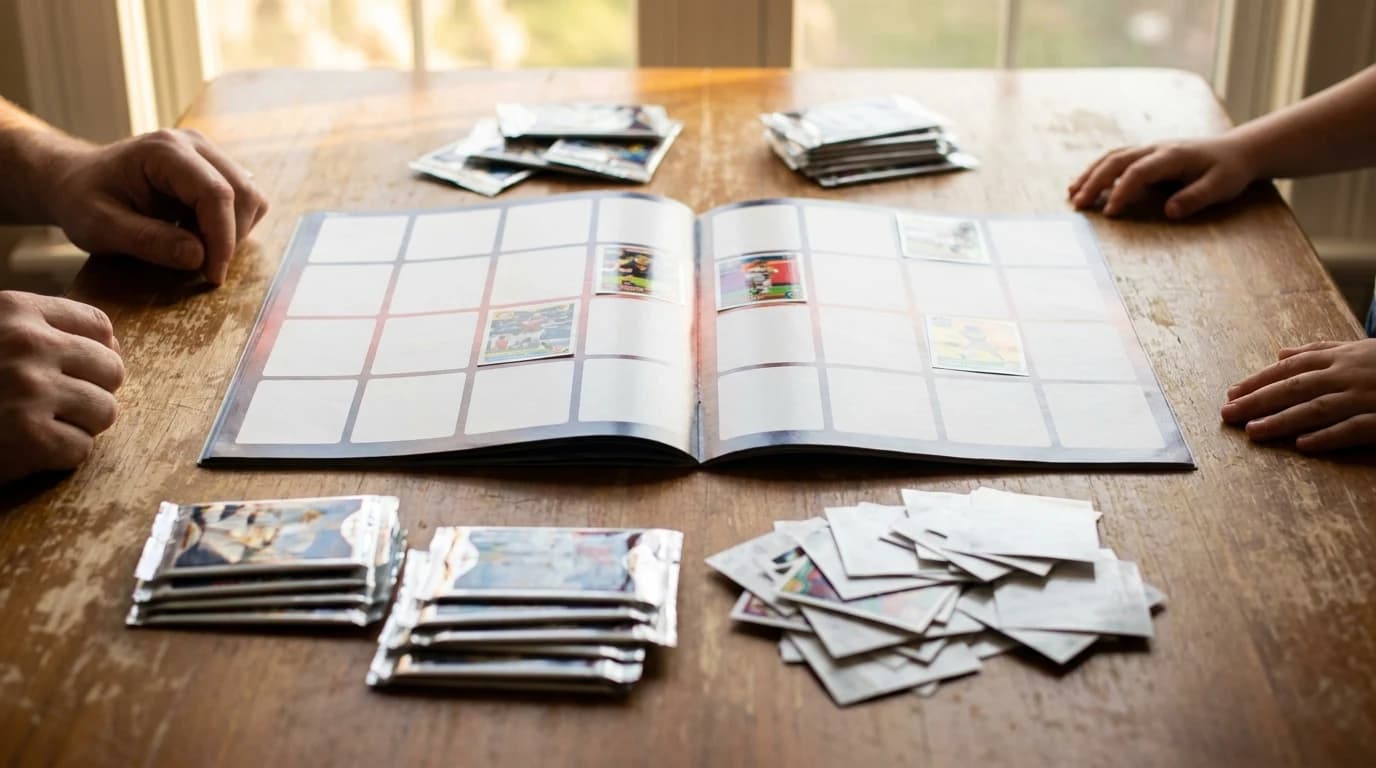
Panini's FIFA World Cup 2026 collection is 980 stickers, seven to a packet. Buying packets at random and never trading, the average collector needs about 1,045 packets - roughly 7,300 stickers to fill a set of 980.
The total is not the interesting part. The distribution is.
| Packets bought | Different stickers you'd expect | Still missing | Gained in that stretch |
|---|---|---|---|
| 261 | 829 | 151 | +829 |
| 523 | 957 | 23 | +128 |
| 784 | 976 | 4 | +19 |
| 1,045 | 979-980 | 0-1 | +3 |
Rule of thumb: the first quarter of the money buys 85% of the album. The last quarter buys three stickers.
That is the same curve Sardy and Velenik published for the 660-sticker 2010 album: 550 different stickers out of the first quarter of the packets, then +90, then +17, then +3. Our arithmetic reproduces their headline figure for that album exactly - 4,666.3 stickers bought one at a time - so the table above is their calculation re-run on a set half again as large.
Nobody is holding back the good sticker
Every collector believes some stickers are printed short. The only published test we could find says otherwise. The two Geneva statisticians collected 12 boxes - 6,000 stickers, across four Swiss cantons - and ran a Monte-Carlo test of whether all 660 stickers turned up equally often. The p-value was 0.9974. Dropping the two cantons where a full album fell out of three boxes, it was 0.1235. Neither result rejects a uniform print run.
They also modelled why the myth survives. Ten friends buying 100 packets each, pooling 5,000 stickers and swapping optimally, still end up with at least one sticker missing to all ten of them more than a quarter of the time. A whole playground can be certain a sticker is rare when nothing is rare.
Worth stating plainly: that study covers one print run, in one country, in 2010. It is evidence against the folklore, not a guarantee about the album on your table.
What that changes: if scarcity were the problem, buying more packets would fix it. Because the tail is arithmetic, more packets is the one thing that cannot.
Three levers, and only one does real work
What actually shortens an album:
- Swapping, and specifically group size. With optimal swapping across a group, the expected packets each person needs falls toward one packet per slot - 140 packets each on a 980-sticker album, against 1,045 alone.
- Ordering the tail by name from the publisher, once the misses are few and known.
- Front-loading. Early packets are almost all useful. Nearly all the efficiency in the hobby lives in the first few hundred.
What people try instead, and why it fails:
- Buying deeper into the same product past ~950 stickers. Every packet is now seven near-certain duplicates.
- Paying a resale premium for one "rare" sticker that the data says is not rare.
- Waiting for a later print run to be kinder. Nothing in the evidence suggests it will be.

What the tail costs, two ways
Panini's US store lists a 25-packet box at $50 and a 50-packet box at $100 - $2 a packet either way, about 29 cents a sticker. Its missing-stickers service sells named stickers from the same 2026 collection at $0.70 each, shipping to the US, Canada and the Dominican Republic, with a maximum of five orders per album and a per-order sticker limit that varies by collection.
| Getting from 957 stickers to a finished album | What you buy | Cost |
|---|---|---|
| Keep opening packets | ~522 more packets | ~$1,044 |
| Order the 23 you are missing | 23 named stickers | $16.10 |
Per sticker, ordering looks like the bad deal - more than double the packet price. On the tail it is roughly 65 times cheaper, because a packet at that point is a 1-in-43 shot at each slot you still need and an order is a certainty.
That is the entire strategy, and it is where the 2010 paper landed too: buy in bulk early, swap hard in the middle, then buy the last stickers by name. Their costed version for a group of ten came to CHF 125-155, against CHF 933 for going it alone at 2010 Swiss prices.
Run the numbers on your own album
Count the checklist in the back of the album. That number is n.
packets ≈ n × (ln n + 0.58) ÷ stickers per packet
| Album size | Stickers needed | Packets at 5 a packet | Packets at 7 a packet |
|---|---|---|---|
| 300 | 1,885 | 377 | 269 |
| 500 | 3,396 | 679 | 485 |
| 660 | 4,666 | 933 | 667 |
| 980 | 7,316 | 1,463 | 1,045 |
Two honest limits on the model. It assumes every sticker is equally likely and treats packets as independent draws, while real packets hold no duplicates inside a single packet - which makes the true figure very slightly lower, 930.8 against 933.3 packets on the 660 album. That is a rounding error, not a strategy. And some publishers sell duplicate-free boxes, which changes the early game completely, so read what the box actually promises before paying for one.
Before you start one
The variable that decides whether an album gets finished is not the album. It is how many people near you are filling the same one, because group size is the lever and a set nobody else collects has a group size of one.
League-calendar football sets have that going for them: a Panini Premier League collection or the Topps UEFA Champions League set tends to put a whole class or office on the same album in the same months. A more interesting niche set can stall at 950 forever with nobody to trade with - and by the table above, 950 is exactly where an album stops being fun and starts being expensive.
Your next step
Starting a collection? Pick an album people around you are already filling.
Common questions
How many packs does it take to complete a Panini sticker album?
Are some stickers deliberately printed in smaller numbers?
Can you buy the specific stickers you are missing?
Is a box of packets better value than loose packets?
Research Sources
- Sardy & Velenik (2010) - Paninimania: sticker rarity and cost-effective strategy (PDF, Univ. of Geneva)
- Panini - FIFA World Cup 2026 pack contents: 980 stickers to collect, seven per packet
- Panini America - Missing Stickers service: price per sticker, order limits, shipping regions
- Panini America - FIFA World Cup 2026 sticker collection box prices