Quick Answer
Shuffle a double-six set face down. Two players take 7 tiles each; three or four usually take 5. Take turns matching a tile to an open end of the line. In Block you pass when you can't play; in Draw you take tiles from the boneyard until one fits. First to empty their hand scores the pips left in opponents' hands.
Key takeaways
- Block and Draw are the same game with one difference: what you do when no tile in your hand matches.
- Two players take 7 tiles on four of the five sheets we compared; at three and four players the counts split between 5, 6 and 7.
- Under Pagat's Draw rules at four players, only 2 tiles can ever be drawn, because the last two in the boneyard stay put.
- The sheets disagree on doubles: Pagat treats them as plain crosswise tiles, while University Games makes the first double a spinner that branches four ways.
- Target scores range from 61 to 250 depending on the sheet, so agree on one before the first deal.
On this page
Most people who ask how to play dominoes mean one of two games played with a double-six set: Block or Draw. Both work the same way. Shuffle the tiles face down, take a hand, and take turns matching a tile to an open end of the line. The first player to empty their hand wins the round and scores the pips left in everyone else's.
The only real difference is what happens when you can't play. Settle that first, then deal.
Block or Draw: decide before you deal
| Block | Draw | |
|---|---|---|
| Can't play? | Pass your turn | Draw from the boneyard until a tile fits |
| Leftover tiles | Out of the game for the round | The boneyard, used during play |
| Feel | Tighter: dead hands stay dead | Longer: a bad hand can recover |
| Round ends | Someone goes out, or nobody can play | Same, once drawing stops |
Pagat's Draw page puts it simply: any Block game becomes a Draw game once you allow play from the boneyard. If your family "just plays dominoes," it is almost certainly one of these two, or Muggins, which adds scoring during play.
How many tiles each player takes
A double-six set has 28 tiles, the count University Games' rule sheet tells you to keep if you play Muggins from a bigger set. Here is what five published sheets deal.
| Rule sheet | Game | 2 players | 3 players | 4 players |
|---|---|---|---|---|
| Pagat, Block | Block | 7 | 5 | 5 |
| Pagat, Draw | Draw | 7 | 7 | 6 |
| UC Santa Cruz handout | Draw | 7 | 5 | 5 |
| University Games | Muggins | 7 | 5 | 5 |
| 28 Double Dominoes sheet | Draw | 5 | 5 | 5 |
Our arithmetic, and why it matters: Pagat's Draw game leaves the last two boneyard tiles undrawn. At four players, 24 tiles are dealt, 4 remain, and only 2 can ever be drawn. At two players, 14 sit in the boneyard. If a four-player Draw game feels like Block, this is why.
Pagat also records a South American habit of dealing 8 minus the number of players: 6, 5 or 4 tiles.
Your first round, tile by tile
- Shuffle. Lay every tile face down and mix them on the table.
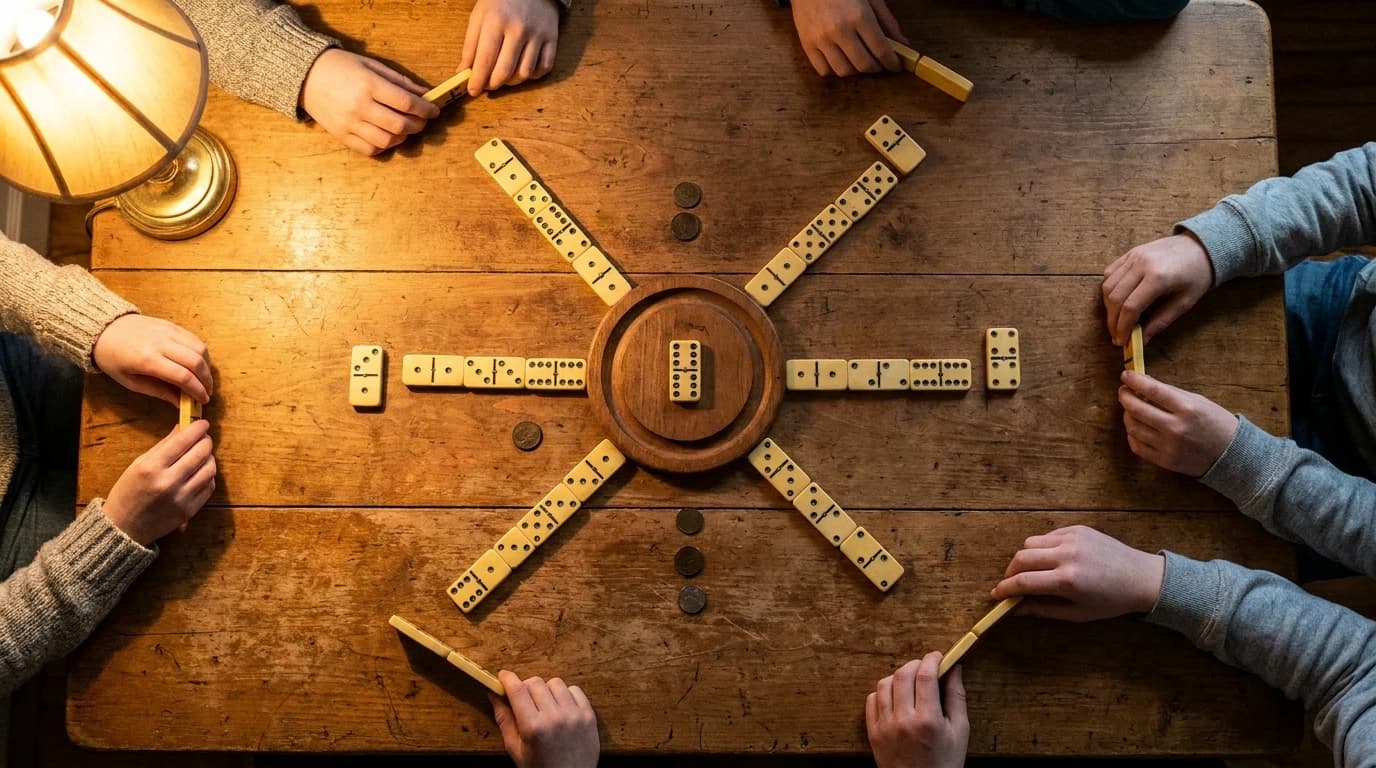
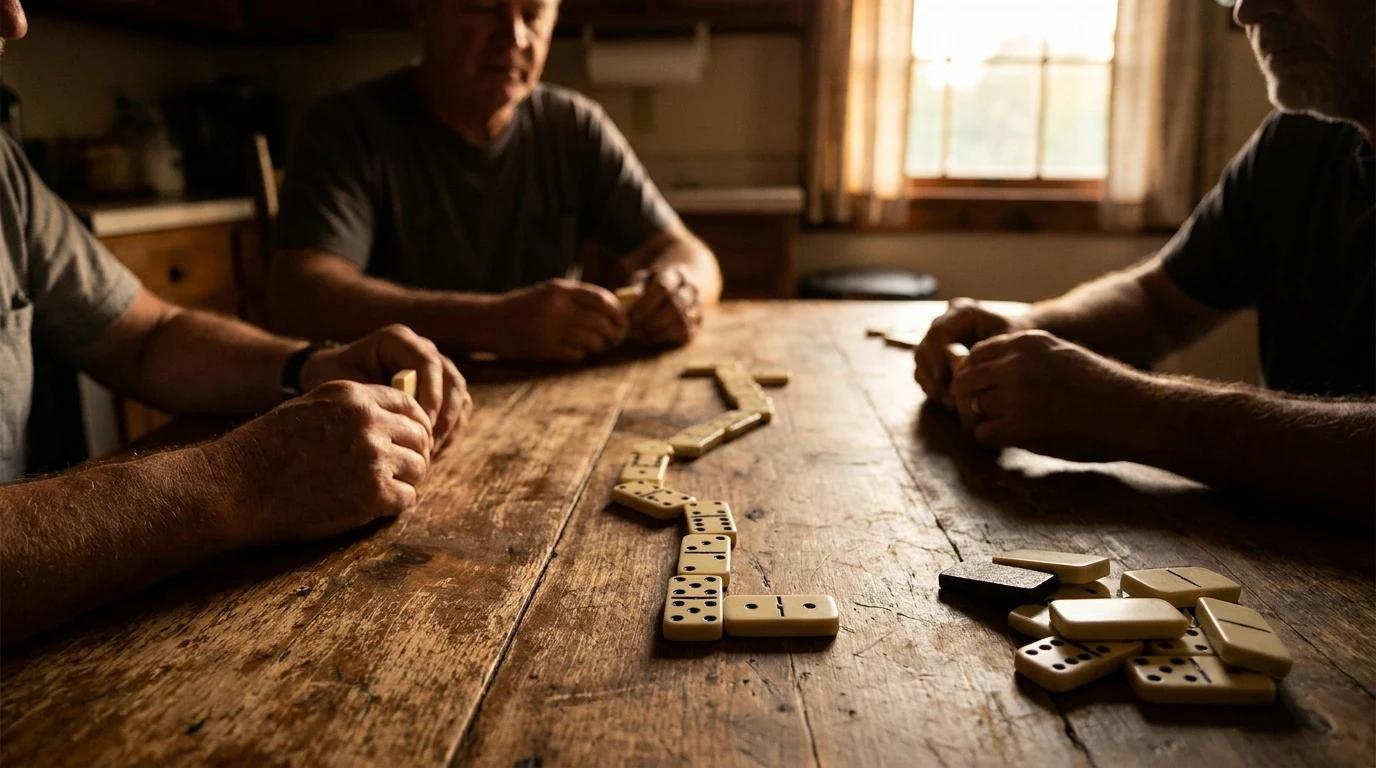
- Take your hand from the table above. Keep them hidden from the other players.
- Push the rest aside. That is the boneyard, and in Block it stays untouched.
- Pick a starter. The UC Santa Cruz handout starts with the highest double and plays clockwise.
- Match an open end. The next tile must touch a matching number: a 4 against a 4.
- Place doubles crosswise. A [6-6] sits across the line, not along it.
- Stuck? Pass in Block. In Draw, take tiles until one fits; if the boneyard is empty, pass.
- Go out or block. The round ends when someone plays their last tile or nobody can move.
Doubles: crosswise tile or spinner?
This is where house rules start fights, because the sheets genuinely split.
- Plain crosswise tile. Pagat's Block and Draw rules turn doubles across the line but say they are not spinners. The line keeps exactly two open ends.
- First double is a spinner. In University Games' Muggins, the first double can be played off all four sides, first its two sides, then its two ends.
- Every double branches. The 28 Double Dominoes sheet lets doubles connect in all four directions.
Spinners give more open ends, so fewer passes and shorter rounds. Pick one before the first tile goes down.
Scoring one hand, three ways
Three players, Draw rules. You play your last tile. Ana holds [6-4] and [3-0], 13 pips. Ben holds [5-5], 10 pips.
| Rule sheet | How it scores | Your points |
|---|---|---|
| UC Santa Cruz | Pips left with the other players | 13 + 10 = 23 |
| Pagat | Losers' total minus your own pips | 23 - 0 = 23 |
| University Games | Opponents' sums, rounded to the nearest five | 15 + 10 = 25 |
Now say the game blocks with you still holding [2-1], 3 pips, the lowest hand. Pagat credits you 23 - 3 = 20. University Games still credits the rounded 25. The UC Santa Cruz handout only covers a player going out, so a blocked game needs a house rule.
Muggins changes the whole score sheet: University Games scores the open ends after every turn. If they total a multiple of five, you score that total, and an opponent who spots a missed score can call "Muggins!" and take it.
Agree on these five things first
- Block or Draw?
- Hand size for your player count, from the table above.
- Can you draw when you could play? Pagat's Draw rules allow it, to hunt for a blocking tile. University Games says a playable tile must be played.
- Spinner or no spinner for doubles.
- Target score. Pagat plays to 100 for two players or partners and 61 for three or four, so a cribbage board keeps score. The UC Santa Cruz handout suggests 100, or 30 or 50 for a shorter night. Muggins on the University Games sheet runs to 250.
Have a double-12 set and a bigger table? That set is built for trains. Our Mexican Train rules guide covers hand sizes up to eight players and every open-double argument.
Where to go after your first game
We don't currently rank a domino set, so we are not pointing you at one; any double-six set has the 28 tiles these games need. Once the table has dominoes down, try cribbage for two or mancala's captures.
Your next step
Ready to choose? Here's where to go next.
Common questions
How many dominoes do you start with?
What is the difference between Block and Draw dominoes?
Who goes first in dominoes?
What happens when nobody can play?
What do you play to in dominoes?
Research Sources
- Pagat.com, Block Dominoes: rules and variations (hand sizes 7/5/5, scoring, 100 and 61 point games)
- Pagat.com, Draw Dominoes: rules and variations (hand sizes 7/7/6, last two boneyard tiles, variations)
- UC Santa Cruz handout, How to Play a Basic Game of Dominoes (PDF)
- University Games, Domino Game Rules sheet including Muggins (PDF)
- Buffalo & Erie County Public Library, 28 Double Dominoes (6 Colors) Instructions (PDF)